
Updated September 16, 2026: According to Michigan outbreak data, the Michigan Department of Health and Human Services (MDHHS) now reports 14,718 cyclosporiasis cases. As of September 3, 366 reported cases indicated that they had been hospitalized. The state has also identified two deaths associated with the outbreak.
A defined subset of Michigan illnesses was part of the multistate outbreak linked to recalled Taylor Farms de Mexico iceberg lettuce. CDC’s final outbreak update reports 12,883 illnesses in 21 states, including 570 hospitalizations and two deaths. CDC declared that outbreak over on September 11 and says there is no current risk from the implicated lettuce because it is no longer available in stores or restaurants.
Michigan’s investigation remains broader than the federal lettuce outbreak. MDHHS says lettuce or salad greens may be one source, but other foods have not been ruled out. No single produce type, grower or supplier has been identified as the source of every Michigan case.
Do You Need a Cyclospora Lawyer?
Rapidly Growing Outbreak in Michigan
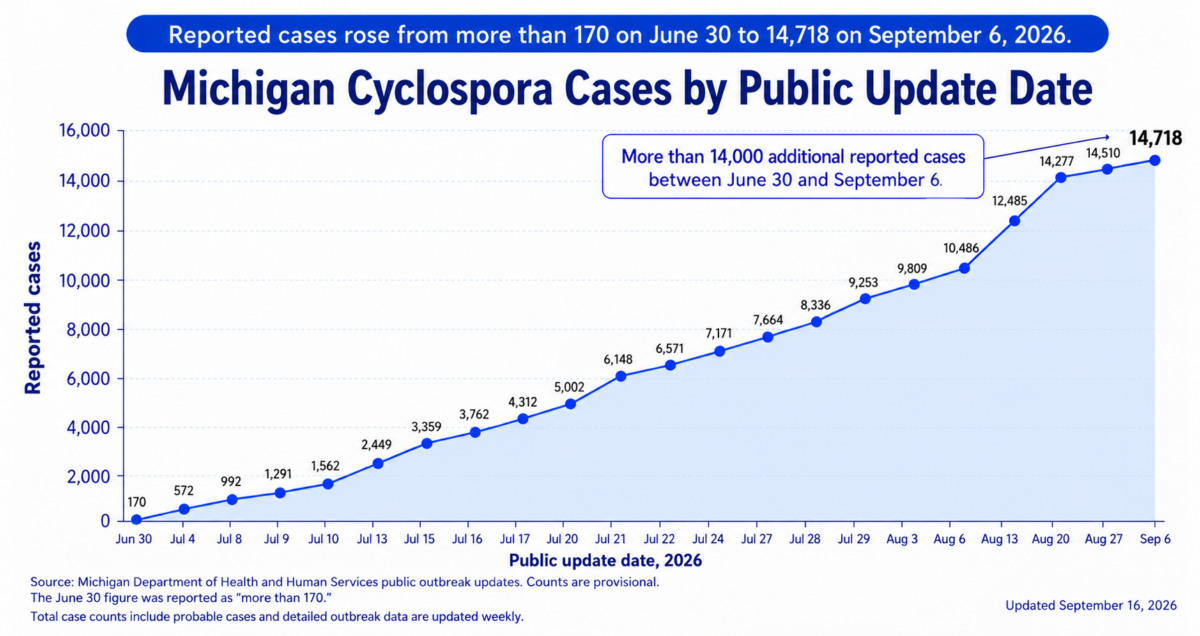
Michigan’s publicly reported Cyclospora total rose from more than 170 cases on June 30 to 14,718 cases on September 3.
- More than 170 cases as of June 30
- 572 on July 4
- 992 on July 8
- 1,251 on July 9
- 1,562 on July 10
- 2,640 on July 13
- 3,309 on July 14
- 3,762 on July 15
- 4,312 on July 16
- 5,002 on July 17
- 6,148 on July 20
- 6,571 on July 21
- 7,171 on July 22
- 7,664 on July 23
- 8,176 on July 24
- 9,253 on July 27
- 9,680 on July 28
- 10,077 on July 29
- 10,386 on July 30
- 10,773 on July 31
- 11,234 on August 3
- 11,508 on August 4
- 12,218 on August 5
- 12,485 on August 6
- 13,909 on August 13
- 14,277 on August 20
- 14,510 on August 27
- 14,718 on September 3
MDHHS now updates total case counts, hospitalization status and detailed outbreak data on the first Thursday of each month by noon Eastern Time.
Some Michigan Cases Were Part of the 21-State Lettuce Outbreak
CDC’s final outbreak update reports 12,883 illnesses in 21 states linked to processed iceberg lettuce from Taylor Farms de Mexico. At least 570 people were hospitalized, and two deaths were reported. CDC declared the outbreak over on September 11, 2026.
The outbreak included people exposed to the lettuce through multiple restaurant, retail and foodservice settings, including people who previously reported eating at Taco Bell. Not everyone included in the 12,883-case outbreak ate at Taco Bell.
The federal outbreak does not account for every Cyclospora illness reported in Michigan. MDHHS is investigating a much broader statewide increase, and no single food, grower or supplier has been identified as the source of all 14,718 Michigan cases.
FDA says all recalled lettuce related to the federal outbreak is now off the market. FDA’s investigation into how the lettuce became contaminated is still ongoing.
Michigan Cyclospora Outbreak Quick Facts
- Michigan cases: According to Michigan outbreak data, 14,718 illnesses have been reported.
- Michigan hospitalizations: As of September 3, 366 reported cases indicated that they had been hospitalized.
- Michigan deaths: Two deaths have been identified. MDHHS says both people had significant underlying health conditions that may have been affected by cyclosporiasis and dehydration. Both became ill before the July 17 lettuce recall.
- Michigan outbreak source: Lettuce or salad greens may be one source, but investigators have not ruled out other foods. MDHHS has not identified one food, grower or supplier as the source of every Michigan case.
- Lettuce-linked outbreak: CDC’s final outbreak update reports 12,883 illnesses, 570 hospitalizations and two deaths in 21 states. CDC declared this specific outbreak over September 11.
- U.S. Cyclospora cases: CDC surveillance data show 19,595 laboratory-confirmed cases acquired in the United States from May 1 through September 8, including 1,043 hospitalizations and two deaths in 49 states plus D.C.
- Cases still under review: CDC is reviewing 9,355 laboratory-confirmed cases to determine whether they were acquired in the United States or during travel, plus at least 6,149 additional reports that are not laboratory confirmed or are still pending interview/submission.
- Other Cyclospora investigations: FDA’s active investigation table lists unidentified-source outbreaks with 231 cases (#1392), 38 cases (#1385) and 22 cases (#1398).
- Current lettuce risk: CDC says there is no current risk from the Taylor Farms lettuce source because the recalled products are no longer available in stores or restaurants. FDA is still investigating how the contamination occurred.
North Carolina is also reporting elevated cyclosporiasis activity, but NCDHHS says its 940-case increase does not currently appear connected to this outbreak. Parsley, cilantro and lettuce are recurring in North Carolina interviews, with no confirmed source.
Michigan Interviews Show Exposure Was Not Limited to Restaurants
Michigan’s Cyclospora cases were not limited to people who ate at restaurants or fast-food chains. In a July 24 update, MDHHS reported interviewing more than 2,900 people affected by the outbreak. Many had not eaten lettuce at a restaurant, but still reported eating lettuce at home or in other settings.
MDHHS said this pattern suggested contaminated produce may have been distributed through several channels, including grocery stores, restaurants and food-service businesses. The findings did not point to food handling at one restaurant or chain as the cause of Michigan’s broader outbreak.
Federal investigators later confirmed that shredded iceberg lettuce from Taylor Farms de Mexico caused a large multistate Cyclospora outbreak. The lettuce was served or sold through Taco Bell, other restaurants, food-service businesses and retail channels. FDA’s final outbreak update lists 12,883 illnesses in 21 states, 570 hospitalizations and two deaths, and CDC declared the outbreak over on September 11, 2026.
Not every Michigan Cyclospora case was tied to the recalled lettuce. MDHHS reported 14,718 cases statewide as of September 6, which is more than the number included in the federal lettuce-linked outbreak across all 21 states. Michigan’s broader investigation therefore included illnesses that were not necessarily connected to Taylor Farms de Mexico lettuce.
People diagnosed with cyclosporiasis should provide health officials with as much detail as possible about what they ate during the two weeks before symptoms began. Helpful information can include grocery-store lettuce and salads, restaurant or fast-food meals, catered food, workplace meals and delivery orders.
Receipts, restaurant locations, grocery stores, brands, purchase dates, delivery-app histories and loyalty-account records can also help document where an exposure may have occurred. These records may be important when a Cyclospora lawyer evaluates a claim.
Taylor Farms de Mexico Iceberg Lettuce Recall
Taylor Farms de Mexico recalled all iceberg lettuce sourced from central Mexico on July 17, 2026, because of the Cyclospora outbreak. The recall included shredded and processed iceberg lettuce sold to food-service customers, restaurants and retailers, including Marketside products sold at Walmart. The outbreak was declared over on September 11, but FDA’s investigation into how the lettuce became contaminated is continuing.
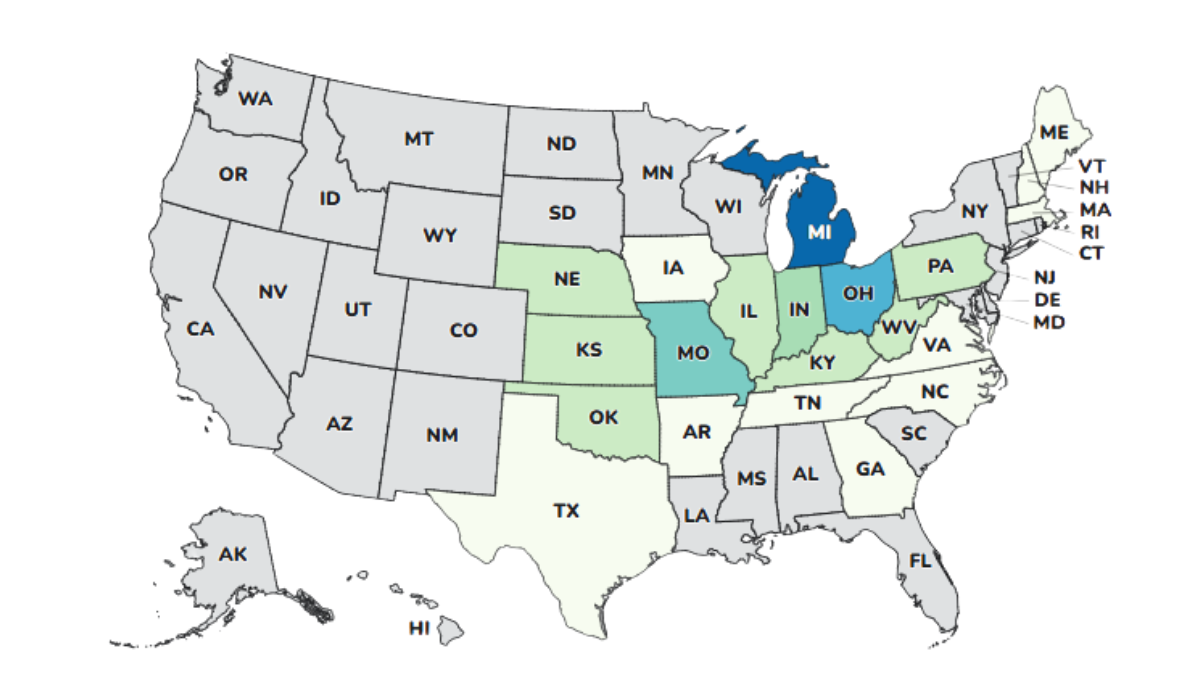
FDA confirmed that recalled iceberg lettuce was distributed to food-service customers in 31 states: Alabama, Arkansas, Connecticut, Florida, Georgia, Iowa, Illinois, Indiana, Kansas, Kentucky, Louisiana, Massachusetts, Maine, Maryland, Michigan, Missouri, Mississippi, North Carolina, Nebraska, New Hampshire, New Jersey, New York, Ohio, Oklahoma, Pennsylvania, South Carolina, Tennessee, Texas, Virginia, Wisconsin and West Virginia. FDA says the lettuce may also have reached the District of Columbia, Delaware, North Dakota, Puerto Rico, Rhode Island, South Dakota, Vermont and Washington.
The recalled lettuce was distributed from June 29 through July 16. All affected products are now past their best-by dates, and FDA says they should no longer be available in stores or restaurants. FDA also says it is confident that all recalled lettuce associated with this outbreak is off the market.
Walmart Marketside Lettuce Recall
The Taylor Farms recall included two Marketside lettuce products sold at select Walmart stores:
- Marketside Iceberg Salad: 12-ounce and 24-ounce bags with Best If Used By dates from July 18 through August 3, 2026.
- Marketside Shredded Lettuce: 8-ounce and 16-ounce bags with Best If Used By dates from July 18 through August 3, 2026.
The recalled Marketside products were sold at select Walmart stores in Alabama, Arkansas, Florida, Georgia, Indiana, Kansas, Kentucky, Louisiana, Missouri, Mississippi, Oklahoma, Tennessee, Texas, Virginia and West Virginia.
Because the recalled products are past their best-by dates, consumers should no longer find them for sale. FDA advises anyone who previously had recalled lettuce to clean and sanitize surfaces or containers that may have come into contact with it.
Previous Outbreaks Linked to Taylor Farms Produce
Taylor Farms is based in Salinas, CA, and operates multiple facilities in the U.S. and Mexico. Locations include: Arizona, California, Colorado, Florida, Illinois, Maryland, New Jersey, Tennessee, Texas, and Mexico. This is the fourth major multistate food poisoning outbreak linked to Taylor Farms produce since 2013.
2024 Fatal McDonald’s E. coli Outbreak
In 2024, a fatal E. coli outbreak linked to slivered onions on McDonald’s Quarter Pounder hamburgers caused 104 illnesses and one death. Thirty-four people were hospitalized, four of them with hemolytic uremic syndrome (HUS), a life-threatening complication of E. coli infections that causes kidney failure.
Taylor Farms, a McDonald’s supplier, issued a recall for onions produced at its Colorado facility on October 24, 2024. FDA inspectors found multiple food safety violations at the plant where the onions were produced.
2015 Costco Chicken Salad E. coli Outbreak
In 2015, an E. coli outbreak linked to Costco chicken salad sickened 19 people in seven states. Five people were hospitalized, two of them with HUS.
The Montana Public Health Laboratory tested a sample of celery and onion diced blend produced by Taylor Farms Pacific, Inc., and collected from a Costco store in Montana, and the results indicated the presence of E. coli O157:H7. The product was used to make the Costco rotisserie chicken salad. Further laboratory analysis by the FDA was unable to confirm the presence of E. coli O157:H7 in the sample of celery and onion diced blend. But on November 26, 2015, Taylor Farms Pacific, Inc., recalled the celery and onion diced blend for possible E. coli O157:H7.
2013 Cyclospora Outbreak at Olive Garden and Red Lobster
In 2013, bagged salad mix produced by Taylor Farms de Mexico and served at Olive Garden and Red Lobster restaurants caused 239 illnesses. Different food sources caused 400 more cases in 23 other states that summer, the first year Cyclospora made an appearance as the source of a major, non-travel-related foodborne outbreak in the U.S.
Taylor Farms de Mexico suspended operations for two weeks while the FDA investigated. The company received permission from the agency to restart after agreeing to implement a comprehensive Cyclospora sampling program for leafy greens and other products from their farms and processing facility in Mexico. The program was also supposed to include water sampling and continued monitoring of the sanitary conditions at the facilities
What is Cyclospora?
Cyclospora is a parasite native to tropical climates that causes illness when people consume food or water contaminated with human feces containing it. Outbreaks are frequently associated with fresh produce.
Humans are the only known species that the parasite Cyclospora infects. In the U.S., non-travel-related cases are frequently linked to imported produce. Previous Cyclospora outbreaks have been linked to bagged salad, cilantro, basil, snow peas, and berries.
What are the Symptoms of a Cyclospora Infection?
Symptoms of a Cyclospora infection, called cyclosporiasis, usually appear within 1 to 14 days of exposure. They can seem to improve and then return, making it hard for people to work, travel, care for children, attend school, or keep up with daily responsibilities. Without treatment, cyclosporiasis symptoms can last for months.
They include:
- Frequent bouts of watery, sometimes explosive diarrhea.
- Loss of appetite, weight loss
- Stomach cramps or abdominal pain
- Bloating and increased gas
- Nausea
- Fatigue that can be severe
- Vomiting, body aches, headache, or low-grade fever in some patients
Usually, these infections are not life-threatening, but dehydration from symptoms can cause severe illness, especially among children, seniors, and those with weakened immune systems.
How is Cyclosporiasis Diagnosed and Treated?
Diagnosis usually requires a stool sample. If you have sudden, ongoing diarrhea and may be part of the Michigan outbreak, tell your healthcare provider about the outbreak and ask whether Cyclospora testing should be ordered. Some stool tests do not automatically look for Cyclospora unless the provider or laboratory specifically considers it.
The CDC’s clinical care guidance states that trimethoprim-sulfamethoxazole, often called TMP-SMX, is the treatment of choice. Treatment decisions belong to your healthcare provider, especially if you have medication allergies, pregnancy concerns, immune system issues, dehydration, kidney disease, or other medical risks.
People at higher risk of dehydration or serious illness, including young children, older adults, and people with weakened immune systems, should be especially careful about prolonged diarrhea and fluid loss.
What Should You Do if You Develop Symptoms of Cyclosporiasis?
If you think you may be part of this outbreak, take these steps now:
- Get medical care and testing. Tell your provider about the Michigan Cyclospora outbreak and ask whether stool testing for Cyclospora is appropriate. Standard parasite testing may not include Cyclospora, and the MDHHS provider bulletin advises providers to ensure the stool order specifically targets Cyclospora.
- Report a positive diagnosis. If you test positive, make sure the health department is notified. Public health interviews help investigators find the source.
- Write a food history. List produce, salads, herbs, berries you ate at home, restaurants, catered meals, workplace meals, school or event meals, and travel during the two weeks before symptoms began.
- Save purchase records. Keep receipts, grocery receipts, loyalty-card records, delivery-app orders, restaurant receipts, credit-card statements, photos of packaging, product labels, and store notices. If you ate at Taco Bell or another restaurant, save the exact location, date, time, menu items, app order, payment record, and any photograph of a posted ingredient notice.
- Save medical and wage records. Keep bills, prescription receipts, discharge papers, messages with providers, missed-work records, and notes about symptom days.
- Talk to a Cyclospora attorney early. Evidence can disappear quickly in produce cases. A lawyer can help identify stores, suppliers, restaurants, and records that may connect your illness to the outbreak.
What Happened in the Michigan Cyclospora Outbreak?
Michigan experienced an unusually large increase in cyclosporiasis during summer 2026. MDHHS announced the outbreak on July 1 after more than 170 cases were reported in just nine days. By September 6, the state had reported 14,718 cases, 366 hospitalizations and two deaths. Michigan typically reports about 50 cyclosporiasis cases in an entire year.
The outbreak affected communities across Michigan. Detailed state data through September 3 show the highest totals in Wayne County with 2,158 cases, Oakland County with 1,692, Washtenaw County with 1,115 and Ingham County with 925.
MDHHS says lettuce or salad greens may have been a source of some illnesses, but other foods have not been ruled out and no single produce type, grower or supplier has been identified as the source of every Michigan case.
How the Michigan Outbreak Fits Into the National Cyclospora Surge
Michigan’s surge occurred during a much larger increase in Cyclospora illnesses across the United States. CDC reported 19,595 laboratory-confirmed cases acquired in the U.S. from May 1 through September 8, including 1,043 hospitalizations and two deaths. Cases were reported in 49 states and the District of Columbia. CDC says additional illnesses are still being reviewed because Cyclospora cases can take weeks to diagnose, investigate and report.
Michigan’s 14,718 cases should not be added to CDC’s national total. The state and federal numbers overlap, and MDHHS and CDC use different case definitions and reporting methods. CDC notes that state totals can be higher because states may include illnesses that do not meet CDC’s formal surveillance criteria.
One major part of the 2026 surge was traced to shredded iceberg lettuce from Taylor Farms de Mexico. Federal investigators ultimately linked 12,883 illnesses in 21 states to the lettuce, including 570 hospitalizations and two deaths in Michigan. People were exposed through multiple restaurant, retail and food-service settings, including some who had previously reported eating at Taco Bell. CDC declared that outbreak over on September 11, 2026.
The lettuce-linked outbreak did not explain every Cyclospora illness reported in Michigan or nationwide. MDHHS continues to investigate Michigan’s broader outbreak, while FDA continues to investigate how the Taylor Farms de Mexico lettuce became contaminated.
Can I Sue if I got Cyclospora in the Michigan Outbreak?
Yes, a Cyclospora lawsuit may be possible if evidence connects your diagnosed illness to contaminated food sold or served by a company. Pritzker Hageman has a detailed guide on suing for Cyclospora food poisoning from produce, and the same evidence principles apply here: a confirmed diagnosis, proof of exposure to the implicated food, and documented damages.
For the multistate Taco Bell outbreak, public health agencies have identified an implicated food category, a recall, and a traced supply route. A potential Cyclospora lawsuit still depends on the patient’s diagnosis, exposure history, timing, restaurant or grocery records, medical evidence, and the facts connecting the illness to a legally responsible company. Michigan’s broader investigation may include illnesses from other sources. Patients should preserve Taco Bell orders, other restaurant receipts, grocery and loyalty records, packaging, payment records, health-department communications, medical test results, and wage-loss information before those records disappear.
Depending on the facts, potential defendants in a Cyclospora case can include produce growers, packing houses, processors, distributors, grocery stores, restaurants, caterers, institutional foodservice companies, or others in the supply chain. Read more about grocery store Cyclospora claims and restaurant food poisoning lawsuits.

How Can Our Lawyers Help You?
1-888-377-8900 (Toll-Free) | [email protected]
What Damages Can a Cyclospora Lawsuit Include?
A food poisoning claim can seek compensation for the harm caused by the illness. Depending on the facts, damages may include:
- Medical bills and out-of-pocket healthcare costs
- Prescription expenses and follow-up care
- Lost wages or lost business income
- Travel costs and other expenses caused by the illness
- Pain, suffering, fatigue, and loss of normal life
- Wrongful death damages if a foodborne illness leads to death
The value of a case depends on evidence, diagnosis, length and severity of illness, medical treatment, wage loss, long-term effects, and whether investigators can link the illness to a legally responsible company.
Why Hire Pritzker Hageman Food Safety Lawyers for Your Cyclospora Outbreak Case?
Pritzker Hageman’s Cyclospora lawyers have represented clients in major Cyclospora outbreaks linked to restaurants, grocery stores, salad, vegetable trays, herbs, and other fresh produce. The firm’s food safety team has handled claims involving outbreaks linked to McDonald’s salads, Del Monte vegetable trays sold at Kwik Trip and other retailers, Taylor Farms/Darden restaurant salad, fresh basil, and other produce vehicles.
Our food poisoning attorneys work with epidemiologists, microbiologists, and traceback experts. We look for the evidence that links a person’s diagnosis to a contaminated food source: testing, interviews, purchase records, lot codes, distribution records, supplier data, and government findings.
Pritzker Hageman has a national food poisoning practice and can help clients who were sickened while traveling, eating at chain restaurants, buying food from multi-state grocery retailers, or attending events. For a free consultation, call 1-888-377-8900, text 612-261-0856, or contact Pritzker Hageman online. We are not paid unless we win.
How to Reduce the Risk of Getting Sick
MDHHS now says Michigan residents may resume routine guidance for consuming lettuce and salad greens because new case reports and diarrhea-related emergency department visits are declining. The broad precautionary recommendation to avoid bagged salad mixes is no longer in effect.
MDHHS says the outbreak data suggest that most exposures occurred in late June to early July and that the majority of the contaminated produce is likely no longer available for consumption. The state continues to recommend avoiding recalled Taylor Farms de Mexico iceberg lettuce.
Washing recalled lettuce does not make it safe to eat. Cyclospora can cling tightly to produce, and common cleaning methods such as vinegar, soap, chlorine and commercial produce washes do not destroy the parasite. Methods that do not destroy Cyclospora include several approaches consumers may assume would make contaminated produce safe.
How Public Health Interviews Can Help Identify the Source
Cyclospora investigations can be difficult because many people eat several fresh produce items during the exposure window. Health departments compare food histories from many patients to look for common products, brands, stores, restaurants, events, distributors, or suppliers. A single person’s food history may not identify the source, but many interviews together can point investigators in the right direction.
MDHHS now says it has interviewed more than 2,900 affected people. Many did not report eating lettuce at a restaurant chain or other food establishment. Lettuce still appeared often in questionnaires from people without restaurant or fast-food exposure, which supports investigating grocery stores and other foodservice channels in addition to Taco Bell. Before a health-department interview, review grocery receipts, loyalty-card records, restaurant and delivery-app orders, photographs, calendars, workplace or catered meals, and travel during the two weeks before symptoms began. These details may help investigators connect illnesses to a shared product or distribution route.
Michigan Cyclospora outbreak FAQ
Partly. Some Michigan illnesses are included in the multistate outbreak linked to Taylor Farms de Mexico iceberg lettuce. Michigan’s broader outbreak includes additional illnesses, and MDHHS has not identified one food, grower or supplier that explains every case.
According to MDHHS county-level outbreak data, Wayne and Oakland counties have reported the highest numbers of Cyclospora cases, with Washtenaw and Ingham also among the counties with the most reported illnesses. MDHHS updates county-level data regularly, so individual totals may change as the investigation continues.
Yes, but the federal outbreak is no longer limited to people who reported eating at Taco Bell. CDC and FDA now include people who reported exposure either to Taco Bell or to recalled Taylor Farms de Mexico iceberg lettuce. The finding does not apply to every Taco Bell location or every Michigan case.
Yes. Michigan is included in a multistate Cyclospora outbreak linked to recalled Taylor Farms de Mexico iceberg lettuce. That outbreak represents only part of the Cyclospora activity reported in Michigan, where state health officials continue to investigate additional illnesses that have not all been tied to the recalled lettuce.
Yes. The Taylor Fresh Foods recall includes Marketside Iceberg Salad in 12-ounce and 24-ounce bags and Marketside Shredded Lettuce in 8-ounce and 16-ounce bags, with Best If Used By dates through August 3, 2026. The listed dates have passed, but anyone who still has recalled product at home should not eat it. Additional foodservice products are also included.
The most common symptom is watery diarrhea, often frequent and sometimes explosive. Other symptoms can include loss of appetite, weight loss, stomach cramps, bloating, gas, nausea, fatigue, vomiting, body aches, headache, and low-grade fever.
Symptoms usually begin about one week after exposure, but they can start anywhere within 1 to 14 days of exposure.
Direct person-to-person spread is unlikely because Cyclospora generally needs time in the environment after leaving the body before it becomes infectious. Food or water contamination is the usual concern in outbreaks.
If you have sudden, ongoing diarrhea and may have been exposed in the Michigan outbreak, tell your provider about the outbreak and ask whether stool testing for Cyclospora is appropriate.
Cyclosporiasis is treated differently than most bacterial infections. Your healthcare provider should decide the right treatment based on your health history, medications, allergies, and symptoms.
A lawsuit may be possible if evidence connects a diagnosed illness to contaminated food sold or served by a company. Investigators have identified lettuce or salad greens as a potential source, but the particular product and supply chain remain unknown. Preserve evidence and seek legal guidance before purchase, ordering, supplier, and medical records disappear.
Save medical records, test results, receipts, loyalty-card records, delivery orders, restaurant receipts, photos of product labels, packaging, food histories, wage-loss records, and communications with health officials.
No. What matters is where and how you were exposed, whether you were diagnosed, and whether evidence links your illness to contaminated food sold or served by a responsible company. Travelers and out-of-state residents can still be part of an outbreak investigation, and contaminated food products may have been sold out of state, as well.
Call your healthcare provider for medical guidance, cooperate with your local health department, and contact Pritzker Hageman for a free legal consultation at 1-888-377-8900 or by text at 612-261-0856. You can also use our online contact form.
Related Pritzker Hageman Resources
- Can I Sue For Cyclospora Food Poisoning From Produce?
- Summertime is Peak Season for Cyclospora
- Bagged Salad Cyclospora Outbreak Ends With 701 Sick
- Cyclospora Parasite Poses Seasonal Threat to Fresh Produce
- First Iowa McDonald’s Cyclospora Lawsuit Filed by Pritzker Hageman Attorneys
- Taco Del GNAR Cyclospora Outbreak in Ridgway, CO
- Supply Chain Failure Led to Alabama Cyclospora Outbreak
- Iowa Salad Cyclospora Outbreak Hits ALDI, Hy-Vee, Jewel-Osco Shoppers
- Can I Sue a Grocery Store for Cyclospora?
- 5 Reasons to File a Cyclospora Lawsuit
- Cyclospora from Restaurant Food Drives Summer Case Total to 1,696
- Cyclospora Legal News Archive
Experienced Cyclospora Lawyers
If you or a family member were diagnosed with cyclosporiasis after eating fresh produce, salad, herbs, berries, grocery food, restaurant food, catered food, or foodservice meals in Michigan, Pritzker Hageman wants to help. Our lawyers can review your food history, purchase records, medical diagnosis, and potential outbreak connection.
Pritzker Hageman Cyclospora lawyers have represented clients sickened in every major Cyclospora outbreak in the U.S. To request a free consultation about your potential case, please call 1-888-377-8900, text 612-261-0856, or complete the form below.