
Updated September 15, 2026: : CDC has declared the Cyclospora outbreak linked to Taylor Farms de Mexico iceberg lettuce over. The final CDC outbreak update reports 12,883 illnesses in 21 states, 570 hospitalizations and two deaths. The last illness onset was August 17, 2026.
Federal investigators linked the outbreak to processed iceberg lettuce from Taylor Farms de Mexico. The outbreak included people exposed to the lettuce through Taco Bell and other restaurant, retail and foodservice settings. CDC says the contaminated lettuce is no longer available in stores or restaurants and there is no current risk of getting cyclosporiasis from this source. FDA’s investigation into how the lettuce became contaminated is still ongoing.
CDC surveillance data show that the lettuce outbreak was only part of the unusually large 2026 increase in Cyclospora illnesses. From May 1 through September 8, CDC received reports of 19,595 laboratory-confirmed cases acquired in the United States, including 1,043 hospitalizations and two deaths in 49 states plus the District of Columbia. These national surveillance numbers include the lettuce outbreak as well as illnesses that were not linked to it.
Current Cyclospora Outbreak Snapshot
- Lettuce-linked outbreak: CDC’s final update reports 12,883 illnesses, 570 hospitalizations and two deaths in 21 states. CDC declared the outbreak over September 11.
- National Cyclospora cases: CDC surveillance data include 19,595 laboratory-confirmed cases acquired in the United States from May 1 through September 8, with 1,043 hospitalizations and two deaths in 49 states plus the District of Columbia.
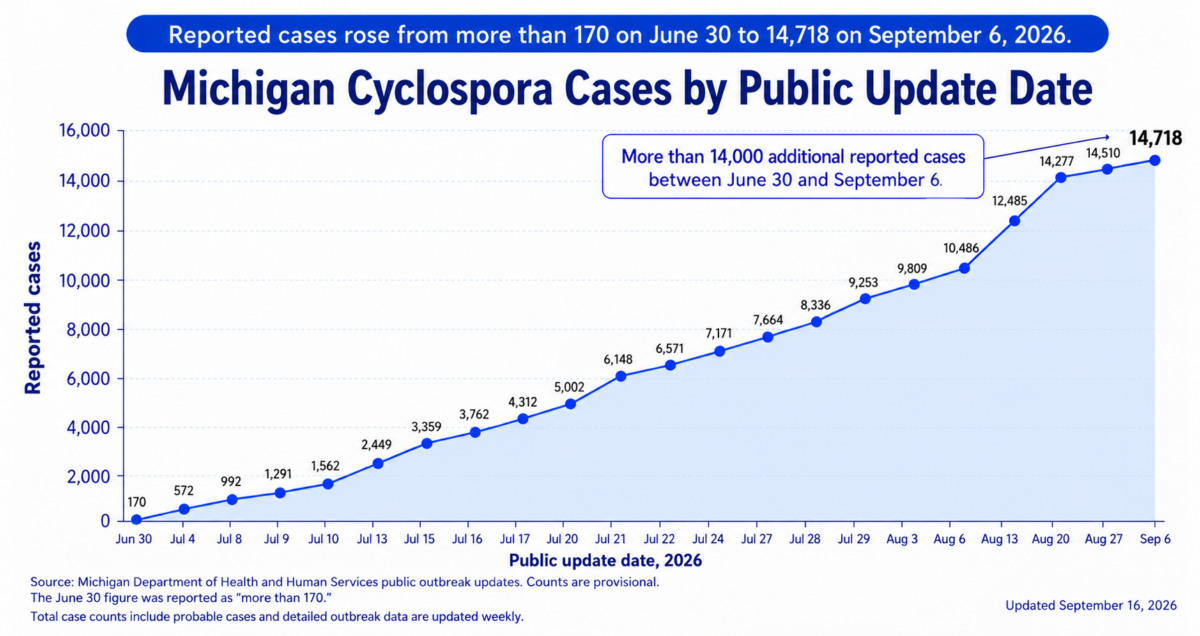
- Michigan outbreak: Michigan outbreak datas show 14,718 reported cases. As of September 3, 366 reported cases indicated they had been hospitalized, and two deaths have been identified.
- Iceberg lettuce recall: FDA’s outbreak investigation says all recalled Taylor Farms de Mexico iceberg lettuce should now be off the market. The best-by dates have passed and the products are no longer expected to be in stores or restaurants.
- Other Cyclospora investigations: FDA’s active investigation table lists unidentified-source Cyclospora outbreaks with 231 cases (reference #1392), 38 cases (#1385) and 22 cases (#1398).
Michigan Reported More Than 14,000 Cyclospora Cases During the 2026 Surge
Michigan’s publicly reported total reached 14,718 cases, including 366 people who reported being hospitalized and two deaths. Michigan’s broader investigation includes cases that were not all tied to the same food source. MDHHS says lettuce or salad greens may have been a source, but other foods have not been ruled out, and no single produce type, grower or supplier has been identified as the source of every Michigan case.
A large portion of the 2026 surge was connected to the multistate outbreak linked to Taylor Farms de Mexico iceberg lettuce. CDC declared that outbreak over on September 11, 2026. The final federal count included 12,883 illnesses in 21 states, at least 570 hospitalizations and two deaths in Michigan. Illnesses linked to the lettuce outbreak began from June 14 through August 17, 2026.
The recalled lettuce is no longer available in stores or restaurants. FDA is continuing to investigate how the lettuce became contaminated with Cyclospora.
Were You Sickened by Cyclospora?
Michigan Interviews Pointed to Lettuce Across Multiple Settings
Many people interviewed by MDHHS said they had not eaten lettuce at a restaurant or fast-food chain. But they still reported eating lettuce in other places, such as at home. This suggested that contaminated lettuce may have been sold through grocery stores as well as served at restaurants.
MDHHS said this pattern pointed to a problem with the produce itself, rather than food handling at one restaurant or chain. The contaminated lettuce may have reached people through several different stores, restaurants and food-service businesses.
Federal investigators later confirmed that shredded iceberg lettuce from Taylor Farms de Mexico was linked to a large multistate Cyclospora outbreak. The lettuce was served at Taco Bell and other food-service locations and was also distributed through retail channels. Not everyone included in the outbreak had eaten at Taco Bell. In its final update, CDC reported 12,883 illnesses in 21 states and declared the outbreak over on September 11, 2026.
CDC Declares 21-State Taylor Farms Lettuce Outbreak Over
CDC’s final outbreak update reports 12,883 Cyclospora illnesses in 21 states, including 570 hospitalizations and two deaths. CDC declared the outbreak over on September 11, 2026, after recent infections linked to the outbreak fell sharply. At the peak before the recall, CDC says more than 1,000 infections occurred in a single day, while fewer than two infections per day on average occurred in August.
The outbreak was linked to shredded iceberg lettuce from Taylor Farms de Mexico. People in the outbreak reported exposure to the lettuce through multiple locations, including Taco Bell. The final 21 states were Arkansas, Georgia, Iowa, Illinois, Indiana, Kansas, Kentucky, Massachusetts, Maine, Michigan, Missouri, Nebraska, New Hampshire, North Carolina, Ohio, Oklahoma, Pennsylvania, Tennessee, Texas, Virginia and West Virginia.
According to FDA, all recalled lettuce related to this outbreak is off the market. FDA has finished onsite inspections and sample collection at lettuce growers and the processing facility in Mexico, but analysis of those samples is still pending. FDA continues investigating how the lettuce became contaminated.
FDA Is Still Investigating Three Cyclospora Clusters With Unknown Food Sources
FDA is investigating three additional Cyclospora outbreaks for which the food source has not been identified. According to FDA’s CORE outbreak table, the ongoing investigations include:
- Reference #1392: 231 illnesses
- Reference #1385: 38 illnesses
- Reference #1398: 22 illnesses
FDA has started traceback and product sampling for all three outbreaks, but has not publicly identified the foods involved. A fourth investigation, reference #1384, ended after 18 illnesses without a food source being publicly identified.
These outbreaks are separate from the large 2026 outbreak linked to Taylor Farms de Mexico iceberg lettuce. Although CDC has declared the lettuce-linked outbreak over, FDA says its investigation continues, along with investigations into other Cyclospora clusters from this summer.
An FDA investigation does not always lead to a recall. The agency may investigate illnesses and trace foods through the supply chain before there is enough evidence to identify a specific product or tell consumers to avoid it.
For people who developed cyclosporiasis, records showing what and where they ate may become important if investigators later identify a food source. Receipts, grocery loyalty-card histories, restaurant or delivery-app orders, credit-card statements and product packaging can help document possible exposures.
North Carolina Cyclospora Investigations Examine Parsley, Cilantro and Lettuce
North Carolina has reported 944 cyclosporiasis cases and 32 hospitalizations since May 2026, according to the state’s latest data. Cases began declining toward the end of August.
The source of North Carolina’s broader increase has not been identified. In interviews with recent patients, parsley and cilantro were reported more often than expected, making the herbs possible leads for investigators. However, NCDHHS has not confirmed that either food caused the illnesses.
North Carolina was also included in the separate multistate outbreak linked to Taylor Farms de Mexico iceberg lettuce. CDC ultimately connected 12,883 illnesses in 21 states to that outbreak before declaring it over on September 11, 2026.
That does not mean all North Carolina cases were linked to lettuce. The state’s total includes illnesses that may have had different sources, and officials continue to investigate other possible exposures, including parsley and cilantro.
What the Taco Bell Connection Means
Taco Bell was an early clue in the investigation, but the 2026 Cyclospora outbreak was ultimately much broader. Federal investigators linked 12,883 illnesses in 21 states to processed iceberg lettuce from Taylor Farms de Mexico. At least 570 people were hospitalized, and two deaths were reported in Michigan. CDC declared the outbreak over on September 11, 2026.
Early in the outbreak, many sick people reported eating at Taco Bell. FDA’s traceback investigation traced the shredded iceberg lettuce served at affected Taco Bell locations to Taylor Farms de Mexico. As investigators interviewed more people, they found illnesses linked to the same processed iceberg lettuce served or purchased at other locations. Not everyone included in the final outbreak ate at Taco Bell.
Taylor Farms de Mexico recalled all iceberg lettuce sourced from central Mexico on July 17. The recalled products are now past their best-by dates and should no longer be available in stores or restaurants. Taco Bell also stopped using lettuce from Taylor Farms de Mexico on July 17.
The investigation findings do not mean every Taco Bell restaurant served contaminated lettuce or that every Cyclospora illness in 2026 was part of this outbreak. FDA confirmed distribution of recalled lettuce to restaurants and food-service customers across numerous states, and CDC investigated other Cyclospora outbreaks and illnesses that were unrelated to the Taylor Farms outbreak.
Although the outbreak is over, FDA’s investigation is continuing. FDA has completed inspections and sample collection at iceberg lettuce growers and the processing facility in Mexico, and laboratory analysis of those samples was still pending in its latest update.
Why Cyclospora Outbreaks Are Hard to Trace
Cyclospora outbreaks can be difficult to solve because people may not remember every food they ate. Fresh produce can pass through long supply chains, and specialized testing is often needed to diagnose the infection. Investigators may identify the food involved without ever determining exactly how or where it became contaminated.
Cyclospora also behaves differently from many other foodborne germs. The FDA fresh produce overview explains that Cyclospora cayetanensis is a parasite that infects humans. After the parasite leaves an infected person in feces, it must spend at least one to two weeks in the environment before it can infect someone else. That is why Cyclospora usually spreads through contaminated food or water rather than directly from one person to another.
Fresh produce can make traceback especially difficult. Lettuce, cilantro, basil, berries and other produce may travel from a farm through processors, distributors, restaurants and grocery stores before someone eats it. Produce may also be chopped, mixed into salads, added to salsa or used as a garnish. By the time someone becomes sick, they may remember where they ate but not every ingredient in the meal.
Diagnosing Cyclospora can also take time. CDC’s clinical guidance says most U.S. laboratories do not routinely test for Cyclospora, and not every gastrointestinal PCR panel includes it. The parasite can also be shed in small and inconsistent amounts, so one negative stool sample does not always rule out infection. Several samples collected on different days may be needed.
How Investigators Identify the Food Source in a Cyclospora Outbreak
The 2026 iceberg lettuce outbreak shows how these challenges can continue even after investigators identify a food. CDC ultimately linked 12,883 illnesses in 21 states to processed iceberg lettuce from Taylor Farms de Mexico and declared the outbreak over on September 11.
FDA, however, is still investigating how the lettuce became contaminated. Inspections and sample collection at lettuce growers and a processing facility in Mexico have ended, but laboratory analysis of those samples remains pending.
Detailed patient interviews are an important part of that process. One person’s food history may not reveal much, but patterns across dozens or hundreds of interviews can point investigators toward the same ingredient, restaurant, retailer, distributor or growing region.
For people diagnosed with cyclosporiasis, keeping receipts, grocery loyalty records, restaurant orders and other records of what they ate can help investigators reconstruct possible exposures.
Fresh Produce Has Been the Recurring Theme in Cyclospora Outbreaks
Past Cyclospora outbreaks have repeatedly involved fresh produce. FDA lists fresh fruits and vegetables as common outbreak vehicles and notes that chlorine and other common antimicrobial chemical treatments are not effective against Cyclospora. Public health agencies have previously investigated outbreaks linked to produce such as raspberries, basil, cilantro, snow peas, bagged salad mixes, lettuce, parsley, and vegetable trays.
Pritzker Hageman has written about many of these issues, including Cyclospora food poisoning from produce, Cyclospora from basil, and the 2020 Fresh Express bagged salad Cyclospora outbreak. The firm has also represented clients in major fresh produce outbreaks involving restaurants, retailers, processors, and distributors.
FDA’s Cyclospora Prevention, Response and Research Action Plan explains that reported U.S. cases have been rising in recent years, likely due in part to better diagnostic testing, and that public health authorities have confirmed more domestically acquired cases traced to both domestic and imported produce.
Cyclospora Symptoms Can Last for Weeks and May Relapse
Cyclospora infects the small intestine and typically causes watery diarrhea with frequent, sometimes explosive bowel movements. The CDC clinical overview lists common symptoms that can include loss of appetite, weight loss, stomach cramps, bloating, gas, nausea, and prolonged fatigue. Other symptoms can include vomiting, body aches, headache, low-grade fever, and flu-like symptoms.
Symptoms usually begin about one week after exposure, but CDC says the incubation period can range from two days to two weeks or more. If untreated, illness may last from a few days to a month or longer and may seem to improve and then come back. That relapsing pattern is one reason some patients delay getting tested, and one reason providers may not immediately suspect Cyclospora.
Dehydration can become serious, especially for young children, older adults, and people with weakened immune systems. People with persistent diarrhea should seek medical care and ask whether Cyclospora testing is appropriate.
Diagnosis Matters Because Not Every Stool Test Looks for Cyclospora
A key practical point for patients is that a routine stool test may not include Cyclospora unless the provider or laboratory specifically orders it. The CDC says testing for Cyclospora is not routinely conducted in most U.S. laboratories. MDHHS advises providers not to rely on standard ova and parasite orders unless they confirm Cyclospora is included.
Patients with sudden, ongoing diarrhea during this outbreak should tell their provider about possible Cyclospora exposure and ask whether stool testing should specifically include Cyclospora. A positive laboratory result matters medically because cyclosporiasis has a specific preferred treatment. It can also matter legally because a confirmed diagnosis is often one of the most important pieces of evidence in a food poisoning claim.
How is Cyclosporiasis Treated?
The CDC clinical care guidance states that trimethoprim-sulfamethoxazole, often called TMP-SMX, is the treatment of choice for cyclosporiasis. CDC also notes that most healthy people eventually recover without treatment, although illness may be prolonged. Treatment decisions should be made by a healthcare provider, especially for patients with medication allergies, pregnancy concerns, kidney disease, immune system issues, dehydration, or other medical risks.
What Should People Do If They May Be Part of a Cyclospora Outbreak?
- Get medical care and ask about Cyclospora testing. Tell the healthcare provider about the current outbreak activity and ask whether the stool order specifically targets Cyclospora.
- Report a positive diagnosis. Local and state health departments need patient interviews to identify common foods, restaurants, stores, events, suppliers, and distributors.
- Write down a detailed food history. Include salads, leafy greens, herbs, berries, green onions, fresh produce, grocery store purchases, restaurants, fast food, catering, delivery-app orders, workplace meals, school meals, hospital or nursing-home meals, parties, and travel during the 14 days before symptoms began.
- Save records. Keep medical records, test results, prescriptions, discharge papers, bills, missed-work records, receipts, grocery loyalty records, restaurant receipts, delivery orders, credit-card statements, product photos, packaging, and texts or emails about illness.
- Do not rely on memory alone. Produce cases often turn on small details such as a garnish, side salad, berry topping, salsa, herb blend, lettuce supplier, or foodservice distributor.
- Talk to an experienced Cyclospora attorney before evidence disappears. A lawyer can help identify stores, restaurants, suppliers, corporate records, traceback evidence, and public health documents that may link a diagnosed illness to a legally responsible company.
Can People Sue for Cyclospora Food Poisoning?
A Cyclospora lawsuit may be possible if evidence connects a diagnosed illness to contaminated food sold or served by a company. In many cases, the strongest claims involve a positive stool test, compatible symptom timing, a food exposure that matches the outbreak investigation, and records showing where the person bought or ate the implicated food.
Potential defendants can include produce growers, packing houses, processors, distributors, wholesalers, grocery chains, restaurants, caterers, institutional foodservice companies, and other businesses in the supply chain. The legal theory depends on the facts, but contaminated food cases often focus on whether a company sold unsafe food and whether that food caused the client’s illness.
Our pages on suing for Cyclospora from produce, suing a grocery store for Cyclospora, and restaurant food poisoning lawsuits explain these issues in more detail. Pritzker Hageman’s food poisoning attorneys work with epidemiologists, microbiologists, traceback specialists, and public health evidence to prove outbreak claims.

How Can Our Lawyers Help You?
1-888-377-8900 (Toll-Free) | [email protected]
What Consumers Should Know Now That the Lettuce Outbreak Has Ended
CDC says there is no current risk of getting cyclosporiasis from the lettuce source linked to this outbreak. The best-by dates have passed, and the implicated lettuce is no longer available in stores or restaurants.
Cyclospora can still cause illness from other contaminated foods or water. Wash fresh produce thoroughly under running water before eating, cutting or cooking it. Washing can reduce contamination but cannot guarantee Cyclospora removal. Cooking produce to at least 158 degrees Fahrenheit can kill the parasite.
Cyclospora Outbreak FAQ
Yes. CDC declared the multistate Cyclospora outbreak linked to Taylor Farms de Mexico iceberg lettuce over on September 11, 2026. The final outbreak total was 12,883 illnesses in 21 states, including 570 hospitalizations and two deaths. FDA is still investigating how the lettuce became contaminated.
The final outbreak included illnesses in 21 states: Arkansas, Georgia, Illinois, Indiana, Iowa, Kansas, Kentucky, Maine, Massachusetts, Michigan, Missouri, Nebraska, New Hampshire, North Carolina, Ohio, Oklahoma, Pennsylvania, Tennessee, Texas, Virginia and West Virginia.
Federal investigators linked the outbreak to processed iceberg lettuce from Taylor Farms de Mexico. Taylor Farms de Mexico recalled all iceberg lettuce sourced from central Mexico on July 17, 2026. CDC says the contaminated lettuce is no longer available in stores or restaurants.
Yes, but the outbreak was not limited to Taco Bell. Many of the first people interviewed reported eating at Taco Bell, and FDA traced shredded iceberg lettuce served at affected locations to Taylor Farms de Mexico. Investigators later identified people exposed to the same lettuce through other restaurants, food-service businesses and retail channels. Not everyone included in the final outbreak ate at Taco Bell.
No. The 12,883 illnesses linked to Taylor Farms de Mexico iceberg lettuce were only part of the larger increase in Cyclospora infections reported nationwide. According to CDC national surveillance data, 19,595 laboratory-confirmed, domestically acquired cases were reported from May 1 through September 8, 2026. Those cases were reported in 49 states and the District of Columbia and included 1,043 hospitalizations and two deaths.
Yes. FDA is still investigating several separate Cyclospora clusters with unidentified food sources. Its current outbreak table lists ongoing investigations involving 231 illnesses in outbreak #1392, 38 illnesses in #1385 and 22 illnesses in #1398. FDA has begun traceback in all three but has not publicly identified the foods involved.
No. CDC and FDA say the recalled lettuce is no longer available in stores or restaurants, and all best-by dates for the affected products have passed.
Direct person-to-person spread is unlikely. Cyclospora passed in stool is not immediately infectious. The parasite must spend time in the environment before it can infect another person, which is why outbreaks are usually linked to contaminated food or water.
People diagnosed with cyclosporiasis should follow their healthcare provider’s treatment recommendations and cooperate with any health department interview about what they ate before becoming sick. They should also save test results, medical records, receipts, grocery loyalty records, restaurant or delivery-app orders and other records that could help identify a possible exposure.
Yes, a Cyclospora lawsuit may be possible when evidence connects a diagnosed illness to contaminated food sold or served by a company. Important evidence can include a positive Cyclospora test, the timing of symptoms, food purchase or restaurant records, and public-health evidence linking the exposure to an outbreak.
Experienced Cyclospora lawyers
Pritzker Hageman is a national food safety law firm that represents people sickened in foodborne illness outbreaks. Our lawyers have handled Cyclospora cases involving restaurants, grocery stores, multi-state retailers, produce distributors, and fresh produce suppliers. We know how to work with public health evidence, product traceback, microbiology, food histories, and corporate records.
If you were diagnosed with cyclosporiasis after eating fresh produce, restaurant food, fast food, catered food, or grocery-store food, contact our food poisoning attorneys for a free consultation. Call 1-888-377-8900, text 612-261-0856, or contact Pritzker Hageman online.
Cyclospora Resources
For a complete explanation of symptoms, incubation, stool testing, treatment, evidence, compensation, and legal options, read our Cyclospora lawyer and cyclosporiasis lawsuit guide.