
Updated September 15, 2026: North Carolina case data currently show 944 cyclosporiasis cases reported since May 2026, including 32 hospitalizations. Most cases have been reported in Wake County, which has 521 cases. Cases began trending down at the end of August, and NCDHHS now updates the dashboard every other Tuesday.
NCDHHS has not identified one food, brand, grower or supplier as the cause of the broader increase. Recent North Carolina cases reported eating parsley and cilantro more often than expected when compared with population-wide food surveys. That pattern can help investigators focus their work, but it does not prove that either herb caused the illnesses.
North Carolina’s investigation is also distinct from the separate multistate outbreak linked by federal officials to recalled iceberg lettuce from Taylor Farms de Mexico and exposure at Taco Bell locations. On July 17, NCDHHS said the North Carolina increase did not appear to be associated with that outbreak.
Were You Sickened by Cyclospora?
If you were diagnosed with cyclosporiasis after eating parsley, cilantro, lettuce, restaurant food, catered food or grocery-store produce in North Carolina, save your medical and purchase records now. Pritzker Hageman’s Cyclospora lawyers represent people in foodborne-illness outbreaks nationwide.
For a free consultation, call 1-888-377-8900, text 612-261-0856, or contact our food safety legal team online today.
Latest North Carolina Cyclospora Outbreak Facts
- Cases: 944 cyclosporiasis cases have been reported since May 2026.
- Hospitalizations: 32 hospitalizations have been reported since May.
- Geographic center: Wake County has the largest reported total, with 521 cases.
- Current food signals: Recent cases reported eating parsley and cilantro more often than expected. NCDHHS has not confirmed either food as the source.
- Trend: Cases began trending down at the end of August.
- Update schedule: NCDHHS now updates the dashboard every other Tuesday instead of weekly.
- Relationship to the federal lettuce outbreak: NCDHHS says the broader North Carolina increase does not appear associated with the Taco Bell outbreak. However, CDC and FDA included North Carolina among the 21 states in the final Taylor Farms lettuce outbreak, meaning some North Carolina illnesses met the federal outbreak definition.
Are Parsley and Cilantro Confirmed as the Cause?
No. Parsley and cilantro are possible exposure leads, not confirmed sources of North Carolina’s Cyclospora cases.
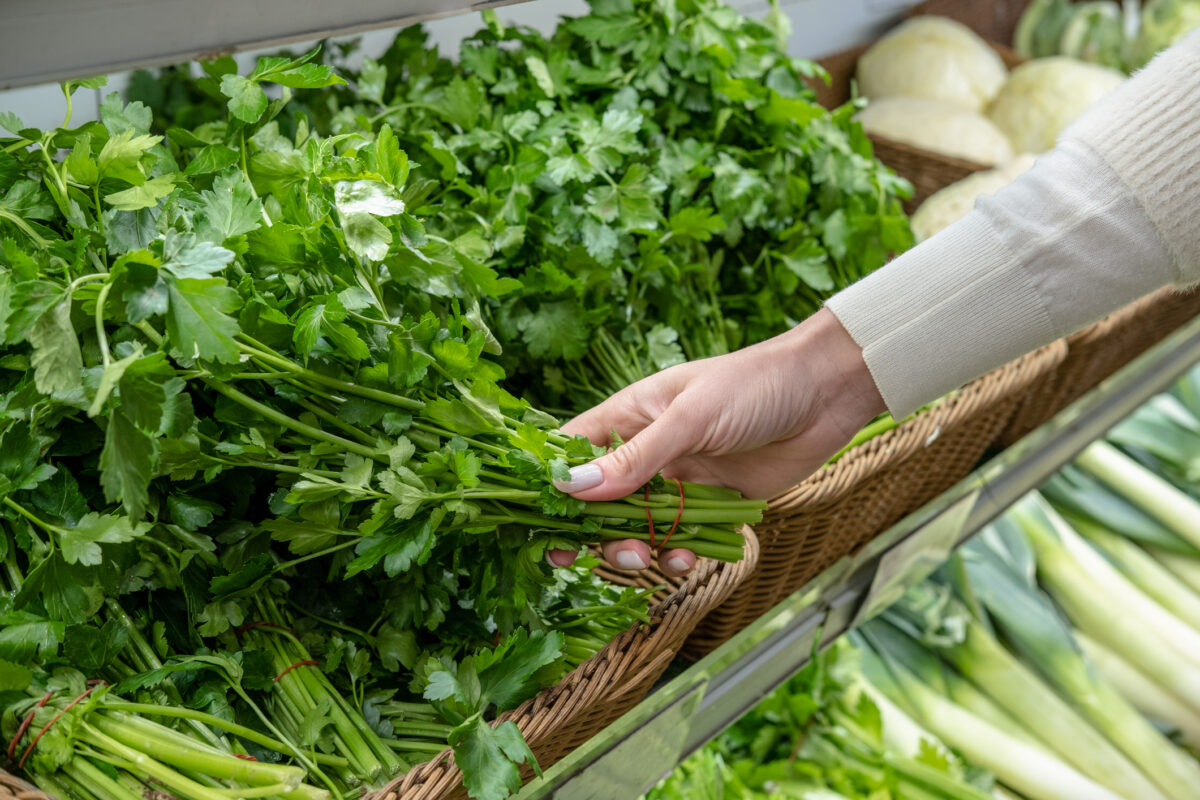
During a foodborne illness investigation, health officials interview people about what they ate in the days before they became sick. Investigators then look for foods, restaurants, stores and suppliers that appear repeatedly across different patients’ food histories.
Parsley and cilantro can be especially difficult to trace because they are often used in small amounts or mixed into other foods.
Cilantro may be added to salsa, guacamole, tacos, salads, soups and garnishes. Parsley can appear in salads, sauces, soups, prepared meals and garnishes. People may remember the meal they ate without remembering every herb or ingredient it contained.
Repeated reports of the same food can give investigators an important clue, but they do not prove that food caused the illnesses. Different ingredients can also come from the same supplier or pass through the same preparation or distribution system.
NCDHHS has identified parsley, cilantro and lettuce as commonly reported foods among people with cyclosporiasis, but officials have not confirmed any of them as the source of North Carolina’s broader increase in cases. A source would require stronger epidemiologic, traceback or laboratory evidence.
How Unusual Is the 2026 North Carolina Increase?
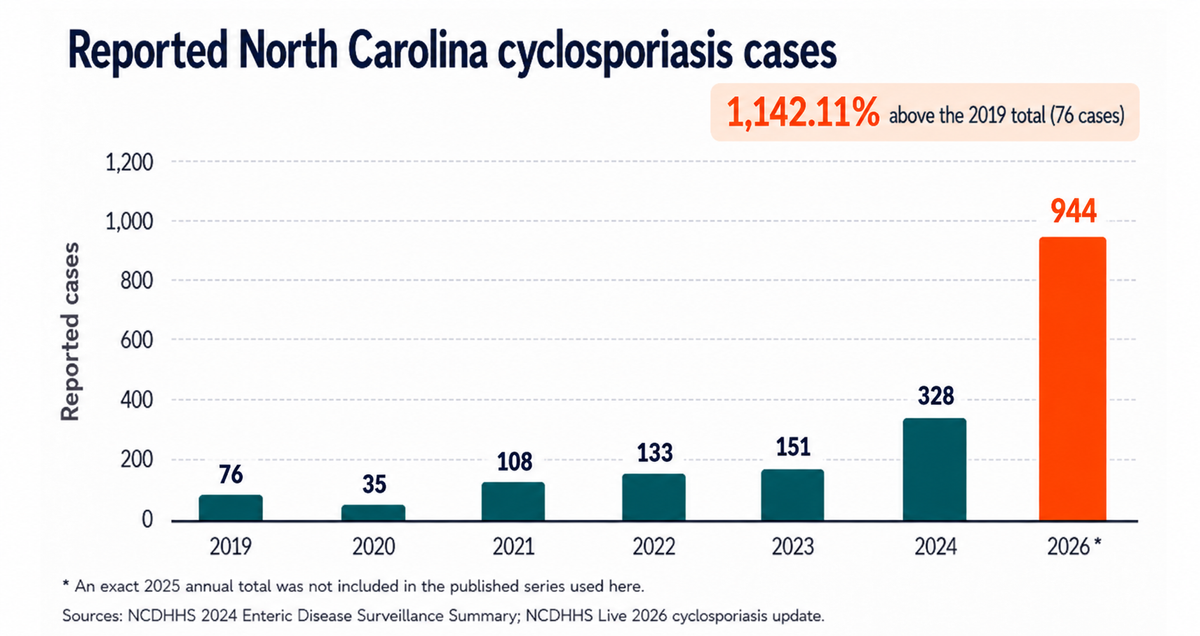
The current count is already much higher than North Carolina’s recent full-year totals. The state’s 2024 enteric-disease surveillance report listed 76 cyclosporiasis cases in 2019, 35 in 2020, 108 in 2021, 133 in 2022, 151 in 2023 and 328 in 2024.
North Carolina’s cases reported since May 1, 2026, are almost 200% higher than the state’s 328 cases during all of 2024. NCDHHS also says the current count has exceeded the totals reported in both 2024 and 2025. The 2026 figure is a partial-season count, and public health officials expect reports to continue arriving.
Figure 1. Reported North Carolina cyclosporiasis cases in the available official annual series. The 2026 number is a partial-season count through August 11.
Reported cases are not the same as the true number of infections. People with milder symptoms may not seek care. A clinician may order a routine stool panel that does not include Cyclospora. Even when the correct test is ordered, the parasite can be shed intermittently and at low levels, so one negative specimen does not always rule it out. Those factors can leave cases undiagnosed or delay their appearance in official totals.
North Carolina’s Broader Increase Is Not the Same as the Federal Lettuce Outbreak
NCDHHS continues to say the broader increase in North Carolina does not appear to be associated with the outbreak involving Taco Bell. The state is still investigating the source of its much larger 944-case increase.
Separately, CDC’s final outbreak update includes North Carolina among the 21 states with illnesses in the Taylor Farms de Mexico lettuce outbreak. That means some North Carolina illnesses were part of the federal outbreak, but the federal investigation does not explain all 944 cases reported by the state. The two datasets should not be combined. They describe overlapping but different groups of illnesses and use different case definitions.
CDC declared the Taylor Farms lettuce outbreak over on September 11. The final outbreak included 12,883 illnesses in 21 states, 570 hospitalizations and two deaths. North Carolina was one of the states with cases. CDC says the implicated lettuce is no longer available in stores or restaurants, so there is no current risk from this source. FDA continues investigating how the lettuce became contaminated.
Does the Taylor Farms Lettuce Recall Matter in North Carolina?
Yes, but for a different reason. Taylor Farms de Mexico recalled iceberg lettuce sourced from central Mexico after FDA traceback and outbreak data converged on shredded iceberg lettuce served at Taco Bell locations. The FDA recall notice says recalled shredded product was distributed from June 29 through July 16 to restaurants, retailers and foodservice customers in several states, including North Carolina.
The recall includes many foodservice products and Marketside-brand Iceberg Salad in 12-ounce and 24-ounce packages and Marketside Shredded Lettuce in 8-ounce and 16-ounce packages with listed best-if-used-by dates from July 18 through August 3. Consumers, restaurants and retailers should use the complete FDA recall list to check brands, package sizes, lot information and dates.
Do not eat recalled lettuce. Return it or discard it, and wash containers, refrigerator areas, utensils and surfaces that touched it with hot soapy water or in a dishwasher when appropriate.
The recall’s North Carolina distribution does not establish that the recalled product caused the separate North Carolina case increase. It does mean North Carolina consumers and food businesses must follow the recall while state investigators continue the parsley, cilantro and lettuce traceback.
What the Taylor Farms False-Positive Sample Did – and Did Not – Mean
On July 18, FDA initially reported a positive Cyclospora result in a lettuce sample supplied by Taylor Farms de Mexico. After laboratory experts re-reviewed the complex test result, the agency classified it as a false positive and said there were no confirmed positive product samples as of July 19.
That correction did not end the recall or reverse the federal outbreak link. In its July 24 investigation update, FDA said the false-positive sample did not change the overwhelming epidemiologic evidence or traceback convergence supporting the recall. The agency continued to identify shredded iceberg lettuce from Taylor Farms and growers in central Mexico as the vehicle for the nine-state outbreak.
This is a useful example of how foodborne-outbreak proof works. A positive product sample can be powerful, but investigators can identify an outbreak source through a combination of patient interviews, ingredient-level statistical analysis, supplier convergence and distribution records even when no leftover food tests positive. The same evidence principles may matter in North Carolina if the perishable herbs and lettuce eaten weeks ago are no longer available to test.
How North Carolina Investigators Are Looking for the Source
The investigation has two connected tracks.
First, NCDHHS and local health departments interview people with reported cyclosporiasis. They collect symptom dates, laboratory results, travel history and detailed food exposures during the 14 days before illness began. Investigators compare those interviews to find clusters involving common restaurants, grocery stores, events, meals or ingredients.
Second, NCDA&CS leads traceback of ingredients identified through those interviews. Traceback can move from a restaurant or store to a distributor, wholesaler, processor, importer, packing house, farm or growing region. Investigators compare invoices, shipping documents, lot records, order dates and supplier relationships to find a common point in the supply chain.
Cyclospora investigations are especially difficult because there is no routine whole-genome sequencing system comparable to the bacterial fingerprinting used for Salmonella, E. coli or Listeria. CDC uses genetic testing at selected markers to help group related cases, but the agency still depends heavily on patient interviews, food histories, epidemiology and traceback.
Anyone contacted by a health department can materially help the investigation by taking the interview, checking calendars and account histories, and reporting small ingredients rather than only the main dish.
Build a 14-Day Food History Before Details Disappear
Cyclospora symptoms usually begin about one week after exposure, but the range can be from two days to two weeks or longer. Start with the day symptoms first appeared and work backward at least 14 days.
Include:
- Every restaurant, fast-food, takeout and delivery meal, including the exact location, date, time and menu items.
- Salads, salad kits, lettuce, sandwiches, tacos, burritos, bowls, salsa, pico de gallo, guacamole and fresh garnishes.
- Parsley-containing foods such as tabbouleh, chimichurri, soups, salads, sauces, dressings, prepared deli foods and catered dishes.
- Cilantro-containing foods such as salsa, tacos, rice, soups, curries, salads, dressings, herb sauces and garnishes.
- Grocery purchases of fresh herbs, lettuce, bagged salad, meal kits, prepared foods and refrigerated dips.
- Catered meals, workplace food, school meals, hospital or nursing-home food, weddings, festivals, parties and community events.
- Travel, visitors, shared meals and other people who ate the same food.
- Whether any herb or lettuce was raw, chopped, prewashed, bagged, mixed into a sauce or used only as a garnish.
Use bank and credit-card statements, restaurant apps, delivery accounts, grocery loyalty histories, emailed receipts, photographs, texts, calendars, location history and messages with friends or coworkers to rebuild the timeline. Do not rely on memory alone.
Why Fresh Parsley and Cilantro Can Be Hard to Trace
Fresh herbs create several investigative problems at once.
- They are highly perishable. The suspect bunch, package or prepared meal is often gone before symptoms begin or an outbreak is recognized.
- They are frequently eaten raw. There may be no cooking step capable of killing the parasite.
- They are used in small amounts. Patients may not notice or remember a garnish, chopped herb, sauce or mixed ingredient.
- They can be distributed widely. One lot can move through wholesalers to many restaurants, retailers, caterers and institutional kitchens.
- Chopping can spread contamination. FDA notes that cutting fresh cilantro creates more opportunities for contamination and cross-contamination across a larger volume.
- Washing has limits. Rinsing can reduce contamination but cannot guarantee removal of Cyclospora, and standard chlorine-based sanitizers are not reliably effective against it.
- Records can be incomplete. A restaurant may know its distributor but not the exact farm without deeper supplier records.
These characteristics explain why a strong investigation may begin with a broad ingredient signal and take weeks or months to identify a supplier or growing source.
What Previous Cilantro and Parsley Outbreaks Show
Past outbreaks do not prove the source of the current North Carolina illnesses. They do show why investigators take repeated herb exposures seriously.
The 2013 Outbreak Included More Than One Produce Source
In summer 2013, 631 cyclosporiasis cases were reported from 25 states and New York City. The CDC’s response summary explains that restaurant-associated illnesses in Iowa and Nebraska were linked to prepackaged salad mix from Taylor Farms de Mexico in Guanajuato, while some Texas illnesses were linked to fresh cilantro from Puebla.
That history is especially relevant to the current confusion. One season can contain multiple Cyclospora outbreaks with different foods and supply chains. A large outbreak in one region does not prove that cases in another region share the same vehicle.
Pritzker Hageman’s earlier coverage of the 2013 Texas cilantro investigation explains how restaurant clusters, grocery loyalty records and ingredient-level analysis helped investigators narrow the Texas cases to cilantro.
Cilantro Caused a 2023 Restaurant Outbreak
A CDC report on a 2023 Alabama restaurant outbreak identified 47 cases among restaurant patrons, including 38 laboratory-confirmed cases. Ingredient-level analysis and traceback linked the outbreak to contaminated cilantro imported from Mexico. Cilantro appeared in multiple foods and sauces, illustrating why investigators must analyze ingredients rather than only menu-item names.
Fresh Parsley Was Confirmed in a 2025 Outbreak
FDA’s executive incident summary for a 2025 parsley outbreak says fresh parsley was the confirmed vehicle based on epidemiologic and traceback evidence. The incident included 69 laboratory-confirmed infections in four states. Investigators did not identify the ultimate source of contamination, and parsley samples collected during the investigation were negative.
The 2025 investigation demonstrates two important points: parsley can carry Cyclospora, and a food can be confirmed through combined epidemiologic and traceback evidence even when available product samples test negative.
FDA Has Detected Cyclospora on Fresh Herbs During Surveillance
In an FDA fresh-herb surveillance sampling assignment, the agency detected Cyclospora cayetanensis in 11 of 120 basil samples and 7 of 553 cilantro samples tested for the parasite. None of the 139 parsley samples tested for Cyclospora was positive.
Those historical surveillance results are not evidence about the 2026 North Carolina outbreak. FDA cautions that the sampling design may not represent all herbs in commerce and should not be used to make broad conclusions. The results do show that contamination can occur and that absence in a limited set of samples does not establish that an herb can never be a vehicle.
A Seasonal FDA Import Alert Still Applies to Some Cilantro
FDA’s current Import Alert 24-23 allows detention without physical examination of fresh cilantro from Puebla, Mexico, offered for entry from April 1 through August 31 unless it comes from a listed firm and approved farm source. The alert grew out of recurring U.S. outbreaks associated with Puebla cilantro in 2012 through 2015 and sanitation problems documented at multiple farms and packing houses.
Nothing publicly released by North Carolina identifies Puebla or any other growing region as the source of the 2026 cases. The import alert is historical and regulatory context, not a current-source finding.
What North Carolina Consumers and Restaurants Should Do Now
NCDHHS has urged consumers and restaurants to be cautious with lettuce, parsley and cilantro while the state investigation continues. The agency says people should consider removing those ingredients or cooking them fully to avoid illness. NCDHHS recommends cooking foods to 165 degrees Fahrenheit.
Federal guidance also says cooking can kill Cyclospora and identifies at least 158 degrees Fahrenheit as an effective temperature. During this North Carolina investigation, following the state’s more conservative 165-degree recommendation provides a clear single rule.
Additional steps can reduce risk but cannot guarantee that contaminated produce is safe:
- Follow every product-specific recall. Do not eat recalled Taylor Farms iceberg lettuce.
- Wash hands with soap and water for at least 20 seconds before and after handling raw produce.
- Rinse fruits, vegetables and herbs thoroughly under clean running water. Do not use soap, bleach or household disinfectants on food.
- Remove damaged areas and discard the outer leaves of lettuce or cabbage.
- Keep raw produce and its containers away from ready-to-eat foods and clean preparation surfaces with hot soapy water.
- Refrigerate cut, peeled or cooked produce within two hours.
- Do not assume that “prewashed” or “ready to eat” means Cyclospora-free.
Washing is still appropriate, but both NCDHHS and federal agencies warn that it may not remove all of the parasite. Consumers should not interpret a visual rinse as proof that a suspected herb or lettuce is safe.
Cyclospora Symptoms and When to Seek Medical Care
Cyclospora infects the small intestine. According to the CDC clinical overview, the hallmark is watery diarrhea with frequent and sometimes explosive bowel movements.
Other symptoms can include:
- Loss of appetite and weight loss.
- Stomach cramps, abdominal pain and bloating.
- Increased gas.
- Nausea and, less commonly, vomiting.
- Prolonged fatigue.
- Body aches, headache, low-grade fever or other flu-like symptoms.
Symptoms often begin about one week after exposure but can start from two days to two weeks or more later. Without treatment, illness may last from a few days to a month or longer. Symptoms can seem to improve and then return one or more times.
Contact a healthcare provider for severe or persistent diarrhea, dehydration, significant weakness, inability to keep fluids down, substantial weight loss, blood in stool, high fever or other concerning symptoms. Young children, older adults and people with weakened immune systems may be at greater risk from severe dehydration or prolonged illness.
This article is general information, not medical advice. Call 911 or seek emergency care for a medical emergency.
Ask Specifically for Cyclospora Testing
Routine stool testing does not always include Cyclospora. CDC advises healthcare providers to request testing for the parasite specifically because routine ova-and-parasite examinations and some gastrointestinal PCR panels may not look for it.
Diagnostic methods can include a molecular PCR test or stool examination using special staining or fluorescence techniques. Because oocysts may be shed intermittently and at low levels, a single negative specimen does not always exclude the infection. A clinician may request several stool specimens collected on different days when suspicion remains high.
Tell the provider:
- That North Carolina is experiencing elevated cyclosporiasis activity.
- The date diarrhea began and whether symptoms have relapsed.
- Whether you ate lettuce, parsley, cilantro or other raw produce.
- Every restaurant, store, caterer, event or institutional meal in the prior 14 days.
- Whether anyone who shared a meal is also sick.
- Whether you traveled outside the United States during the prior 14 days.
A laboratory-confirmed result helps the clinician select treatment, helps public health officials investigate the outbreak and can become important evidence in a legal claim.
Treatment for Cyclosporiasis
The CDC’s clinical-care guidance identifies trimethoprim-sulfamethoxazole, often abbreviated TMP-SMX and sold under names such as Bactrim, Septra or Cotrim, as the treatment of choice. Treatment decisions, dosing and duration belong to a healthcare provider.
People who are allergic or intolerant to TMP-SMX should not self-treat. CDC says no highly effective alternative has been identified and that several commonly discussed antibiotics are ineffective. Pregnancy, breastfeeding, infancy, immune-system conditions, kidney disease, medication interactions and severe dehydration all require individualized medical judgment.
Hydration is also important. A healthcare provider can advise whether oral fluids and electrolytes are sufficient or whether IV fluids or other care is needed.
Is Cyclospora Contagious?
Direct person-to-person spread is considered unlikely. Cyclospora oocysts passed in stool are not immediately infectious. They generally must mature in the environment for at least one to two weeks before they can infect another person.
That biology points investigators toward contaminated food or water rather than immediate household spread. Good handwashing remains important, and anyone with vomiting or diarrhea should not prepare food for others. Food workers should follow their employer and local public-health return-to-work rules.
Report a Diagnosis and Take the Public-Health Interview
Cyclosporiasis is a reportable disease in North Carolina. Healthcare providers and laboratories generally report cases through the public-health system, but patients should still cooperate fully when a local or state investigator calls.
Before the interview:
- Reconstruct the 14-day food history.
- Retrieve electronic receipts and loyalty-card records.
- Write down the exact names and addresses of restaurants and stores.
- List ingredients in shared dishes, sauces, garnishes and salads.
- Identify others who ate the same food and whether they became sick.
- Keep the investigator’s name, agency and contact information.
Public-health interviews are not a formality. Patterns across many complete interviews may be the evidence that identifies a restaurant cluster, common distributor, brand, farm or growing region.
What Evidence Should You Save?
Produce evidence disappears quickly. Preserve:
- Laboratory results, medical records, discharge instructions and prescriptions.
- Medical bills, pharmacy receipts and travel expenses for care.
- A symptom calendar showing diarrhea, relapses, dehydration, weight change and activity limits.
- Employer records, pay stubs, canceled work, lost-business records and school absences.
- Restaurant receipts, delivery-app orders, grocery receipts, loyalty-card histories and credit-card statements.
- Product packaging, labels, lot codes, use-by dates, photographs and recall notices.
- Exact restaurant and store locations, dates, times, menu items and names of dining companions.
- Emails, texts, event notices or workplace communications about shared illness.
- Health-department questionnaires, interview notes and case numbers.
Do not eat suspected leftovers. Keep them isolated. Before discarding or moving suspected food, ask the health department or a lawyer whether it should be preserved and how it can be handled safely.
Can You File a Cyclospora Lawsuit Before the Source Is Confirmed?
Possibly. A public recall or confirmed outbreak source can strengthen a case, but it is not always required before a lawyer begins investigating.
A strong Cyclospora claim commonly includes:
- A diagnosis supported by a stool test specifically identifying Cyclospora or other reliable medical and public-health evidence.
- Symptom timing that fits the incubation period.
- A food exposure that matches a case cluster, ingredient pattern, traceback finding or later recall.
- Purchase or restaurant records showing where and when the food was obtained.
- Significant harm such as prolonged illness, dehydration, hospitalization, medical expenses, lost income or major disruption of normal life.
Potentially responsible companies may include a grower, packing house, processor, importer, distributor, wholesaler, grocery store, restaurant, caterer, meal-kit company or institutional foodservice provider. More than one company can be involved in the same supply chain.
Our guide to Cyclospora lawsuits involving produce, lettuce and herbs explains how these claims are investigated. Separate pages address Cyclospora from grocery-store food and restaurant food poisoning lawsuits.
Why Pritzker Hageman for a North Carolina Cyclospora Case?
Cyclospora cases require more than a general understanding of personal-injury law. They turn on incubation timing, specialized stool testing, ingredient-level epidemiology, perishable purchase evidence and produce traceback across multiple businesses.
Pritzker Hageman’s national food poisoning attorneys have represented people in major Cyclospora outbreaks involving restaurants, grocery stores, bagged salad, vegetable trays, fresh herbs and other produce. Our team works with epidemiologists, microbiologists, traceback specialists and medical experts to identify where contaminated food came from and document the harm it caused.
We also understand that the North Carolina investigation may change. A responsible legal review distinguishes among an exposure lead, a suspected vehicle, a recalled product and a confirmed source. We preserve the records needed to evaluate the claim as public-health evidence develops.
If you or a family member had a laboratory-confirmed Cyclospora infection after eating restaurant food, catered food, parsley, cilantro, lettuce or grocery-store produce in Wake County, Raleigh or elsewhere in North Carolina, contact us for a free consultation. Call 1-888-377-8900, text 612-261-0856, or contact Pritzker Hageman online. You pay no attorney fee unless we obtain compensation for you.

How Can Our Lawyers Help You?
1-888-377-8900 (Toll-Free) | [email protected]
North Carolina Cyclospora Outbreak FAQ
No. NCDHHS says recent cases reported eating parsley and cilantro more often than expected, but that pattern does not prove either food caused the illnesses. No single food, brand, grower or supplier has been identified as the source of North Carolina’s broader increase.
NCDHHS currently reports 944 cases since May 2026, including 32 hospitalizations. Wake County has the largest reported total, with 521 cases. Cases began trending down at the end of August, and the dashboard now updates every other Tuesday.
Not as one statewide outbreak. NCDHHS says the broader North Carolina increase does not appear to be associated with the Taco Bell outbreak. However, CDC and FDA included North Carolina among the 21 states in the final Taylor Farms lettuce outbreak, so some North Carolina illnesses met the federal outbreak definition.
Yes, for a defined subset of illnesses. North Carolina was included in the final 21-state Taylor Farms lettuce outbreak, and recalled product was distributed in the state. But NCDHHS has not identified Taylor Farms lettuce as the source of North Carolina’s broader 944 case increase.
No parsley or cilantro recall has been publicly announced in connection with the North Carolina investigation as of July 25, 2026. Check NCDHHS, CDC and FDA updates because that could change.
Washing under clean running water is appropriate and may reduce contamination, but it cannot guarantee removal. Cyclospora is resistant to routine chlorine-based sanitizers. Do not wash produce with soap or bleach.
Yes. Federal guidance says at least 158 degrees Fahrenheit can kill the parasite. During this investigation, NCDHHS recommends cooking foods fully to 165 degrees Fahrenheit and suggests considering removal or full cooking of lettuce, parsley and cilantro.
Symptoms usually begin about one week after exposure, with a range from approximately two days to two weeks or longer. Build a food history covering at least the 14 days before illness began.
The hallmark is watery diarrhea with frequent and sometimes explosive bowel movements. Other symptoms include appetite loss, weight loss, cramps, bloating, gas, nausea, fatigue, vomiting, body aches, headache and low-grade fever.
Yes. Untreated cyclosporiasis can follow a relapsing course. Symptoms may improve and then return one or more times and can last a month or longer.
A stool test must specifically look for Cyclospora. Options include PCR and special microscopic methods. Routine stool panels and routine ova-and-parasite exams do not always include it, so the provider may need to request it by name.
CDC identifies trimethoprim-sulfamethoxazole, or TMP-SMX, as the treatment of choice. A healthcare provider must decide whether it is appropriate, particularly for people with allergies, pregnancy concerns, kidney disease, immune conditions or other medical risks.
Direct spread is unlikely because the parasite must mature outside the body for at least one to two weeks before it becomes infectious. Contaminated food or water is the usual outbreak concern.
Possibly. Lawyers can preserve medical, purchase and exposure evidence while an investigation develops. A positive Cyclospora test, compatible timing, detailed food history, documented losses and a later epidemiologic or traceback link can support a claim even without a positive food sample.
Save lab results, medical records, bills, prescriptions, symptom and wage-loss records, restaurant and grocery receipts, loyalty histories, app orders, payment-card statements, packaging, lot codes, photographs and health-department communications.
Experienced Cyclospora lawyers
Pritzker Hageman is a national food safety law firm that represents people sickened in foodborne illness outbreaks. Our lawyers have handled Cyclospora cases involving restaurants, grocery stores, multi-state retailers, produce distributors, and fresh produce suppliers. We know how to work with public health evidence, product traceback, microbiology, food histories, and corporate records.
If you were diagnosed with cyclosporiasis after eating fresh produce, restaurant food, fast food, catered food, or grocery-store food, contact our food poisoning attorneys for a free consultation. Call 1-888-377-8900, text 612-261-0856, or contact Pritzker Hageman online.
Official Sources and Further Reading
- NCDHHS Cyclosporiasis Cases and Outbreaks Dashboard
- NCDHHS July 17 North Carolina investigation update
- NCDHHS live North Carolina case-count and safety page
- CDC national Cyclospora surveillance
- CDC nine-state iceberg-lettuce outbreak notice
- FDA nine-state outbreak investigation
- FDA Taylor Farms iceberg-lettuce recall
- CDC clinical overview, testing and diagnosis
- CDC clinical care and treatment
- FDA Cyclospora food-safety guidance
- FDA fresh-herb surveillance sampling
Cyclospora Resources
For a complete explanation of symptoms, incubation, stool testing, treatment, evidence, compensation, and legal options, read our Cyclospora lawyer and cyclosporiasis lawsuit guide.