
Updated July 25, 2026 – A recall of shell eggs produced at two Texas farms is now part of a multistate Salmonella Enteritidis outbreak investigation. As of July 24, the Centers for Disease Control and Prevention reports 98 illnesses in 17 states, 26 hospitalizations, and no deaths.

The outbreak is linked in part to white shell eggs and brown cage-free shell eggs recalled by Midwest Poultry Services, L.P., which also operates as MPS Egg Farms. The recalled eggs were sold under the Kroger, Simple Truth, Brookshire’s, Country Morning, and Cal-Maine Sunups names. They also went to restaurants and other foodservice customers.
Midwest Poultry Services, based in North Manchester, Indiana, is a major U.S. shell egg supplier and operates farms throughout the country that produce 11 million eggs each day, according to the company’s website.
This is no longer only a precautionary recall. Patient interviews, supply-chain traceback, and genetic testing connect recalled eggs to illnesses. At the same time, the U.S. Food and Drug Administration’s investigation states that Midwest Poultry Services does not account for every illness in the outbreak. Investigators are looking for additional sources.
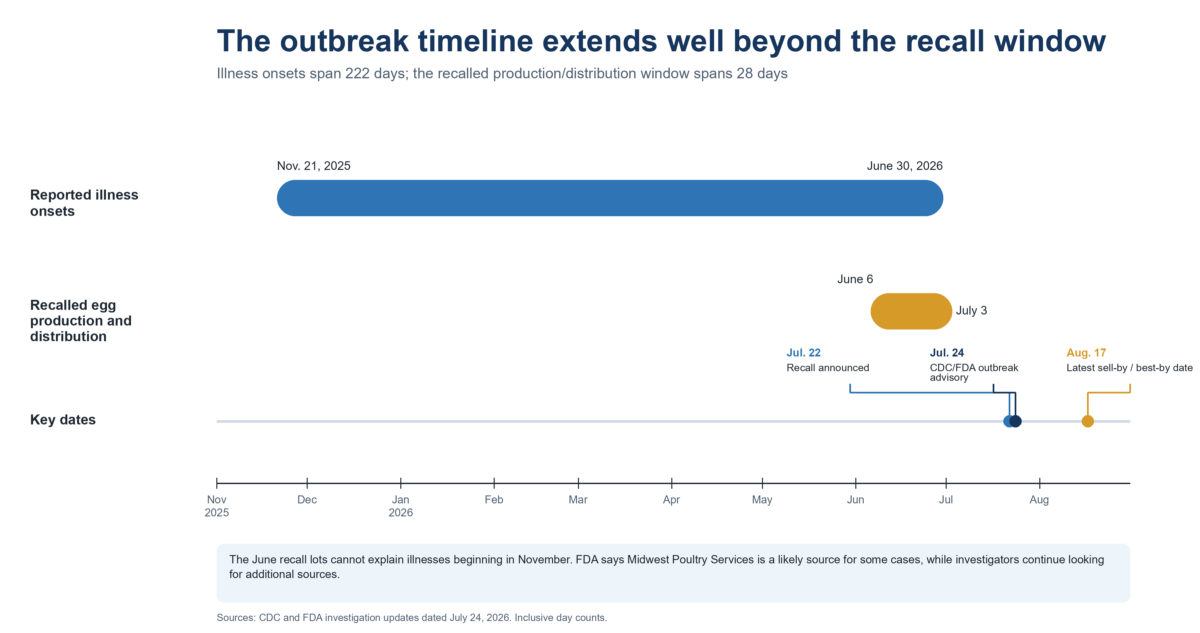
The timeline is unusually important. Reported illnesses began November 21, 2025, and continued through June 30, 2026. The recalled eggs, however, were produced and distributed from the Texas farms from June 6 through July 3, 2026. That difference does not mean the recalled June lots were available in November. It means the outbreak cluster is broader than the current recall window, and the investigation has not yet explained every case.
Do You Need a Salmonella Lawyer?
If you or a loved one was diagnosed with Salmonella after eating eggs or an egg-containing meal, contact the Pritzker Hageman Salmonella Legal Team for a free consultation. Call 1-888-377-8900, text 612-261-0856, or contact us online. We represent clients nationwide, and we are not paid unless we win.
Egg Salmonella Outbreak at a Glance
- 98 confirmed cases in 17 states as of July 24, 2026.
- 26 hospitalizations among 72 people with hospitalization information, a 36% hospitalization rate among people for whom that information was available.
- No deaths reported as of July 24.
- Illness onset dates: November 21, 2025, through June 30, 2026.
- Age range: younger than 1 year to 81 years; median age 48.
- Egg exposure: 40 of 44 people interviewed, or 91%, reported eating shell eggs in the week before they became sick.
- Recall size: 1,589,577 dozen eggs, equal to 19,074,924 individual eggs.
- Recall date: July 22, 2026.
- Recalled production/distribution window: June 6 through July 3, 2026.
- Antimicrobial finding: Whole genome sequencing predicted that bacteria from all 98 patient samples were nonsusceptible to ciprofloxacin and resistant to nalidixic acid.
- Investigation status: Ongoing. FDA says recalled Midwest Poultry Services eggs are a likely source for some cases but do not account for all illnesses.
Where Have Egg Outbreak Illnesses Been Reported?
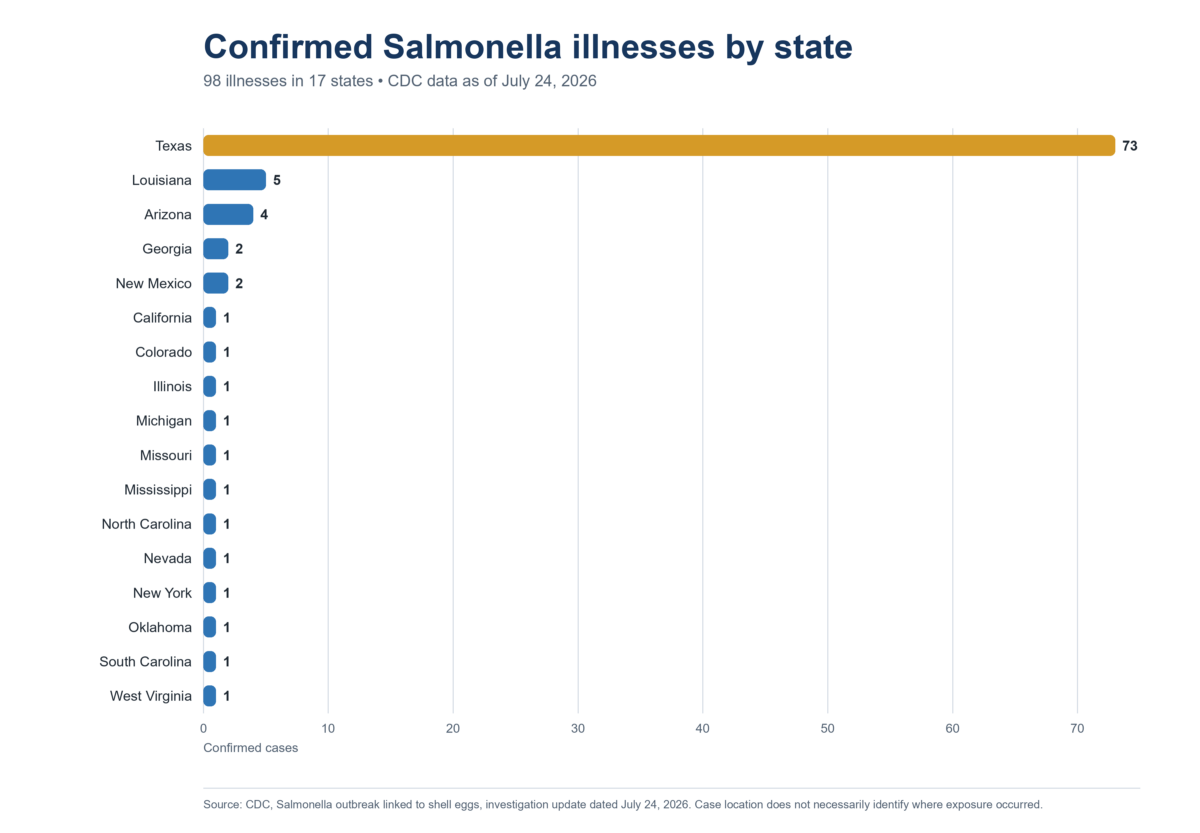
Texas accounts for 73 of the 98 confirmed illnesses. Louisiana has five cases; Arizona has four; Georgia and New Mexico have two each. California, Colorado, Illinois, Michigan, Missouri, Mississippi, North Carolina, Nevada, New York, Oklahoma, South Carolina, and West Virginia each have one reported case.
Those case locations are not the same thing as confirmed recall distribution. FDA has confirmed distribution of recalled products in Arkansas, Louisiana, Mississippi, New Mexico, Oklahoma, and Texas. FDA cautions that the eggs could have been distributed farther.
As of July 24, Arkansas was a confirmed product-distribution state but did not have a reported outbreak case. Several states with outbreak cases were not on FDA’s confirmed distribution list. A case in a state does not by itself establish where the patient was exposed; people travel and eat at restaurants, and the investigation may identify other products or sources.
Why the Illness Window Is Much Wider Than the Recall Window
The first known illness began November 21, 2025. The most recent known illness began June 30, 2026. That is a 222-day onset span when both endpoints are counted.
The recall covers eggs produced and distributed from the Texas farms from June 6 through July 3, a 28-day span. Sell-by or best-by dates run through August 17, so recalled cartons may still be in refrigerators even though the latest illness currently counted began in June.
CDC also warns that the reported total is probably an undercount. Many people recover without medical care or Salmonella testing, and CDC estimates it can take three to four weeks to determine whether a recent illness belongs to an outbreak. The case total can therefore grow after the last currently reported onset date.
The conclusion is:
- Illnesses began long before the production dates on the July 22 recall.
- Recalled Midwest Poultry Services eggs are a likely source of some illnesses.
- Midwest Poultry Services does not account for every illness in the outbreak.
- Investigators are still working to identify additional sources and recently reported cases.
Which Eggs Were Recalled?
On July 22, Midwest Poultry Services recalled 1,589,577 dozen white shell eggs and brown cage-free shell eggs produced at two Texas farms because of possible Salmonella Enteritidis contamination. The FDA recall notice and product photographs identify retail cartons and bulk foodservice packages.
Fast Carton Check
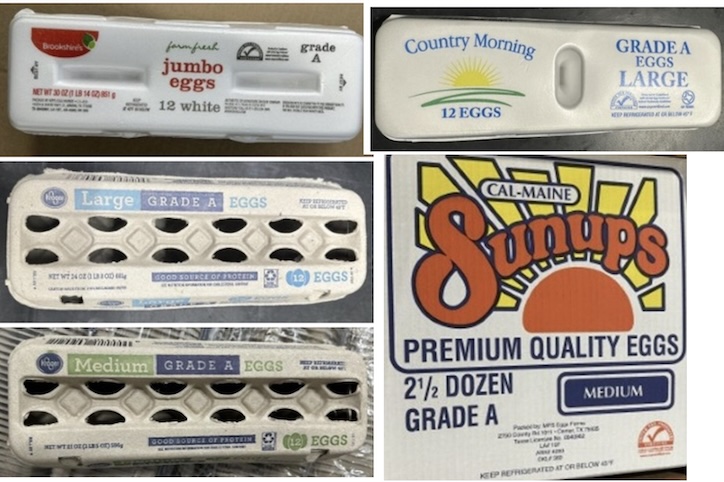
- Brand names: Kroger, Simple Truth, Brookshire’s, Country Morning, and Cal-Maine Sunups.
- Carton codes: P-1950 or 0840962. Some rows in FDA’s product table display the second code without its leading zero as 840962.
- Julian dates: 157 through 184.
- Calendar dates represented by those Julian dates: June 6 through July 3, 2026.
- Sell-by or best-by dates: July 20 through August 17, 2026.
- Retail sizes: 6, 12, 18, 24, 30, 36, and 60 eggs, depending on the product.
- Bulk foodservice sizes: Cases and flats ranging from 20 eggs to 30 dozen.
If the eggs are no longer in their original carton and you cannot determine whether they are recalled, FDA advises throwing them away.
Stores, Restaurants, and Distribution States
Recalled eggs were shipped to retail and foodservice customers in Texas, Oklahoma, and Louisiana. Consumers could buy them at Kroger stores in Texas and Louisiana and at Brookshire Grocery stores in Texas, Oklahoma, Arkansas, Louisiana, New Mexico, and Mississippi. Other smaller stores, restaurants, and foodservice outlets also received recalled eggs.
FDA has confirmed recalled-product distribution in:
- Arkansas
- Louisiana
- Mississippi
- New Mexico
- Oklahoma
- Texas
FDA states that distribution could extend beyond these six states. Restaurant diners may not know the brand of shell eggs used in a meal, which makes dates, receipts, loyalty-card records, and restaurant information important during a public-health interview.
Complete Retail Product List
All products in the table below have Julian dates 157 through 184 and sell-by or best-by dates from July 20 through August 17, 2026.
| Brand and product | UPC | Identifying code |
| Kroger Large, 12 eggs | 011110609038 | P-1950 or 840962 |
| Kroger Large, 18 eggs | 011110609335 | P-1950 or 840962 |
| Kroger Large, 60 eggs | 011110609144 | P-1950 |
| Kroger Extra Large, 12 eggs | 011110609045 | P-1950 or 840962 |
| Kroger Medium, 12 eggs | 011110609021 | P-1950 or 840962 |
| Kroger Medium, 30 eggs | 011110609809 | P-1950 |
| Kroger Jumbo, 12 eggs | 011110609052 | P-1950 or 840962 |
| Simple Truth Cage Free Medium Brown, 12 eggs | 011110870230 | P-1950 |
| Simple Truth Cage Free Large Brown, 12 eggs | 011110797704 | P-1950 |
| Simple Truth Cage Free Large Brown, 18 eggs | 011110893109 | P-1950 |
| Simple Truth Cage Free Large Brown, 24 eggs | 011110150974 | P-1950 |
| Brookshire’s Large, 12 eggs | 092825095552 | P-1950 |
| Brookshire’s Large, 18 eggs | 092825095569 | P-1950 |
| Brookshire’s Large, 36 eggs | 092825109808 | P-1950 |
| Brookshire’s Large, 60 eggs | 092825095637 | P-1950 |
| Brookshire’s Large, 6 eggs | 092825095644 | P-1950 |
| Brookshire’s Extra Large, 18 eggs | 092825095606 | P-1950 |
| Brookshire’s Jumbo, 12 eggs | 092825095583 | P-1950 |
| Country Morning Large, 12 eggs | 078566200004 | P-1950 |
| Country Morning Large, 18 eggs | 078566005036 | P-1950 |
| Country Morning Large, 2 ½ dozen | 079307005162 | P-1950 |
| Country Morning Extra Large, 12 eggs | 078566001021 | P-1950 |
| Country Morning Medium, 12 eggs | 078566001045 | P-1950 |
| Country Morning Jumbo, 12 eggs | 078566001014 | P-1950 |
| Sunups Medium, 2 ½ dozen | 028621304987 | P-1950 |
Recalled Bulk and Foodservice Products
The recall also includes the following bulk products with code P-1950, Julian dates 157 through 184, and sell-by or best-by dates from July 20 through August 17, 2026.
| Bulk product | Package information |
| Grade AA Large Bulk | 30 dozen |
| Grade A Large Bulk | 15 dozen |
| Grade A Large Bulk – TICTAC | Bulk foodservice package |
| Grade A Large Bulk – Brown – TICTAC | Bulk foodservice package |
| Grade A Medium Bulk | 30 dozen |
| Grade A Medium Bulk | 15 dozen |
| Grade A Extra Large Bulk | 15 dozen |
| Grade A Jumbo Bulk | 20 eggs |
With 1.6 million dozen eggs or 19.2 million individual eggs included, this is one of the largest shell egg recalls in recent years. In 2025, August Egg recalled 1.7 million dozen eggs in connection with a Salmonella outbreak. And in 2010, Wright County Egg recalled 550 million eggs in connection with the largest shell egg Salmonella outbreak in U.S. history. Three thousand people were sickened.
What Should Consumers and Businesses Do With Recalled Eggs?
If Recalled Eggs Are at Home
- Do not eat the eggs.
- Return them to the store for a refund or place them in the trash where people and animals cannot eat them.
- Wash containers, refrigerator shelves, utensils, counters, and other surfaces that touched the eggs with hot, soapy water or in a dishwasher.
- Wash hands before and after handling raw eggs or cleaning contaminated surfaces.
- If you no longer have the original carton and cannot identify the eggs, throw them away.
If a Restaurant, Retailer, or Foodservice Business Received the Eggs
- Do not sell, serve, or use recalled shell eggs.
- Review invoices and supplier records for eggs from the affected production window.
- Identify dishes that may have contained shell eggs, including pooled-egg recipes, baked foods, batters, sauces, dressings, desserts, and breakfast items.
- Clean and sanitize containers, utensils, work surfaces, and equipment that may have touched recalled eggs.
- Preserve purchase, supplier, menu, service-date, and distribution records for public-health investigators.
Cooking can kill Salmonella when food reaches a safe internal temperature, but a recall instruction is not an invitation to cook and eat the recalled product. Recalled eggs should not be eaten, sold, or served.
The Outbreak Strain Is Drug-Resistant
CDC’s July 24 investigation update adds a critical fact: whole genome sequencing of bacteria from all 98 patients’ samples “predicted nonsusceptibility to ciprofloxacin and resistance to nalidixic acid.” CDC also reports that the outbreak strain is related to a Salmonella Enteritidis strain previously isolated from chicken, eggs, and backyard poultry.
In plain language, genetic markers in the outbreak bacteria predict that ciprofloxacin may not work as expected against some infections. Nalidixic acid and ciprofloxacin are both quinolone-class drugs; CDC’s wording does not mean that every patient took an antibiotic, that every patient experienced treatment failure, or that the strain is resistant to every available antibiotic.
Most people with Salmonella recover with fluids and supportive care and do not need antibiotics. Antibiotics may be considered for severe intestinal illness, infection outside the intestines, or patients at higher risk of invasive disease.
When antibiotic treatment is needed, CDC’s clinical overview for healthcare professionals lists fluoroquinolones, azithromycin, and third-generation cephalosporins as recommended first-line options. Ciprofloxacin is a fluoroquinolone. CDC recommends culture and antimicrobial susceptibility testing to guide treatment when antibiotics are necessary.
Patients should not start, stop, or change an antibiotic based only on an outbreak notice. Tell the treating clinician about possible exposure to recalled eggs and the CDC resistance finding so the clinician can select and interpret the appropriate tests.
How Investigators Linked Eggs to the Outbreak
Public-health investigators typically look for three kinds of evidence: epidemiology, traceback, and laboratory results. This investigation has evidence in all three categories.
Epidemiological Evidence
State and local health officials interviewed patients about what they ate during the week before illness. Forty of the 44 people interviewed, or 91%, reported eating shell eggs. That common exposure gave investigators a strong lead.
Traceback Evidence
FDA started with stores and restaurants where patients reported buying or eating eggs and followed invoices and distribution records back through the supply chain. Midwest Poultry Services was a common egg source for some cases.
The traceback is not complete. FDA says the producer does not account for all illnesses, so additional sources may be identified.
Laboratory Evidence
CDC PulseNet compared DNA fingerprints from patient bacteria using whole genome sequencing. The patient samples were closely related genetically, indicating that people in the outbreak likely became sick from the same food.
Midwest Poultry Services also collected samples at its Texas farms. The samples tested positive for Salmonella, and whole genome sequencing performed by a third-party laboratory found that some farm samples matched the outbreak strain. The company shared those results with FDA on July 21 and initiated the recall on July 22.
For an individual legal claim, being in a state on the outbreak map is not enough by itself. Medical testing, exposure timing, purchase or restaurant records, public-health interviews, and the evolving traceback all matter. Read more about how a food poisoning lawyer proves a claim.
Salmonella Symptoms and When to Seek Medical Care
Most people with a Salmonella infection develop:
- Diarrhea, which may be watery, bloody, or contain mucus
- Fever
- Stomach cramps that can be severe
- Nausea
- Vomiting
- Headache
- Loss of appetite
Symptoms usually begin six hours to six days after infection and last four to seven days. Because people may eat eggs in multiple meals or at a restaurant without knowing the supplier, the important exposure date may not be obvious.
Call a healthcare provider promptly for:
- Diarrhea or vomiting lasting more than two days
- Bloody diarrhea or blood in the urine
- Fever higher than 102 degrees Fahrenheit
- Vomiting that prevents fluids from staying down
- Little or no urination, very dark urine, dry mouth or throat, dizziness, unusual thirst, or other signs of dehydration
- Worsening symptoms or signs that the infection has spread outside the intestines
Young children, especially infants; adults 65 and older; people with weakened immune systems; and people with certain underlying heart, vascular, or joint conditions have a greater risk of severe or invasive infection.
Serious and Long-Term Salmonella Complications
Salmonella can move beyond the intestines into the blood, urine, bones, joints, brain, or other organs. CDC estimates that invasive infections occur in about 8% of people with laboratory-confirmed Salmonella.
Complications can include:
- Severe dehydration
- Bacteremia, an infection of the blood
- Sepsis
- Meningitis
- Osteomyelitis, an infection of bone
- Septic arthritis, an infection of a joint
- Endocarditis
- Infected aneurysm or other arterial infection
- Prolonged diarrhea or altered bowel habits
- Reactive arthritis, which can last months or years
No deaths have been reported in this outbreak as of July 24, but Salmonella can be life-threatening, particularly when it becomes invasive or affects a vulnerable patient.
What to Do After Illness From Eggs or an Egg-Containing Meal
1. Get Medical Care and Ask About Testing
Tell the healthcare provider when symptoms began and when and where eggs or egg-containing foods were eaten. Stool culture is the gold standard for confirming Salmonella. If a culture-independent PCR panel detects Salmonella, CDC recommends a follow-up culture so an isolate is available for public-health matching and antimicrobial susceptibility testing.
Ask for copies of laboratory results, discharge instructions, medication records, and bills. The resistance finding makes culture and susceptibility information especially important when antibiotic treatment is considered.
2. Report the Illness
Report a diagnosed or suspected Salmonella illness to the local or state health department. Public-health interviews help investigators connect cases, trace products, and identify restaurants or retailers that received recalled eggs.
3. Document the Food Exposure
Write down every egg or egg-containing food eaten during the week before symptoms, including meals at home, restaurants, hotels, schools, hospitals, catered events, and workplaces. Record dates, locations, meal companions, menu items, and how the eggs were prepared.
Restaurant exposures matter because foodservice cartons may not use the consumer brand names listed above.
4. Preserve Purchase Evidence Safely
Save or request:
- Grocery and restaurant receipts
- Loyalty-card and online-order histories
- Credit- or debit-card statements
- Delivery-app records
- Photographs of the carton, UPC, P-code, Julian date, and sell-by date
- Supplier or invoice records if a business purchased the eggs
Do not keep or eat recalled eggs merely as evidence. Photograph the carton and codes before disposal. Retain food only if a health department or other qualified investigator gives safe collection and storage instructions.
5. Track the Harm
Keep a simple daily record of symptoms, medical visits, medication, missed work, lost income, caregiving needs, and continuing joint or digestive problems. Serious Salmonella cases can create losses long after the initial diarrhea ends.
6. Speak With an Experienced Salmonella Lawyer
A lawyer familiar with outbreak science can obtain records, evaluate testing and traceback evidence, preserve legal claims, and identify potentially responsible companies. Pritzker Hageman’s Salmonella outbreak lawsuit FAQ explains the evidence commonly used in these cases.
Can I File a Lawsuit Over the Midwest Poultry Egg Outbreak?
A person diagnosed with Salmonella may have a claim if the evidence connects the illness to contaminated eggs, an egg-containing meal, or another source identified in the outbreak investigation. Depending on the evidence, potentially responsible parties can include a producer, processor, distributor, retailer, restaurant, caterer, or other foodservice operator.
Our legal team will evaluate the individual exposure history rather than assume that every case has the same source.
Evidence can include:
- A positive Salmonella test and, when available, a matching whole genome sequence
- Symptom and exposure timing consistent with infection
- A carton code, UPC, receipt, loyalty record, or restaurant invoice
- Health-department interviews or notice that the patient is part of the outbreak
- FDA traceback and distribution records
- Test results from farms, products, or the foodservice supply chain
- Medical evidence of hospitalization, invasive infection, long-term complications, or death
Compensation can include medical expenses, lost income, pain and suffering, disability, long-term care needs, and other losses allowed by the applicable law. Filing deadlines differ by state and claim, so people with serious cases should not wait for the entire outbreak investigation to end before asking a lawyer about the deadline.
Read more about a Salmonella lawsuit and the reasons to seek compensation.
Why Pritzker Hageman for a Serious Salmonella Case?
Pritzker Hageman is a national food-safety law firm. Our attorneys understand the epidemiology, traceback, microbiology, and whole genome sequencing evidence used to investigate foodborne outbreaks.
Our trial team obtained a landmark $6.5 million jury verdict in a Salmonella case involving a child who suffered permanent brain damage. We have represented people and families affected by major Salmonella outbreaks across the United States.
Contact Eric today and find out how you can get compensation and justice
1-888-377-8900 (Toll-Free) | [email protected]

If a Salmonella infection caused hospitalization, bacteremia, sepsis, meningitis, reactive arthritis, permanent injury, or death, contact us today.
Frequently Asked Questions
Yes. CDC and FDA are investigating 98 Salmonella Enteritidis illnesses in 17 states. Recalled Midwest Poultry Services shell eggs are a likely source for some cases. FDA says the producer does not account for every illness, and the investigation is ongoing.
CDC reports 26 hospitalizations among 72 patients for whom hospitalization information was available. That is 36% of people with known hospitalization status. No deaths had been reported as of July 24, 2026.
The recalled retail brands are Kroger, Simple Truth, Brookshire’s, Country Morning, and Cal-Maine Sunups. The recall also includes bulk eggs delivered to foodservice customers.
Look for P-1950 or 0840962 on the side of the carton and a Julian date from 157 through 184. FDA’s product table displays 0840962 as 840962 in some rows. Sell-by or best-by dates run from July 20 through August 17, 2026.
In 2026, Julian date 157 is June 6 and Julian date 184 is July 3. These dates correspond to the recalled production and distribution window.
FDA confirmed recalled product in Arkansas, Louisiana, Mississippi, New Mexico, Oklahoma, and Texas. Kroger stores in Texas and Louisiana and Brookshire Grocery stores in all six states received recalled eggs. Smaller retailers, restaurants, and foodservice customers also received eggs, and FDA says distribution may have gone farther.
Cases have been reported in Arizona, California, Colorado, Georgia, Illinois, Louisiana, Michigan, Missouri, Mississippi, North Carolina, New Mexico, Nevada, New York, Oklahoma, South Carolina, Texas, and West Virginia. Texas has 73 of the 98 reported illnesses.
The reported outbreak cluster begins November 21, 2025, but the recalled Texas-farm lots were produced and distributed from June 6 through July 3, 2026. The current recall cannot by itself explain the earlier cases. FDA says Midwest Poultry Services is a common source for some cases but does not account for all illnesses, and investigators are looking for additional sources.
No. FDA describes recalled Midwest Poultry Services eggs as a likely source of illnesses but says the producer does not account for all cases. Individual cases require exposure and laboratory evidence.
CDC says whole genome sequencing predicted nonsusceptibility to ciprofloxacin and resistance to nalidixic acid in bacteria from all 98 patient samples. Some severe infections may require a different antibiotic. Treatment decisions should be based on a clinician’s assessment, culture, and antimicrobial susceptibility results.
Common symptoms are diarrhea, fever, stomach cramps, nausea, vomiting, headache, and loss of appetite. Symptoms usually begin six hours to six days after infection and last four to seven days.
Call a healthcare provider for diarrhea or vomiting lasting more than two days, bloody stool or urine, fever above 102 degrees Fahrenheit, inability to keep liquids down, dehydration, worsening illness, or symptoms suggesting infection outside the intestines.
Medical testing and a detailed exposure history still matter. Request loyalty-card, online-order, delivery-app, credit-card, or restaurant records. Tell the health department where and when eggs or egg-containing dishes were eaten.
Yes. Recalled eggs were shipped to foodservice customers, and diners may not know the egg brand used in a meal. Save restaurant receipts and record the meal date and egg-containing dishes.
No. The 2026 investigation involves a new Salmonella Enteritidis outbreak and a Midwest Poultry Services recall. It is distinct from the 2025 August Egg Company organic egg outbreak and the 2025 Country Eggs cage-free brown egg outbreak.
Possibly. A claim requires evidence connecting the diagnosed illness to contaminated eggs, a restaurant, or another outbreak source. A lawyer can evaluate medical testing, exposure timing, receipts, traceback, and damages.
Official Outbreak and Medical Resources
- CDC: Investigation Update – Salmonella Outbreak, July 2026
- CDC: Consumer Advisory – Salmonella Outbreak Linked to Shell Eggs
- CDC: When People Got Sick – July 2026 Outbreak
- FDA: Outbreak Investigation of Salmonella – Eggs, July 2026
- FDA: Midwest Poultry Services Shell Egg Recall and Product List
- CDC: Symptoms of Salmonella Infection
- CDC: Clinical Overview of Salmonellosis
Additional Information About Salmonella
- Salmonella Outbreak Lawsuit FAQ
- Salmonella Lawsuit: 5 Reasons to Sue for Compensation
- Salmonella Symptoms
- Salmonella Enteritidis
- Salmonella Lawyer
Experienced Salmonella Lawyers
If you developed a Salmonella infection after consuming recalled eggs and would like a free consultation with an experienced Salmonella lawyer, please contact the Pritzker Hageman Salmonella Legal Team. Our attorneys have represented clients in every major Salmonella outbreak in the U.S. Call us at 1-888-377-8900, text 612-261-0856, or contact us online. There is no obligation, and you never pay anything unless we win compensation for you.
We have obtained 100+ separate verdicts and settlements greater than $1 million:
Our client suffered substantial injuries after ingesting a defective product.
We obtained this settlement on behalf of a family whose children were sickened with E. coli.
We obtained a $12.15 million settlement on behalf of an 8-year old girl who was sickened in an E. coli outbreak.
We represented seven children who suffered intestinal injuries as a result of a defective food product.
We obtained this settlement on behalf of a 13-year old girl who was sickened with E. coli.
We won this verdict for a child with kidney damage from E. coli in contaminated food.
Our attorneys won this landmark verdict in a case against Foster Poultry Farms. Our client was a 5-year-old child who contracted Salmonella Heidelberg and, as a result, suffered brain damage.
We obtained a settlement from a company that sold contaminated food to our clients, causing the death of unborn children.
Our client suffered severe neurologic injuries as a result of Listeria monocytogenes, a food-borne pathogen.
On behalf of a client who was seriously sicked by food contaminated with Listeria monocytogenes.
See more settlements & verdicts.
The Pritzker Hageman law firm and our attorneys have been recognized in:
U.S. News & World Report

Pritzker Hageman has been recognized as one of the best law firms for personal injury litigation by U.S. News & World Report every year the award has been given since 2012.
Super Lawyers®, Thomson Reuters

Attorneys at Pritzker Hageman have been awarded the peer selected Super Lawyers distinction every year since 2004.
America’s Top 100 Attorneys®

Lifetime Achievement selection to America’s Top 100 Attorneys®.
Three Time Attorneys of the Year

Pritzker Hageman lawyers have been named Attorneys Of The Year by Minnesota Lawyer three times.