
Updated August 20, 2026: If you tested positive for Salmonella after eating at Chipotle, QDOBA, or another Mexican-style restaurant, act quickly to protect your health and preserve evidence. The 2026 multistate Salmonella Javiana outbreak is linked to recalled jalapeños distributed by Coast Citrus Distributors. Read our current jalapeño Salmonella outbreak report for the latest case count, affected states, recall, and restaurant-risk information.
Medical testing, restaurant records, meal timing, public-health interviews, and whole genome sequencing may all help determine whether an illness belongs to the outbreak. You do not need to identify the exact ingredient on your own. Save what you know, avoid guessing, and let health officials and experienced counsel evaluate the evidence.
Pritzker Hageman is a Minneapolis-based national food-safety law firm. Our Salmonella legal team evaluates serious cases involving hospitalization, invasive infection, lasting complications, disability, and wrongful death. Call 1-888-377-8900, text 612-261-0856, or request a free, confidential consultation. Read more about Salmonella symptoms and serious complications.
Do You Need a Salmonella Lawyer?
What to Do After Getting Sick
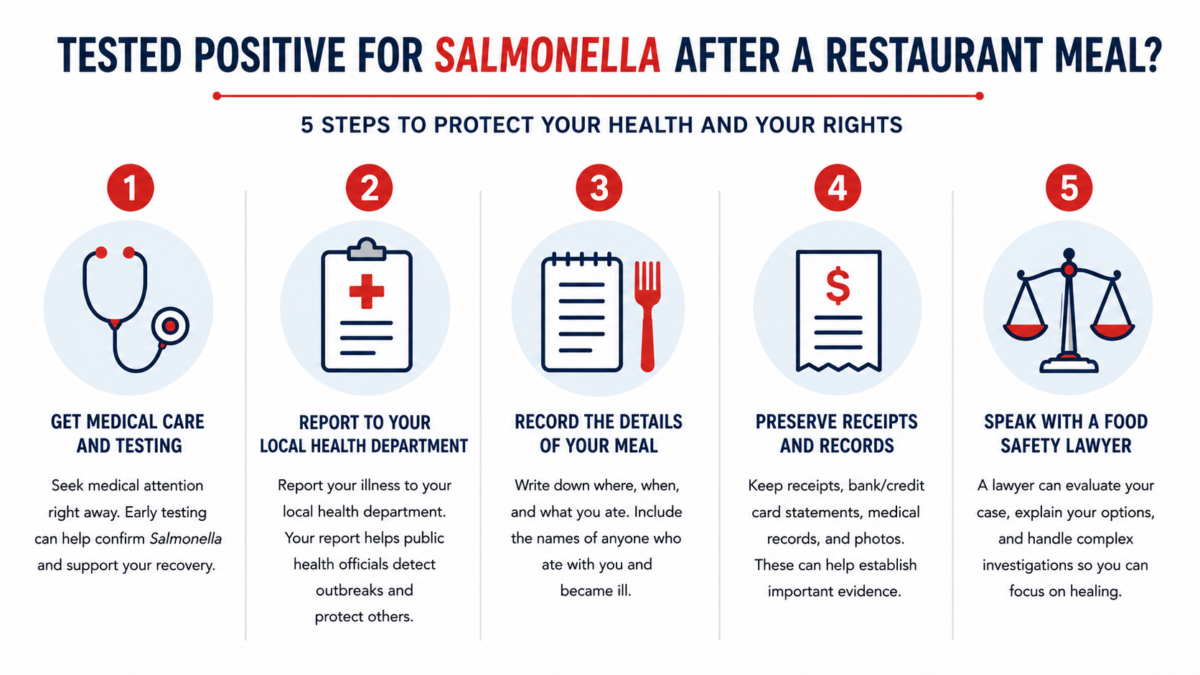
1. Get Medical Care and Ask About Salmonella Testing
Tell the clinician when your symptoms began and when and where you ate. The CDC’s clinical guidance states that culture of a stool, blood, urine, or other clinical sample is the gold standard for diagnosing Salmonella. If a PCR panel or another culture-independent test detects Salmonella, the CDC recommends a follow-up culture when possible so an isolate is available for patient care and public health work.
Ask for copies of your laboratory results, visit notes, discharge instructions, medication records, and bills. Do not assume that a generic diagnosis of gastroenteritis identifies the germ that made you sick.
2. Report the Illness to the Minnesota Department of Health
Report suspected food poisoning through the Minnesota Department of Health (MDH) foodborne illness reporting system or call 1-877-FOOD-ILL (1-877-366-3455). MDH says a report helps investigators identify outbreaks and prevent additional illnesses. Hotline staff may ask about symptoms and food eaten during the four days before illness began.
Minnesota also requires health care providers and laboratories to report salmonellosis to MDH within one working day. Submission of a clinical isolate, if available, is required so the public health laboratory can perform additional testing.
3. Write Down the Meal Details
Record the Chipotle or Qdoba location, meal date and approximate time, every item and ingredient you remember, who ate with you, when each person’s symptoms began, and whether anyone else became ill. Do this while the details are fresh.
Include online orders, delivery orders, catering, and food purchased by another person. The location, timing, and menu details can help investigators look for a common ingredient or supply chain.
4. Save Records of Your Meal and Illness
Keep records that document where and when you ate, what you ordered, your Salmonella diagnosis, and how the illness affected you. These may include:
- Your Chipotle or Qdoba receipt, app history, online order confirmation, or delivery record
- A credit-card or bank statement showing the purchase
- The restaurant location, meal date, order details, and when your symptoms began
- Laboratory results, medical records, hospital paperwork, and medical bills
- Records of missed work, lost income, and other illness-related expenses
- Notes about your symptoms, treatment, and any ongoing health problems
If you still have packaging or leftovers from the meal, do not eat the food. Photograph any packaging, labels, or identifying information, and contact the health department before handling or storing suspected food as evidence.
5. Speak With a Food Safety Lawyer
If you tested positive for Salmonella after eating at a Minnesota Chipotle or Qdoba, a Salmonella lawyer can evaluate whether the diagnosis, timing, restaurant records, public health information, and damages support a claim.
Because these cases are complex and often require analysis of epidemiological findings, laboratory evidence, whole genome sequencing, ingredient distribution, and traceback records, an experienced lawyer can help you understand what steps to take after suspected food poisoning and your options for a restaurant food poisoning lawsuit.
For broader Minnesota guidance that is not limited to Chipotle and Qdoba, read our Minnesota Salmonella lawyer page about MDH reporting, laboratory evidence, compensation, and serious-case evaluation.
How Soon Do Salmonella Symptoms Start?
Salmonella symptoms usually begin six hours to six days after infection and usually last four to seven days. Common symptoms include:
- Watery diarrhea that may contain blood or mucus
- Fever
- Stomach cramps that can be severe
- Nausea
- Vomiting
- Headache
- Loss of appetite
The last thing a person ate is not necessarily what caused the illness. A careful food history matters because different germs have different incubation periods.
When Should You Call a Doctor?
Call a health care provider promptly if you have:
- Diarrhea or vomiting lasting more than two days
- Blood in stool or urine
- A fever higher than 102 degrees Fahrenheit
- Vomiting that prevents you from keeping fluids down
- Little or no urination, dark urine, severe thirst, dry mouth, dizziness, or other signs of dehydration
- Symptoms that are worsening or suggest the infection has spread outside the intestines
Young children, adults 65 and older, and people with weakened immune systems have a greater risk of severe illness. Salmonella can sometimes spread to the blood, urine, bones, joints, brain, or other organs. It can cause complications such as bacteremia, sepsis, meningitis, osteomyelitis (infection in the bone), septic arthritis, or long-lasting reactive arthritis.
How Public Health Officials Determine Whether Illnesses Are Connected
One illness after one restaurant meal does not, by itself, prove the restaurant caused the illness. Public health officials combine several kinds of evidence.
Laboratory evidence: Public health laboratories use whole genome sequencing to compare the DNA fingerprints of bacteria from different patients, food, and environmental samples.
Epidemiological evidence: Investigators interview patients about what and where they ate, then look for exposures that occur more often than expected.
Traceback evidence: Investigators review restaurant, distributor, processor, and supplier records to determine whether a common ingredient or source connects the illnesses.
The CDC’s outbreak investigation process explains that a source is confirmed only after multiple types of evidence support the connection. This is why a positive test, a complete interview, and accurate meal records matter.
Salmonella in Minnesota
The most recent completed MDH annual Salmonella summary reports 1,172 Minnesota cases in 2024, including 986 culture-confirmed cases. MDH identified 26 outbreaks that year. Those numbers show why individual testing and reporting matter, even when the source of an illness is not immediately obvious.
What Minnesota Residents Should Know About Chipotle, Qdoba and Salmonella
A meal followed by illness does not by itself prove that the restaurant or one of its ingredients was the source. Salmonella cases are connected through a combination of laboratory testing, patient interviews, meal timing, common exposures, traceback, and environmental evidence. Symptoms usually begin six hours to six days after infection. Because the last food eaten is not necessarily the source, write down all restaurant, grocery, travel, water, animal, and event exposures from at least the seven days before symptoms began.
A person can be part of a cluster before investigators publicly identify a source. If you have a positive Salmonella result, report the illness to MDH and provide the restaurant location, meal date, order details, and symptom-onset date. Reporting helps investigators compare your illness with other reports. It does not establish by itself that Chipotle or Qdoba caused the infection.
Current Chipotle and QDOBA Jalapeño Salmonella Outbreak
CDC reports 431 Salmonella Javiana illnesses in 32 states, including 57 hospitalizations and no reported deaths. Illnesses began from June 19 through August 2, 2026. Of 224 people interviewed, 203, or 91%, ate at a Mexican-style restaurant, with meal dates from June 14 through July 16. Investigators identified 28 illness clusters at Chipotle and QDOBA locations in 8 states.
FDA traceback linked the outbreak to fresh jalapeños grown in Sinaloa, Mexico, and distributed by Coast Citrus Distributors. Chipotle changed the supplier at affected locations beginning July 20; QDOBA stopped serving jalapeños July 28. CDC and FDA do not consider either chain a current ongoing risk after removal, but the investigation and recall remain ongoing. For any later update, rely on the canonical jalapeño Salmonella outbreak page.
Pritzker Hageman’s 2015 Minnesota Chipotle Salmonella Case
Pritzker Hageman has represented people sickened in Salmonella outbreaks involving Chipotle restaurants in Minnesota. In 2015, Minnesota health officials linked 64 Salmonella Newport illnesses to 22 Chipotle locations. Nine people were hospitalized, and investigators identified contaminated tomatoes used in salsa as the source of the outbreak. The firm reported on the investigation as it developed and filed a Salmonella lawsuit on behalf of a client who became ill after eating at a Maplewood Chipotle restaurant.
Separate Chipotle incidents involved other pathogens. In 2020, the company agreed to a $25 million fine to resolve federal criminal charges connected to foodborne illness incidents between 2015 and 2018. The U.S. Department of Justice announcement states that those criminal charges primarily involved norovirus incidents and one Clostridium perfringens incident. The 2020 resolution should not be confused with the 2015 Minnesota Salmonella outbreak.
Can I Sue After a Salmonella Diagnosis?
A person diagnosed with Salmonella may have a legal claim if sufficient evidence connects the illness to contaminated food or a restaurant. A public outbreak announcement can provide important evidence, but the legal analysis depends on the facts of the individual case.
Evidence may include:
- A positive Salmonella test and, when available, a related whole genome sequence
- Meal and symptom timing consistent with Salmonella infection
- Receipts, order history, payment records, or other proof of the restaurant exposure
- A public health interview or notice that the illness is part of a cluster
- Ingredient, supplier, distribution, or traceback records
- Laboratory results from food, a restaurant, a supplier, or another patient
- Medical evidence of hospitalization, invasive infection, long-term complications, disability, or death
Evidence to Save for the 2026 Jalapeño Outbreak
- Laboratory evidence: the positive report, stool-culture or PCR result, isolate information, and any public-health sequencing or case-identification notice.
- Restaurant evidence: the exact location, meal date and time, receipt, order confirmation, app or loyalty history, delivery record, payment statement, and menu items.
- Exposure details: everything eaten and drunk during the week before symptoms, not just the food you suspect, plus the names and symptoms of dining companions.
- Medical and damages evidence: records, bills, prescriptions, photographs, symptom diary, work-loss records, travel changes, and documentation of continuing joint, digestive, neurological, or other problems.
- Public-health evidence: interview notes, emails, letters, calls, outbreak identification, and the name of each agency representative.
- Physical evidence: leftovers or packaging kept sealed and separate. Ask the health department or a lawyer before discarding food or arranging private testing.
Our Salmonella outbreak lawsuit FAQ explains how laboratory, epidemiologic, and traceback evidence work together. The Salmonella lawsuit guide explains the legal proof and categories of recoverable loss.
Why Pritzker Hageman for a Serious Salmonella Case?
Pritzker Hageman is a Minnesota-based national food safety law firm. Our Salmonella legal team understands the laboratory, epidemiological, and supply-chain evidence used in foodborne illness investigations.
The firm’s trial team, led by Managing Partner Eric Hageman, obtained a $6.5 million jury verdict in a landmark Salmonella lawsuit involving a child who suffered permanent brain damage. Our lawyers have also represented people and families affected by major restaurant and food-product outbreaks across the country.
Compensation can include medical expenses, lost income, pain and suffering, disability, future care, and other losses allowed by the applicable law. The value of a case depends on the evidence and the harm. No lawyer can responsibly determine case value from a diagnosis alone.
Serious food poisoning injury claims are usually handled individually, not as class actions, because each person’s medical course, losses, and damages are different.
Filing deadlines called statutes of limitations differ by state and claim. Important records can also disappear before a legal deadline expires. People with serious illnesses should seek advice promptly.
Contact Eric today and find out how you can get compensation and justice
1-888-377-8900 (Toll-Free) | [email protected]

Frequently Asked Questions
Any restaurant can serve a contaminated ingredient or food that became contaminated during preparation. A meal followed by illness does not by itself prove the source. Laboratory testing, timing, interviews, and supply-chain evidence are used to determine whether a restaurant or ingredient is connected.
Salmonella symptoms usually begin six hours to six days after infection. Most illnesses last four to seven days, although complications can last much longer.
A laboratory-confirmed diagnosis is usually the strongest starting point for a Salmonella claim. Culture is the diagnostic gold standard. If a PCR panel detects Salmonella, ask the clinician whether a follow-up culture is appropriate.
Yes. A patient food history contains details that a laboratory report may not include. Report suspected food poisoning to the Minnesota Department of Health at 1-877-FOOD-ILL or through the state’s confidential online system.
Look for an app or online order, delivery record, bank or credit-card statement, email, text, photograph, calendar entry, or phone location history. Write down the location, date, approximate time, and order while you still remember them.
No. A lawyer can evaluate a diagnosed illness, preserve records, and monitor public health evidence before an investigation is complete. A claim still requires sufficient evidence connecting the illness to a food or restaurant.
Usually not when a person has a significant injury. Medical outcomes and financial losses vary, so serious food poisoning cases are generally evaluated as individual claims.
Yes. CDC and FDA are investigating a multistate Salmonella Javiana outbreak linked to recalled fresh jalapeños served at Mexican-style restaurants, including Chipotle and QDOBA. As of August 19, 2026, 431 people in 32 states had been identified, including 57 hospitalizations and no reported deaths. The chains removed the affected product, and officials do not consider either chain a current ongoing risk. Read the current jalapeño Salmonella outbreak report before relying on an older article, advertisement, or social-media post.
Talk With a Chipotle or QDOBA Salmonella Lawyer
If you or a family member tested positive for Salmonella after a relevant restaurant meal and suffered a hospitalization, invasive infection, lasting complication, disability, or death, Pritzker Hageman can evaluate the evidence and explain your options. If you are still sick, get medical care first and review the warning signs in our Salmonella symptoms guide.
Pritzker Hageman filed a federal lawsuit for a Minnesota client in the 2015 Chipotle Salmonella outbreak and obtained a $6.5 million jury verdict in a landmark Salmonella case. Eric Hageman and our national Salmonella legal team handle serious foodborne-illness claims nationwide. Prior results do not guarantee a similar outcome.
Call 1-888-377-8900, text 612-261-0856, or request a free, confidential consultation. There is no attorney fee unless we recover compensation for you.
The Pritzker Hageman law firm and our attorneys have been recognized in:
U.S. News & World Report

Pritzker Hageman has been recognized as one of the best law firms for personal injury litigation by U.S. News & World Report every year the award has been given since 2012.
Super Lawyers®, Thomson Reuters

Attorneys at Pritzker Hageman have been awarded the peer selected Super Lawyers distinction every year since 2004.
America’s Top 100 Attorneys®
Lifetime Achievement selection to America’s Top 100 Attorneys®.
Three Time Attorneys of the Year

Pritzker Hageman lawyers have been named Attorneys Of The Year by Minnesota Lawyer three times.
We have obtained 100+ separate verdicts and settlements greater than $1 million:
Our client suffered substantial injuries after ingesting a defective product.
We obtained this settlement on behalf of a family whose children were sickened with E. coli.
We obtained a $12.15 million settlement on behalf of an 8-year old girl who was sickened in an E. coli outbreak.
We represented seven children who suffered intestinal injuries as a result of a defective food product.
We obtained this settlement on behalf of a 13-year old girl who was sickened with E. coli.
We won this verdict for a child with kidney damage from E. coli in contaminated food.
Our attorneys won this landmark verdict in a case against Foster Poultry Farms. Our client was a 5-year-old child who contracted Salmonella Heidelberg and, as a result, suffered brain damage.
We obtained a settlement from a company that sold contaminated food to our clients, causing the death of unborn children.
Our client suffered severe neurologic injuries as a result of Listeria monocytogenes, a food-borne pathogen.
On behalf of a client who was seriously sicked by food contaminated with Listeria monocytogenes.
See more settlements & verdicts.