
Pritzker Hageman is a Minneapolis-based food safety law firm that represents people with serious Salmonella infections in Minnesota and across the country. Our lawyers evaluate cases involving contaminated restaurant food, grocery products, recalled foods, catered meals, and other exposures.
If you or a family member has a laboratory-confirmed Salmonella infection that caused hospitalization, an infection outside the intestines, lasting complications, disability, or death, call 612-338-0202 (or 1-888-377-8900 toll free) or request a free consultation online. We do not charge a fee unless we recover compensation for you.
A positive test is an important starting point, but it does not by itself prove where the infection came from. A Minnesota Salmonella lawyer should evaluate the laboratory result, the timing of symptoms, food and purchase records, public health interviews, whole genome sequencing, traceback information, and the harm caused by the illness.
For an overview of cases in every state, read our national Salmonella lawyer guide. This page focuses on Minnesota reporting, Minnesota evidence, and legal help for people whose exposure or illness has a meaningful connection to Minnesota.
Current Minnesota Outbreak: Jalapeños Served at Chipotle, QDOBA, and Other Restaurants
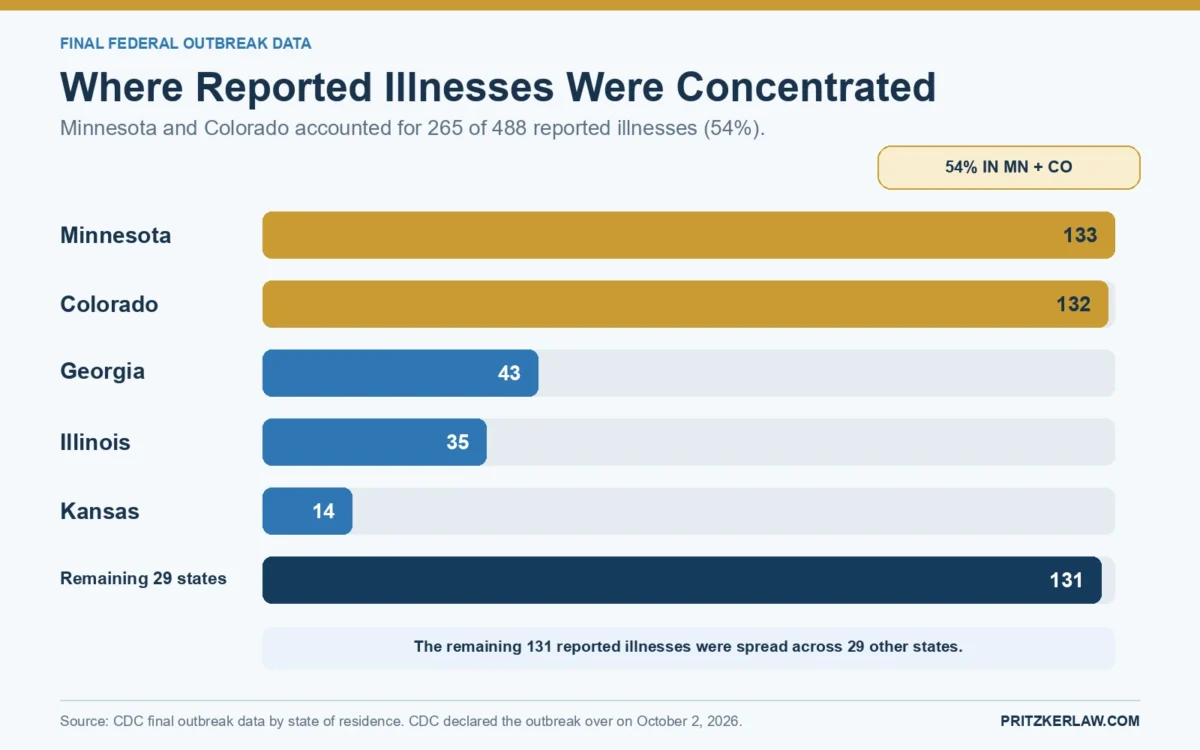
August 20, 2026 update: Minnesota has 129 reported illnesses in the multistate Salmonella Javiana outbreak linked to fresh jalapeños from Sinaloa, Mexico, distributed by Coast Citrus Distributors. Nationwide, CDC reports 431 illnesses in 32 states, including 57 hospitalizations and no deaths, as of August 19, 2026. Minnesota remains the hardest-hit state, followed by Colorado with 118 cases. Investigators identified clusters at Chipotle and QDOBA locations. The chains removed the affected peppers, and officials do not consider either chain a current ongoing risk.
Read our jalapeño Salmonella outbreak report for current case counts, recall details, affected states, and official guidance. If you tested positive after a restaurant meal, use our Chipotle and QDOBA positive-test guide to preserve medical, meal, and public-health evidence.
Our Minneapolis-based Salmonella legal team evaluates serious cases involving hospitalization, invasive infection, lasting complications, disability, and wrongful death. Request a free, confidential consultation or call 1-888-377-8900.
When Should You Contact a Minnesota Salmonella Attorney?
Contact a food safety lawyer promptly if a Salmonella infection has caused serious harm and there may be evidence connecting it to a restaurant, food product, event, or other source. The strongest cases often involve one or more of the following:
- A stool, blood, urine, or other clinical sample tested positive for Salmonella.
- The illness required emergency treatment or hospitalization.
- Salmonella spread to the blood, brain, bones, joints, urine, or another part of the body.
- The infection caused reactive arthritis, prolonged gastrointestinal problems, neurologic injury, or another lasting complication.
- A child, older adult, or person with a weakened immune system became severely ill.
- A family member died from the infection or its complications.
- The Minnesota Department of Health or another health agency contacted the patient about an illness cluster or outbreak.
- Receipts, app orders, shopper-card records, bank statements, photographs, packaging, or witnesses document the suspected exposure.
- Other unrelated people became ill after eating at the same restaurant, attending the same event, or consuming the same product.
We concentrate on serious personal injury and wrongful death cases. A Salmonella lawsuit requires evidence connecting the infection to a legally responsible party, and every claim must be evaluated on its own facts.
Do You Need a Salmonella Lawyer?
What to Do After a Salmonella Diagnosis in Minnesota
1. Get Medical Care and Ask About Laboratory Testing
Get medical help first. Tell the clinician when symptoms began, what symptoms occurred, whether there was blood in the stool or urine, and whether you recently ate at a restaurant, attended an event, traveled, handled animals, or consumed a recalled product.
CDC clinical guidance states that culture is the gold standard for diagnosing Salmonella. If a PCR panel or another culture-independent diagnostic test detects Salmonella, CDC recommends a follow-up culture when possible so an isolate is available for patient care, antimicrobial susceptibility testing, and public health work.
Ask for copies of laboratory results, clinical notes, hospital records, discharge instructions, medication records, and bills. A general diagnosis such as gastroenteritis does not identify the germ that caused the illness.
2. Report Suspected Foodborne Illness to Minnesota Health Officials
Report suspected foodborne illness to the Minnesota Department of Health through its confidential online system, by email, or by calling 1-877-FOOD-ILL (1-877-366-3455). MDH says these reports help identify outbreaks and prevent additional illnesses.
Hotline staff may ask about symptoms and foods eaten during the four days before illness began. Because Salmonella symptoms can begin as late as six days after infection, write down at least seven days of food, restaurant, event, travel, water, and animal exposures before the symptoms started.
Minnesota requires health care practitioners and laboratories to report salmonellosis within one working day. A patient’s food history is still valuable because a laboratory report may not identify the restaurant, product, meal, or other exposure that investigators need to know about.
3. Write Down the Exposure Details
Do not rely on memory alone. Record:
- Every restaurant, grocery store, event, meal-delivery service, and catered meal during the seven days before symptoms began.
- The address or city of each location.
- The date and approximate time of each meal or purchase.
- Menu items, ingredients, brands, package sizes, lot codes, sell-by dates, and loyalty-card information.
- The names of people who ate with you and whether any of them became ill.
- The time symptoms began and how the illness changed day by day.
- Any contact from MDH, a local health department, a restaurant, a retailer, or a food company.
The last food eaten is not necessarily the source. A complete timeline helps investigators and lawyers compare the exposure with Salmonella’s incubation period and with other reported cases.
4. Preserve Purchase, Product, and Medical Records
Keep receipts, order confirmations, delivery records, payment statements, shopper-card histories, photographs, packaging, laboratory reports, medical records, bills, insurance statements, missed-work records, and notes about ongoing symptoms.
If suspected food or packaging remains, do not eat the food or let anyone else eat it. Photograph labels, lot codes, dates, and the condition of the package. Contact MDH or the appropriate local health department before opening, moving, storing, or submitting suspected food for testing. Follow the agency’s instructions so no one is exposed and the item is not accidentally compromised.
For a broader checklist, see the steps our food safety lawyers recommend after food poisoning.
5. Get a Prompt Legal Evaluation
Evidence can disappear even when a filing deadline is months or years away. Restaurants change suppliers, electronic order histories can become harder to retrieve, products are discarded, and witnesses forget details.
An experienced lawyer can evaluate whether the evidence supports a claim, identify potentially responsible businesses, preserve records, and explain which deadlines may apply. Contacting a lawyer does not prove that a restaurant or food company caused the illness, and no responsible lawyer should promise a result before reviewing the facts. Our dedicated food safety legal team can help you get the information you need. You can contact our team online any time, day or night.
How Minnesota Health Officials Connect Salmonella Cases
CDC explains that outbreak investigators use epidemiologic data, traceback data, and food or environmental testing together. One illness after one meal does not, by itself, establish the source.
Laboratory Evidence
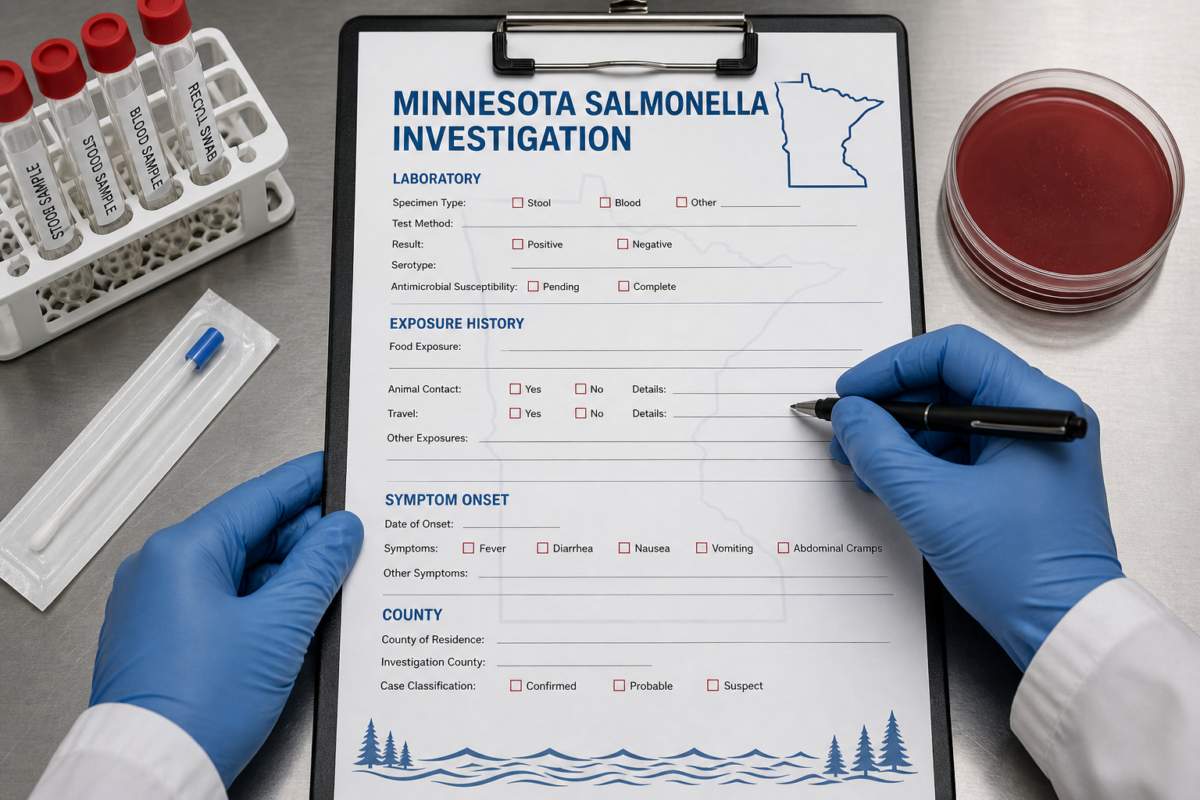
Clinical laboratories identify Salmonella in patient samples. Public health laboratories can use whole genome sequencing to compare the bacteria’s DNA fingerprint with isolates from other patients, food, animals, or an environment.
Whole genome sequencing provides a more detailed fingerprint than the older PFGE method. Closely related isolates can help identify a cluster, but investigators still consider what and where people ate and whether other evidence supports a common source.
Epidemiologic Evidence
Investigators interview patients about food, restaurants, events, travel, water, animal contact, and other exposures. They compare how often people in a cluster reported a particular exposure with what would ordinarily be expected.
An illness cluster can involve two or more unrelated people who ate at the same restaurant, attended the same event, or shopped at the same location before becoming sick. Clusters can help investigators test a hypothesis, but the source is confirmed only after the available evidence supports the connection.
Traceback and Environmental Evidence
Investigators may review restaurant, distributor, processor, retailer, and farm records to find a common ingredient or point in the supply chain. Food and environmental samples can also be tested.
A matching Salmonella strain in food or an environment can be powerful evidence. It is not interpreted in isolation. Investigators also need evidence that sick people consumed the contaminated food or shared the relevant exposure.
Salmonella in Minnesota
The most recent completed MDH annual summary reports 1,172 Minnesota Salmonella cases in 2024. Of those, 986 were culture-confirmed and 186 were positive by a culture-independent diagnostic test without subsequent culture confirmation. MDH reported that 208, or 21 percent, of the culture-confirmed patients were hospitalized. The 2024 highlights state that cases were associated with 26 identified outbreaks.
These statewide numbers do not prove the source of any individual’s infection. They show why testing, reporting, and a complete exposure history matter. A person can be part of an outbreak before the source is identified or before information is released publicly.
Salmonella exposure in Minnesota can involve:
- Food served at a restaurant, cafeteria, school, nursing facility, correctional facility, festival, fair, wedding, or catered event.
- Eggs, poultry, meat, produce, nuts, spices, dairy products, prepared foods, supplements, or other grocery products.
- A contaminated ingredient distributed to multiple restaurants or retailers.
- Cross-contamination during preparation or service.
- Contact with reptiles, backyard poultry, pets, animal food, or animal environments.
- Contaminated water.
The source matters legally because the responsible party may be a restaurant, retailer, distributor, processor, manufacturer, grower, caterer, property operator, or another business. More than one company can be involved.
For the latest case counts, affected states, recall, and restaurant-risk information, read our 2026 jalapeño Salmonella outbreak report. If you tested positive after eating at Chipotle, QDOBA, or another Mexican-style restaurant, follow our medical and evidence-preservation guide.
Contact Eric today and find out how you can get compensation and justice
1-888-377-8900 (Toll-Free) | [email protected]

Can You Sue for Salmonella in Minnesota?
You may have a claim if there is sufficient evidence connecting a diagnosed Salmonella infection to contaminated food, a restaurant, a product, an event, or another legally responsible source. A lawyer must also evaluate the applicable law, the responsible parties, the damages, and the filing deadlines.
Evidence that can support a claim includes:
- A laboratory-confirmed diagnosis and, when available, a related whole genome sequence.
- Meal, purchase, travel, event, or animal-contact timing consistent with the incubation period.
- Receipts, order histories, payment records, shopper-card data, photographs, packaging, or witness statements.
- A public health interview or notice that the patient is part of a cluster.
- Related illnesses among people outside the same household.
- Traceback, supplier, distribution, inspection, recall, food-testing, or environmental-testing records.
- Medical evidence of hospitalization, invasive infection, long-term complications, disability, or death.
An outbreak announcement can strengthen a case, but a public announcement is not always required before a lawyer begins an investigation. Likewise, being part of an outbreak does not automatically guarantee a lawsuit or compensation.
Claims involving restaurant meals are explained in our guide to food poisoning claims against restaurants. Claims involving contaminated retail products are discussed in our grocery store food poisoning guide.
What Compensation May Be Available?
Compensation in a serious Salmonella case may include:
- Past and future medical expenses.
- Lost income and reduced earning capacity.
- Pain, suffering, and loss of normal life.
- Rehabilitation, mobility assistance, or future care.
- Permanent injury or disability.
- Funeral expenses and other wrongful death damages allowed by the applicable law.
The value of a case depends on the quality of the evidence, the severity and duration of the illness, the responsible parties, available insurance or assets, and the law that applies. A diagnosis alone does not determine case value.
Serious foodborne illness cases are usually evaluated as individual claims rather than class actions because each person’s medical course, financial losses, and long-term harm are different.
Why Choose Pritzker Hageman?
Pritzker Hageman is based at 100 University Avenue SE in Minneapolis. Our Salmonella legal team combines food safety litigation experience with an understanding of microbiology, epidemiology, whole genome sequencing, and supply-chain evidence.
Managing Partner Eric Hageman led the trial team that obtained a $6.5 million jury verdict in a Salmonella case involving a child who suffered permanent brain damage. Our proven results include serious foodborne illness, product liability, and wrongful death cases.
Our Minnesota experience includes representing or investigating people affected by restaurant and food-product outbreaks. Examples include the 2015 Minnesota Chipotle Salmonella outbreak, Salmonella illnesses linked to Great Moon Buffet in West Saint Paul, and current Minnesota restaurant investigations such as La Bamba Mexican Taco House in Mankato.
We are a Minnesota firm with a national food safety practice. That allows us to work from our Minneapolis base while following a contaminated ingredient or product across state lines when the evidence requires it.
Frequently Asked Questions
A laboratory-confirmed diagnosis is usually the strongest starting point. Culture is the diagnostic gold standard. If a PCR panel or another culture-independent test detects Salmonella, ask the clinician whether a follow-up culture is appropriate. A lawyer can review an unconfirmed illness, but proving a Salmonella claim is generally more difficult without laboratory evidence.
CDC states that symptoms usually start six hours to six days after infection and usually last four to seven days. Symptoms commonly include diarrhea, fever, and stomach cramps. Nausea, vomiting, headache, and loss of appetite can also occur.
Yes. A provider or laboratory report may not include the detailed food and exposure history that MDH needs. Call 1-877-FOOD-ILL or use the state’s confidential reporting system.
Look for an app order, delivery record, shopper-card history, bank or credit-card statement, email, text, photograph, calendar entry, or phone location history. Write down the location, date, approximate time, and food while the details are still fresh.
No. A lawyer can evaluate a diagnosed illness, preserve records, and monitor public health information before an investigation is public or complete. A claim still requires sufficient evidence connecting the illness to a responsible source.
No. It can be important evidence, but a lawyer still must evaluate causation, responsible parties, damages, deadlines, and applicable law.
The deadline depends on the type of claim, the parties, the jurisdiction, and other facts. Evidence can disappear before the legal deadline. People with serious illnesses should get case-specific advice promptly.
The consultation is free. We do not charge an attorney fee unless we recover compensation for you.

Contact a Minnesota Salmonella Lawyer
If you or a family member has a laboratory-confirmed Salmonella infection involving hospitalization, an invasive infection, lasting complications, disability, or death, contact Pritzker Hageman.
Call 1-888-377-8900, text 612-261-0856, or request a free and confidential consultation. Tell the intake team the test result, the suspected restaurant or product, the exposure date, the symptom-onset date, whether MDH contacted you, and how the illness affected you.
We have obtained 100+ separate verdicts and settlements greater than $1 million:
Our client suffered substantial injuries after ingesting a defective product.
We obtained this settlement on behalf of a family whose children were sickened with E. coli.
We obtained a $12.15 million settlement on behalf of an 8-year old girl who was sickened in an E. coli outbreak.
We represented seven children who suffered intestinal injuries as a result of a defective food product.
We obtained this settlement on behalf of a 13-year old girl who was sickened with E. coli.
We won this verdict for a child with kidney damage from E. coli in contaminated food.
Our attorneys won this landmark verdict in a case against Foster Poultry Farms. Our client was a 5-year-old child who contracted Salmonella Heidelberg and, as a result, suffered brain damage.
We obtained a settlement from a company that sold contaminated food to our clients, causing the death of unborn children.
Our client suffered severe neurologic injuries as a result of Listeria monocytogenes, a food-borne pathogen.
On behalf of a client who was seriously sicked by food contaminated with Listeria monocytogenes.
See more settlements & verdicts.
The Pritzker Hageman law firm and our attorneys have been recognized in:
U.S. News & World Report

Pritzker Hageman has been recognized as one of the best law firms for personal injury litigation by U.S. News & World Report every year the award has been given since 2012.
Super Lawyers®, Thomson Reuters

Attorneys at Pritzker Hageman have been awarded the peer selected Super Lawyers distinction every year since 2004.
America’s Top 100 Attorneys®

Lifetime Achievement selection to America’s Top 100 Attorneys®.
Three Time Attorneys of the Year

Pritzker Hageman lawyers have been named Attorneys Of The Year by Minnesota Lawyer three times.