
Florida health officials are investigating a Listeria outbreak linked to China Buffet at 1245 E. Fowler Avenue in Tampa. The Florida Department of Health public health advisory identifies five people in the outbreak. Four reported eating at the same restaurant between March and June 2026. Environmental samples collected at China Buffet contained the outbreak strain of Listeria monocytogenes, according to the department.
The health department has identified a narrower period for diners who may need medical advice: April 9 through June 28, 2026. Anyone who ate at China Buffet during that period and now has symptoms associated with listeriosis should contact a healthcare provider. Because severe Listeria illness may not begin for weeks, a person can become sick long after the meal itself has faded from memory.
Our Listeria legal team has confirmed outbreak facts, and examined the restaurant’s recent inspection history. We have put together this guide to the medical questions diners may face, and the evidence that may matter in a legal claim. The investigation remains open. No specific buffet item has been publicly identified as the source as of July 12, 2026.
China Buffet Listeria Outbreak at a Glance
- Restaurant: China Buffet, 1245 E. Fowler Ave., Tampa, Florida 33612
- Outbreak count: Five people included in the outbreak
- Restaurant exposure: Four of the five people reported eating at the same restaurant between March and June 2026
- Public-health exposure window: April 9 through June 28, 2026, for diners who develop symptoms and are deciding whether to call a healthcare provider
- Laboratory finding: The outbreak strain of Listeria monocytogenes was found in environmental samples from the restaurant
- Food vehicle: No particular food or menu item has been publicly named
- Agencies: Florida Department of Health and Florida Department of Business and Professional Regulation
- Investigation status: Ongoing as of the state advisory issued July 10, 2026
Do You Need a Listeria Lawyer?
Pritzker Hageman represents people and families in serious Listeria cases nationwide. A consultation is free and confidential. Call 1-888-377-8900, text 612-261-0856, or contact our food safety legal team online. Our lawyers can review the timing of the meal and illness, medical testing, public-health findings, and records that may help document the restaurant visit. There is no fee unless we obtain compensation for you.
What Florida Health Officials Have Confirmed
The July 10 advisory uses unusually direct language for an investigation that is still underway. Florida DOH says epidemiologic information and laboratory evidence confirm that China Buffet is the likely outbreak source. That conclusion rests on more than a cluster of people remembering the same restaurant.
Investigators collected environmental samples during an initial assessment conducted with DBPR. Testing identified the outbreak strain of Listeria monocytogenes in the restaurant environment. DOH and DBPR then conducted multiple onsite assessments and required remediation measures. The agencies said they were continuing to work with the restaurant while the investigation continued.
The advisory does not identify the five patients, provide their counties of residence, describe their outcomes, or state whether all five were hospitalized. It also does not name a contaminated dish, ingredient, distributor, or supplier. Those gaps should remain gaps unless Florida officials release additional information.
What Does It Mean That the Outbreak Strain Was Found at the Restaurant?
A positive environmental sample can be highly informative when its genetic profile matches bacteria recovered from people in an outbreak. Public-health laboratories use whole genome sequencing to compare Listeria isolates in great detail. The CDC explains that whole genome sequencing helps investigators connect illnesses that may otherwise appear unrelated and compare patient isolates with isolates collected from food or the environment.
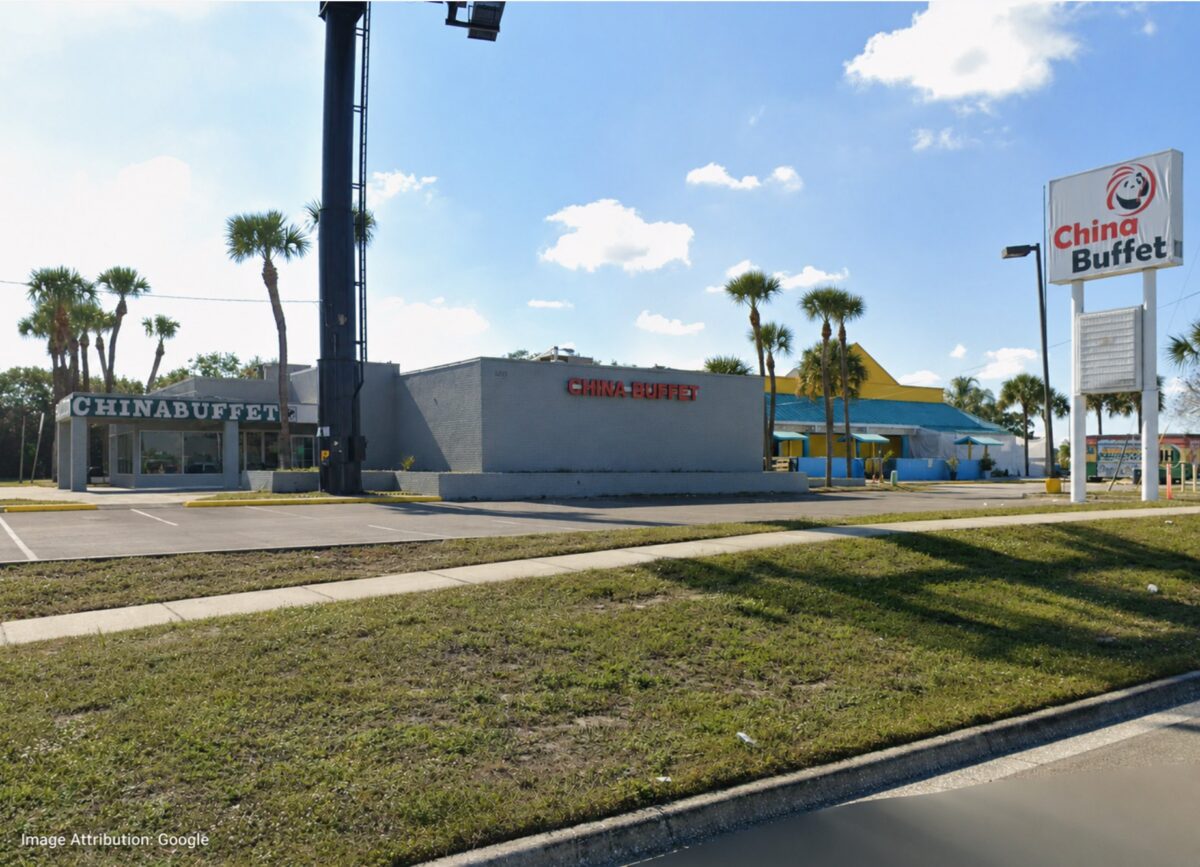
Environmental sampling in a commercial kitchen may include food-contact surfaces and non-food-contact areas such as equipment, floors, and drains. The FDA describes environmental sampling as a tool for detecting pathogens and evaluating whether sanitation controls are working. A genetic match between an environmental isolate and isolates from sick people becomes especially significant when diners’ histories point to the same establishment.
Florida’s advisory does not disclose where inside China Buffet the matching sample was collected. It would be inaccurate to assign the positive result to an ice machine, drain, preparation surface, buffet utensil, or any other location without an official record. The confirmed point is narrower: the outbreak strain was recovered from the restaurant environment.
Has a Specific China Buffet Food Been Identified?
No. Florida officials have linked the outbreak to the restaurant, but they have not publicly identified a particular buffet item, ingredient, or supplier. The absence of a named food does not erase the epidemiologic and laboratory evidence. It does limit what can responsibly be said about how contamination reached a diner’s plate.
Listeria can enter a food-service operation through contaminated ingredients, equipment, employees’ hands, or the facility environment. Unlike many foodborne bacteria, it can survive and grow at refrigeration temperatures. Once established in a damp or difficult-to-clean area, it may persist and move to food through direct contact, utensils, equipment, condensation, splashes, or employee traffic. Those are general pathways described by food-safety authorities, not findings about this restaurant unless Florida investigators say so.
What the 2026 China Buffet Inspection Record Shows
DBPR inspection records provide useful context, but they need careful handling. The agency itself says each inspection is a snapshot of conditions at that moment and may not represent the establishment’s long-term condition. A violation may be corrected during the visit, may require a later callback, or may result in administrative action or closure.
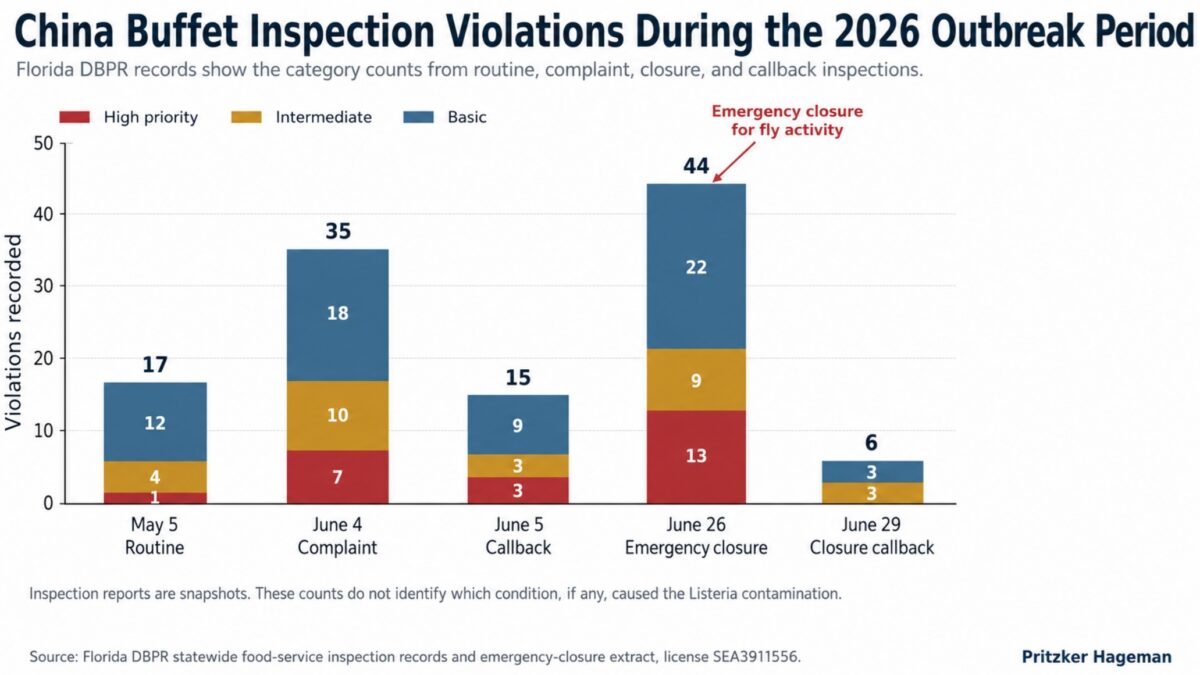
The official June 4, 2026 complaint inspection report lists seven high-priority, 10 intermediate, and 18 basic violations. Among the observations were:
- Time- and temperature-controlled foods held above 41 degrees Fahrenheit, with stop-sale orders for multiple foods.
- Raw animal foods stored above or without proper separation from ready-to-eat foods.
- A dented can subject to a stop-sale order.
- Live small flying insects in dining and kitchen areas and dead flies near a side door.
- Pesticides stored in a dry-food storage area.
- A food-contact cutting board described as soiled and no longer cleanable.
- Handwashing sinks without soap or paper towels, and one handwashing sink used for dishwashing.
- Prepared ready-to-eat foods held more than 24 hours without date marking.
- Expired required food-safety training for all employees.
- Mold-like buildup inside an ice machine, dead roaches near a side door, food stored on the floor, and cabbage prepared without prior washing.
The June 26 state data record is more serious in scale: 44 total violations, including 13 high-priority violations, followed by an emergency closure. The weekly closure extract lists fly activity as the condition for closure. A June 29 callback recorded six remaining violations and an extension of the emergency-order callback period.
These inspection findings should not be presented as proof that any one violation caused the Listeria outbreak. Florida DOH has not publicly identified the contamination route or the exact location of the positive environmental sample. The inspection record does show why investigators and regulators were examining sanitation, pest control, food handling, temperature control, and cleaning practices during the same general period as the outbreak.
Readers can review current and historical data through the DBPR restaurant public-records page. The current restaurant license is listed as SEA3911556.
Issues at This Location Span Multiple Owners
China Buffet at the same Fowler Avenue address appeared in older inspection and news records before the current corporate owner took over. DBPR’s ownership-change data show that China Buffet of Tampa United Inc. received approval for a change of owner on March 17, 2025.
A January 10, 2022 complaint inspection under the prior license record resulted in a temporary closure. A 2015 WTSP report described an earlier series of shutdowns. Those events provide historical context for problems at the location, but are not attributed to the current owner.
China Buffet Outbreak Timeline
| Date | Confirmed development |
| March-June 2026 | Four outbreak patients reported eating food from the same Tampa restaurant during this period. |
| April 9-June 28, 2026 | Florida DOH’s specified exposure window for China Buffet diners who develop symptoms and should contact a healthcare provider. |
| May 5, 2026 | DBPR routine inspection: 17 violations in the state data, including one high-priority, four intermediate, and 12 basic violations. The recorded disposition was “Inspection Completed – No Further Action.” |
| June 4, 2026 | DBPR complaint inspection: 35 violations, including seven high-priority, 10 intermediate, and 18 basic violations. A follow-up inspection was required and a warning was issued. |
| June 5, 2026 | DBPR callback inspection: 15 violations, including three high-priority, three intermediate, and nine basic violations. The state data records “Admin. complaint recommended.” |
| June 26, 2026 | DBPR routine inspection: 44 violations, including 13 high-priority, nine intermediate, and 22 basic violations. State records list an emergency closure recommendation; the weekly emergency-closure file identifies fly activity as the closure condition. |
| June 29, 2026 | DBPR callback: six violations, including three intermediate and three basic violations. State data records an emergency-order callback time extension. |
| July 10, 2026 | Florida DOH issued its public advisory identifying five outbreak patients and reporting that the outbreak strain was found in environmental samples from China Buffet. |
| July 12, 2026 | This article was last researched and updated. The public-health investigation remained ongoing. |
Who Is Most Likely to Develop Severe Listeriosis?
Many people exposed to Listeria never develop severe illness. The risk changes sharply for certain groups. According to the CDC’s Listeria overview, invasive listeriosis primarily affects:
- Pregnant people and their newborns.
- Adults age 65 and older.
- People with weakened immune systems, including some people with cancer, organ transplants, HIV, kidney or liver disease, diabetes, or immune-suppressing treatment.
A healthy younger adult may experience diarrhea, fever, nausea, or vomiting and recover without treatment. Invasive infection can enter the bloodstream or central nervous system and cause sepsis, meningitis, or encephalitis. The CDC currently estimates about 1,250 Listeria infections and 172 deaths in the United States each year.
Listeria Symptoms After Eating at China Buffet
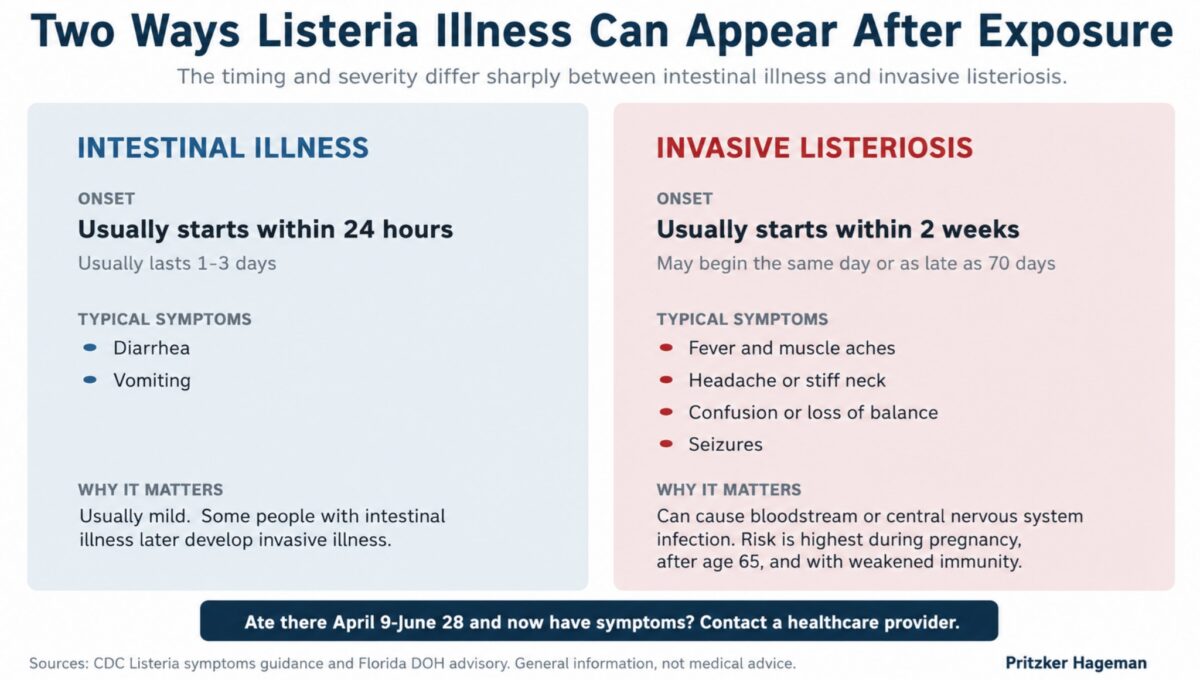
Symptoms depend on whether the infection remains intestinal or becomes invasive. The timing also varies. Florida DOH advises that severe illness usually begins one to four weeks after contaminated food is eaten, but symptoms may begin the same day or as late as 70 days afterward.
Possible intestinal symptoms
- Diarrhea
- Fever
- Nausea or vomiting
- Muscle aches or fatigue
Possible non-intestinal symptoms (“Invasive Listeriosis”)
- Fever and muscle aches
- Headache or stiff neck
- Confusion or altered mental status
- Loss of balance
- Convulsions or seizures
- Symptoms of bloodstream infection or sepsis
More detail is available in our guides to Listeria symptoms and complications and Listeria sepsis.
Listeria During Pregnancy Can Be Mild in the Parent and Severe for the Baby
Pregnancy-associated listeriosis can be difficult to recognize because the pregnant patient may have only fever, fatigue, or muscle aches. The consequences can include miscarriage, stillbirth, premature delivery, or a life-threatening infection in a newborn. A pregnant person who ate at China Buffet during the identified exposure period and develops fever or flu-like symptoms should contact an obstetric clinician promptly and mention the outbreak by name.
Our resources explain Listeria infection during pregnancy, the relationship between listeriosis and miscarriage, and claims involving a baby born with listeriosis.
When Should a China Buffet Diner Call a Healthcare Provider?
Florida DOH specifically advises people to call a healthcare provider if they ate at China Buffet between April 9 and June 28, 2026, and are experiencing symptoms. A caller should give the provider the restaurant’s full name and address, the approximate meal date, the symptoms and when they began, and any pregnancy or immune-system risk factors.
Seek urgent medical care for confusion, severe headache, stiff neck, loss of balance, seizure, difficulty staying awake, signs of sepsis, or rapidly worsening illness. Pregnancy plus fever after a recognized Listeria exposure also deserves prompt medical attention, even when the remaining symptoms seem mild.
People who ate at the restaurant but feel well generally should not assume they need antibiotics or testing. Clinical decisions depend on symptoms, risk status, timing, and medical history. A healthcare professional should make that assessment.
How Is Listeriosis Tested?
Listeriosis is usually diagnosed by culturing Listeria from a normally sterile body site. For a patient with fever and symptoms consistent with invasive illness, the CDC’s clinical guidance calls for blood culture and, when indicated by the clinical presentation, cerebrospinal-fluid testing. Placental, amniotic-fluid, or other pregnancy-related specimens may be tested in appropriate cases.
Routine stool culture is not the standard way to diagnose invasive listeriosis. CDC notes that stool testing has low sensitivity and is not recommended for individual diagnosis, and Listeria blood tests based only on antibodies are also not recommended. The useful test depends on the patient’s illness and should be ordered by the treating clinician.
What China Buffet Customers Should Do Now
- Get medical advice when symptoms or risk factors warrant it. Tell the provider about the Florida-confirmed outbreak and provide the approximate dining date.
- Write down the visit while details are fresh. Record the date, approximate time, dining companions, foods remembered, payment method, and when each symptom began.
- Preserve records that can document the meal. Receipts are useful but not essential. Credit-card statements, bank records, location history, calendar entries, photographs, text messages, loyalty accounts, and statements from dining companions may also help.
- Preserve medical evidence. Keep discharge papers, laboratory results, medication lists, bills, appointment summaries, and the names of providers who treated the illness.
- Report the illness. Contact the Florida Department of Health in Hillsborough County or use the DBPR foodborne-illness complaint form. Public-health investigators may ask for an interview or records.
- Do not discard possible evidence without guidance. If any leftovers, packaging, or labels remain, place them in a secure location away from normal food and contact public-health officials or a food-safety lawyer before throwing them away. Do not eat the food.
- Avoid posting unnecessary medical details publicly. A public social-media post can be copied, misunderstood, or used out of context. Share the information needed by medical providers and investigators, and preserve a private chronology.
- Consider speaking with an experienced Listeria lawyer. Outbreak cases can involve laboratory data, agency records, corporate ownership, suppliers, insurers, and evidence that may be lost with time.
Our article on 10 steps to take after suspected food poisoning provides a broader preservation checklist.
Can I Sue China Buffet for Listeria?
A person who developed listeriosis after eating at China Buffet may have a claim, but inclusion in an outbreak does not automatically determine every legal issue. A case still requires evidence connecting the person’s illness to the restaurant and proof of damages.
The public-health investigation can supply evidence that an individual diner could not obtain alone. Here, Florida officials report a common restaurant exposure, an identified outbreak strain, a matching strain in the restaurant environment, and multiple onsite assessments. A lawyer can compare those findings with the person’s meal date, symptom onset, culture or sequencing results, medical history, and other possible exposures.
A named menu item is helpful when one has been identified, but it is not always required. Restaurant-outbreak cases may be proved through a combination of epidemiology, laboratory evidence, inspection and sanitation records, witness accounts, purchase records, and the absence of a more plausible source. Read more about how a food poisoning lawyer proves a claim and whether you may have a Listeria food poisoning claim.
What Compensation May Be Available?
The recoverable damages depend on the illness and the law that applies. A serious Listeria claim may include compensation for:
- Hospital, physician, rehabilitation, medication, and other medical expenses.
- Future treatment, home care, therapy, or long-term support.
- Lost wages, reduced earning capacity, and household services.
- Pain, disability, cognitive or neurologic injury, and loss of normal life.
- Pregnancy loss, premature birth, neonatal infection, or lifelong injury to a child.
- Funeral expenses and other wrongful-death damages when an infection is fatal.
Pritzker Hageman Handles Listeria Outbreak Cases Nationwide
Listeria litigation is a concentrated part of our food-safety practice. Our lawyers investigate outbreaks, work with epidemiologic and microbiologic evidence, obtain regulatory and corporate records, and pursue claims involving severe illness, pregnancy loss, neonatal infection, brain injury, and wrongful death.
Pritzker Hageman has obtained substantial recoveries in Listeria cases, including cases involving neurologic injury, permanent brain damage, pregnancy loss, and contaminated deli meat. Prior results do not guarantee a similar outcome. They do show the depth of experience needed when a case depends on public-health science as much as conventional witness testimony.
Learn more about our national Listeria practice, our Listeria lawsuit work, and our broader restaurant food poisoning practice.
Contact Eric today and find out how you can get compensation and justice
1-888-377-8900 (Toll-Free) | [email protected]

Frequently Asked Questions About the Tampa China Buffet Listeria Outbreak
Florida DOH reported five people in the outbreak on July 10, 2026. Four said they ate at the same restaurant between March and June 2026. The count may change as the investigation continues.
The restaurant identified by Florida officials is China Buffet at 1245 E. Fowler Ave., Tampa, FL 33612, near the University of South Florida area in Hillsborough County.
The outbreak investigation involves restaurant consumption between March and June 2026. Florida DOH specifically tells people who ate at China Buffet from April 9 through June 28, 2026, to call a healthcare provider if they have symptoms.
Yes. Florida DOH says environmental sampling identified the outbreak strain of Listeria monocytogenes at the restaurant. The advisory does not identify the exact sampling site inside the facility.
No specific food has been publicly identified. Avoid assuming that a particular dish, ingredient, or station was responsible unless health officials release that information.
DBPR records document an emergency closure on June 26 and a callback extension on June 29. The July 10 health advisory does not state the restaurant’s current operating status. Check the current DBPR inspection and licensing record before relying on older reports.
Severe symptoms often begin one to four weeks after exposure, but Florida DOH says onset can occur as early as the same day or as late as 70 days later. Intestinal illness may begin sooner.
People without symptoms generally should not assume testing or antibiotics are needed. Call a healthcare provider for advice if you are pregnant, age 65 or older, immunocompromised, or otherwise concerned. Testing decisions should be individualized.
Invasive listeriosis is commonly diagnosed with a culture from blood or another normally sterile body site. Cerebrospinal fluid may be tested when meningitis is suspected. Routine stool testing is not recommended for diagnosing invasive illness.
No single form of proof is mandatory in every case. A receipt is helpful, but card statements, phone location history, photos, messages, calendar entries, companions, and other records can document a restaurant visit. A claim can also sometimes be established through genetic testing of the strain of Listeria you were infected with.
In many cases, yes. The legal analysis may rely on the confirmed restaurant link, the matching environmental strain, the diner’s exposure date, medical testing, illness timing, and other evidence. A named food item is not the only way to establish causation.
Contact the Florida Department of Health in Hillsborough County and report the restaurant exposure to your healthcare provider. A complaint can also be submitted to DBPR through its foodborne-illness complaint form.
Often times, yes. Pregnancy-loss, neonatal-injury, and wrongful-death claims depend on medical proof, family relationship, applicable state law, and filing deadlines. Prompt legal review helps identify the correct claim and responsible parties.
Deadlines vary by state, claim type, defendant, and the age or status of the injured person. Some notice requirements can be much shorter than an ordinary statute of limitations. Do not wait for the outbreak investigation to end before obtaining advice about a deadline. Florida generally has a 2 year limit on negligence claims but a 4 year limit may apply in some cases. Your specific case may have time requirements that differ. Your legal team will be able to assess the laws that apply to you.
Free Consultation With a Listeria Outbreak Lawyer
Pritzker Hageman represents people with serious foodborne illnesses across the United States. If you or a family member was diagnosed with listeriosis after eating at China Buffet in Tampa, call 1-888-377-8900, text 612-261-0856, or send us a confidential message. The consultation is free. We charge no attorney fee unless we recover compensation.
Official Sources and Continuing Updates
- Florida Department of Health in Hillsborough County: July 10, 2026 Listeria advisory
- Florida DBPR: June 4, 2026 China Buffet inspection report
- Florida DBPR restaurant public records and emergency closures
- CDC: About Listeria infection
- CDC: Listeria signs and symptoms
- CDC: Caring for patients with listeriosis
- CDC: Whole genome sequencing and Listeria surveillance
- FDA: Environmental sampling in food facilities
We have obtained 100+ separate verdicts and settlements greater than $1 million:
Our client suffered substantial injuries after ingesting a defective product.
We obtained this settlement on behalf of a family whose children were sickened with E. coli.
We obtained a $12.15 million settlement on behalf of an 8-year old girl who was sickened in an E. coli outbreak.
We represented seven children who suffered intestinal injuries as a result of a defective food product.
We obtained this settlement on behalf of a 13-year old girl who was sickened with E. coli.
We won this verdict for a child with kidney damage from E. coli in contaminated food.
Our attorneys won this landmark verdict in a case against Foster Poultry Farms. Our client was a 5-year-old child who contracted Salmonella Heidelberg and, as a result, suffered brain damage.
We obtained a settlement from a company that sold contaminated food to our clients, causing the death of unborn children.
Our client suffered severe neurologic injuries as a result of Listeria monocytogenes, a food-borne pathogen.
On behalf of a client who was seriously sicked by food contaminated with Listeria monocytogenes.
See more settlements & verdicts.
The Pritzker Hageman law firm and our attorneys have been recognized in:
U.S. News & World Report

Pritzker Hageman has been recognized as one of the best law firms for personal injury litigation by U.S. News & World Report every year the award has been given since 2012.
Super Lawyers®, Thomson Reuters

Attorneys at Pritzker Hageman have been awarded the peer selected Super Lawyers distinction every year since 2004.
America’s Top 100 Attorneys®

Lifetime Achievement selection to America’s Top 100 Attorneys®.
Three Time Attorneys of the Year

Pritzker Hageman lawyers have been named Attorneys Of The Year by Minnesota Lawyer three times.