
Update: August 6, 2026. First reported on August 4th by Minnesota health officials, a multistate Salmonella Javiana outbreak linked to fresh jalapeño peppers has sickened 345 people in 27 states, according to the CDC outbreak advisory. Thirty-six people have been hospitalized, and no deaths have been reported. Illnesses began from June 19 through July 20, 2026. Because many people are not tested and recent cases can take weeks to identify, the actual number of illnesses is likely higher.
The FDA says the peppers were grown in Sinaloa, Mexico, and distributed nationwide by Coast Citrus Distributors to wholesalers, restaurants, and food-service companies. Coast Citrus agreed to recall the remaining implicated product. Among 191 people interviewed, 177—93%—reported eating at a Mexican-style restaurant before becoming ill. Investigators identified 27 illness clusters at Chipotle Mexican Grill and QDOBA locations in seven states.
Chipotle changed the jalapeño supplier at affected restaurants beginning July 20, and QDOBA stopped serving jalapeños on July 28. The FDA outbreak investigation says the affected product is no longer being served at either chain and does not consider Chipotle or QDOBA a current ongoing risk in this outbreak. The broader investigation and recall remain ongoing.
Pritzker Hageman filed a federal lawsuit for a Minnesotan sickened in the 2015 Minnesota Chipotle Salmonella outbreak and represented other affected people. Our trial team also obtained a $6.5 million jury verdict in a landmark Salmonella case involving a child who suffered permanent brain damage. Our Minneapolis-based Salmonella lawyers evaluate serious cases involving hospitalization, invasive infection, lasting complications, disability, and wrongful death.
If you developed diarrhea, fever, or stomach cramps after eating at Chipotle, QDOBA, or another Mexican-style restaurant, get medical care and ask whether Salmonella testing is appropriate. Then use our step-by-step guide for people who test positive after a restaurant meal. Pritzker Hageman’s national Salmonella legal team evaluates serious cases involving hospitalization, invasive infection, lasting complications, disability, and wrongful death. Call 1-888-377-8900, text 612-261-0856, or request a free, confidential consultation. There is no attorney fee unless we recover compensation for you.
2026 Jalapeño Salmonella Outbreak: At a Glance
- Cases: 345
- States: 27
- Hospitalizations: 36 of 291 people with information available, or 12%
- Deaths: None reported
- Pathogen: Salmonella Javiana
- Illness-onset dates: June 19 through July 20, 2026
- Restaurant meal dates: June 14 through July 14, 2026
- Restaurant exposure: 177 of 191 interviewed people, or 93%, ate at a Mexican-style restaurant
- Restaurant clusters: 27 clusters at Chipotle and QDOBA locations in seven states
- Linked food: Fresh jalapeño peppers grown in Sinaloa, Mexico, and distributed by Coast Citrus Distributors
- Recall: Coast Citrus agreed to recall remaining implicated product
- Current chain risk: CDC and FDA do not consider Chipotle or QDOBA a current ongoing risk after the affected peppers were removed
- Investigation status: Ongoing; full distribution and additional cases remain under review
Do You Need a Salmonella Lawyer?
What Caused the 2026 Salmonella Javiana Outbreak?
Epidemiologic and traceback evidence links this outbreak to fresh jalapeño peppers grown in Sinaloa, Mexico, and distributed by Coast Citrus Distributors. The FDA traced restaurant exposures to a common jalapeño grower in Sinaloa that supplied Coast Citrus. The distributor agreed to recall remaining product implicated by the investigation.
Whole genome sequencing showed that Salmonella bacteria from sick people were closely related genetically, which supports a common source. A genetic match helps define the outbreak, but the restaurant histories and supply-chain traceback were also necessary to identify the peppers. Learn how whole genome sequencing and other outbreak evidence can support a Salmonella claim.
How Are Chipotle and QDOBA Connected to the Outbreak?
Of 191 people interviewed, 177—93%—ate at a Mexican-style restaurant before becoming ill. Their reported meal dates ranged from June 14 through July 14. Public-health investigators identified 27 illness clusters at Chipotle and QDOBA locations in seven states. Both chains received jalapeños imported by Coast Citrus from Sinaloa.
Chipotle began switching the jalapeño supplier at affected stores on July 20. QDOBA stopped using jalapeños on July 28, and its restaurants are no longer serving jalapeños. CDC and FDA say the actions removed the affected product and that neither chain presents a current ongoing risk in this outbreak. That current-risk statement does not erase earlier exposures or prevent a person who ate there during the exposure period from becoming part of the outbreak after laboratory and public-health review.
Which States Have Salmonella Cases?
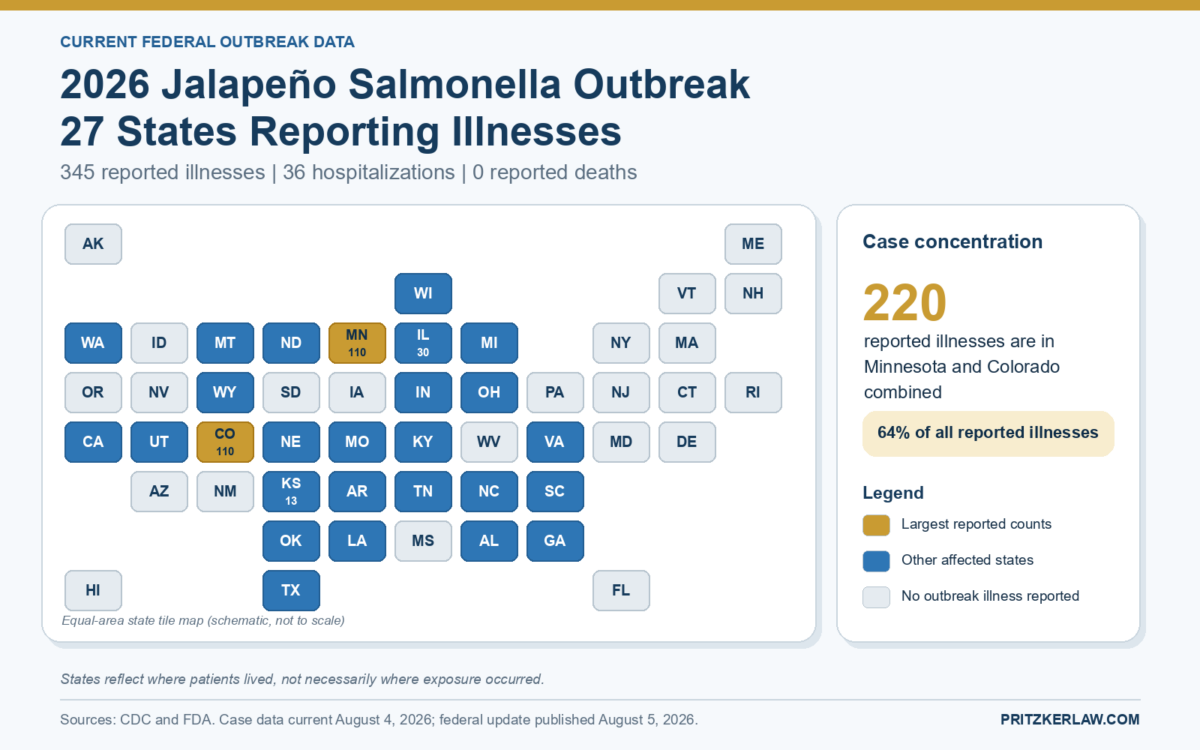
The CDC case map and FDA outbreak advisory report illnesses in 27 states: Alabama, Arkansas, California, Colorado, Georgia, Illinois, Indiana, Kansas, Kentucky, Louisiana, Michigan, Minnesota, Missouri, Montana, North Carolina, North Dakota, Nebraska, Ohio, Oklahoma, South Carolina, Tennessee, Texas, Utah, Virginia, Washington, Wisconsin, and Wyoming. Minnesota and Colorado have the largest known counts, with 110 reported illnesses in each state.
The map shows where people lived, not necessarily where they ate. CDC also warns that the outbreak may extend beyond the states with known illnesses because many people recover without being tested. Recent cases can take three to four weeks to be linked to an outbreak.
Which Jalapeños Were Recalled, and Is There Still a Risk?
Coast Citrus Distributors agreed to recall remaining fresh jalapeños from Sinaloa, Mexico, implicated in the outbreak. The peppers were distributed primarily to restaurants, wholesalers, distributors, and food-service companies nationwide. FDA said Coast Citrus did not appear to supply grocery stores directly, but the agency was still determining the full distribution. Check the FDA advisory for the latest product and distribution information and our Salmonella recall guide.
Do not eat recalled jalapeños. A restaurant, distributor, or food-service business that has affected peppers should not sell or serve them and should clean and sanitize surfaces or containers they touched. If the source cannot be determined, the business should work with its supplier and discard peppers identified as Coast Citrus product from Sinaloa.
Salmonella Symptoms and When to Seek Medical Care
Salmonella symptoms commonly include diarrhea, fever, and stomach cramps. Symptoms usually begin 6 hours to 6 days after infection. Most people recover without specific treatment, but the illness can become severe or spread beyond the intestines.
Contact a medical professional promptly if you have bloody diarrhea, a fever higher than 102 degrees, repeated vomiting that prevents you from keeping liquids down, signs of dehydration, or diarrhea lasting more than three days. Young children, adults 65 and older, pregnant people, and people with weakened immune systems face a higher risk of severe illness.
Some patients develop lasting complications, including reactive arthritis, irritable bowel symptoms, or an invasive infection affecting the bloodstream or other parts of the body.
Testing Can Help Connect an Illness to the Outbreak
The gold standard for diagnosing Salmonella infection is a culture, such as a stool culture, according to the CDC’s clinical guidance. PCR panels can detect Salmonella genetic material, but health officials may need a culture isolate for whole genome sequencing and outbreak matching.
Ask your medical provider what testing is appropriate based on your symptoms and timing. Do not delay or change prescribed treatment in an effort to obtain a sample. Medical decisions should be made with your treating provider.
Save a copy of your test results and medical records. Your meal date, restaurant location, receipt, order history, and communications with the health department may provide additional evidence about how and where you became sick.
What Should You Do If You Ate at Chipotle, QDOBA, or Another Mexican-Style Restaurant?
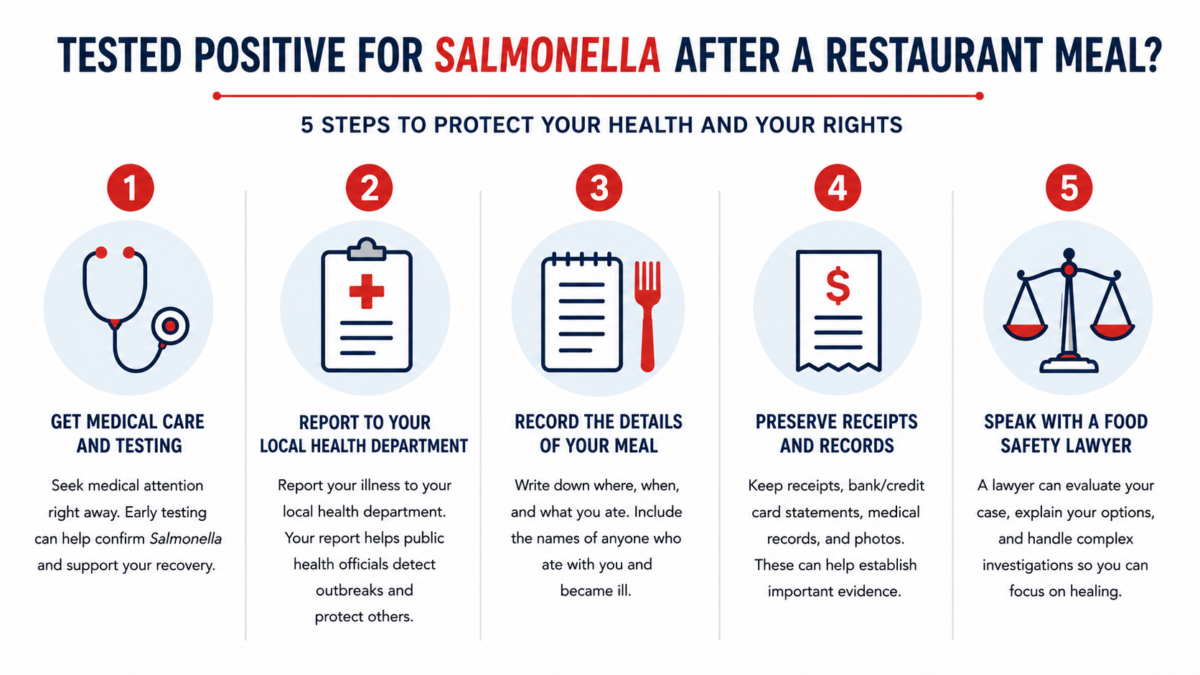
- Get medical care and ask about testing. Tell the provider when and where you ate and when symptoms began. Salmonella symptoms usually begin six hours to six days after exposure. Seek prompt care for bloody diarrhea, diarrhea with fever above 102°F, symptoms lasting more than three days without improvement, vomiting that prevents you from keeping liquids down, or signs of dehydration. Read our Salmonella symptoms and complications guide.
- Report the illness. Contact your state or local health department. Minnesota diners can use the Minnesota Department of Health foodborne-illness reporting page. A public-health interview can connect your illness to other cases even when the exact ingredient was not obvious at the time you ate.
- Save medical evidence. Keep the laboratory report, discharge papers, visit summaries, medication list, bills, photographs, and messages from public-health officials. Write down symptom dates and how the illness affected work, school, caregiving, and daily life.
- Save restaurant and purchase evidence. Preserve receipts, order-confirmation emails, Chipotle or QDOBA app history, loyalty-account records, bank or card statements, delivery-service records, restaurant address, meal date and time, menu selections, and the names of anyone who ate with you. A missing paper receipt does not end a case.
- Handle leftovers carefully. Do not eat suspected food. Keep it sealed and separated from other food, and do not send it to a private laboratory or discard it before asking the health department or your lawyer how it should be preserved.
- Get legal advice before evidence disappears. A lawyer can evaluate laboratory, epidemiologic, restaurant, and supply-chain evidence; preserve records; and identify potentially responsible companies. Read what evidence matters in a Salmonella lawsuit and our positive-test action guide.
Can I Sue After a Salmonella Diagnosis?
A person diagnosed with Salmonella may have a legal claim if sufficient information connects the illness to contaminated food, a restaurant, or another business in the food supply chain. A public outbreak announcement can be important, but whether someone has a claim depends on the facts of the individual case.
Important information may include:
- A positive Salmonella test
- The timing of the meal, symptoms, and diagnosis
- Receipts, order history, payment records, or other proof of the meal
- Communications with the Minnesota Department of Health
- Findings that connect the infection to the outbreak
- Records showing where a suspected ingredient came from and where it was distributed
- Medical records documenting hospitalization, invasive infection, lasting complications, disability, or death
A Salmonella claim may seek compensation for medical expenses, lost income, pain and suffering, future care, and other losses allowed by law. The value of a case depends on the strength of the outbreak link, the severity and duration of the illness, medical expenses, lost income, lasting complications, disability, and other legally recoverable losses.
Now that a distributor has been identified and a recall issued, more than one business may be answerable. The importer and distributor, the grower whose product FDA traced, and the restaurants that served the ingredient can each carry their own responsibility. Which of them matters in a particular case depends on where the person ate or shopped and what the records show.
Contact Eric today and find out how you can get compensation and justice
1-888-377-8900 (Toll-Free) | [email protected]

Pritzker Hageman’s Chipotle Salmonella Experience
Pritzker Hageman is a national food safety law firm. The firm represented Minnesotans in the 2015 Minnesota Chipotle Salmonella outbreak, which was a separate Salmonella Newport outbreak linked to contaminated tomatoes. That outbreak ultimately included 64 illnesses associated with 22 Minnesota Chipotle locations and nine hospitalizations.
The firm’s Salmonella litigation team, led by Managing Partner Eric Hageman, also obtained a $6.5 million Salmonella verdict for a child who suffered permanent brain damage after a severe Salmonella infection.
Our lawyers investigate laboratory findings, patient histories, restaurant records, supplier relationships, and federal traceback evidence to identify the companies responsible for contaminated food.
Frequently Asked Questions
Jalapenos are a suspected vehicle and a potential common ingredient identified through Chipotle’s traceability review. FDA still lists the product as not yet identified, and the traceback includes other produce.
No. Minnesota officials say people also became ill after eating at other Mexican-style restaurants. Those restaurants have not been publicly named. Report any relevant restaurant meal and positive Salmonella result to MDH.
No. The official count reflects illnesses detected and reported through public health surveillance. A legal review focuses on your laboratory results, exposure evidence, medical course, and whether the available investigation evidence connects your illness to the contaminated food.
Talk with your medical provider about whether testing is still appropriate. A claim without a positive test is harder because symptoms alone cannot identify Salmonella or distinguish it from other infections.
No FDA recall is listed for this investigation as of August 4, 2026. Chipotle removed a suspected jalapeno lot from its Minnesota restaurants and other locations that received the product. That precautionary removal is not the same as a public consumer recall.
Serious foodborne illness injury claims are generally evaluated individually because each patient’s medical course, losses, complications, and evidence are different. Consumer refund issues may be treated differently, but they are not the same as a personal injury claim.
The value depends on the severity of the illness, length of hospitalization, invasive infection, permanent complications, medical expenses, lost income, and future care.
Deadlines for filing a claim vary by state and by the type of claim involved. Important records can also be lost before a legal deadline expires, so people with serious illnesses should seek legal advice promptly.
No. CDC and FDA describe the investigation as ongoing. They do not consider Chipotle or QDOBA a current ongoing risk because the chains removed the affected peppers, but FDA is still determining the complete distribution of the recalled jalapeños and CDC warns that additional illnesses may not yet be reported.
A positive Salmonella test, illness timing, restaurant history, food history, public-health interview, and bacterial sequencing can all matter. CDC reports illness onsets from June 19 through July 20 and restaurant meal dates from June 14 through July 14, but investigators—not a website—determine whether a person belongs to the outbreak. Learn more in our Salmonella outbreak lawsuit FAQ.
Possibly. Restaurant records, ingredient lists, supplier records, illness clusters, public-health interviews, and whole genome sequencing can supply evidence that a diner could not know at the time of the meal. Do not guess about ingredients. Record exactly what you ordered and preserve the date, location, app history, receipt, and health-department communications.
FDA says Coast Citrus primarily distributed the peppers to wholesalers, restaurants, and food-service companies and did not appear to supply grocery stores directly. The agency was still determining full distribution. Check the current FDA jalapeño advisory and ask the place of purchase to confirm the supplier. Do not eat recalled peppers.
Contact an experienced lawyer promptly if you tested positive after a relevant restaurant meal and were hospitalized, developed bacteremia, sepsis, colitis, meningitis, reactive arthritis, another lasting complication, or a disabling loss of income. Families should also seek prompt advice after a death potentially connected to Salmonella. The Pritzker Hageman Salmonella legal team can evaluate the evidence and applicable filing deadline.
Contact Pritzker Hageman About a Serious Salmonella Illness
Pritzker Hageman represented people sickened in the 2015 Minnesota Chipotle outbreak and filed a federal Salmonella lawsuit for a Minnesota client. Our trial lawyers also obtained a $6.5 million jury verdict for a child who suffered permanent brain damage from Salmonella.
Lead trial lawyer Eric Hageman and our national Salmonella legal team evaluate serious outbreak cases nationwide. The team can preserve evidence, work with medical and public-health records, analyze restaurant and distribution links, and identify the companies that may be legally responsible.
If you or a family member was hospitalized, developed an invasive infection or lasting complications, or died after a Salmonella infection connected to this outbreak, call 1-888-377-8900, text 612-261-0856, or request a free consultation. There is no fee unless we recover compensation for you.
We have obtained 100+ separate verdicts and settlements greater than $1 million:
Our client suffered substantial injuries after ingesting a defective product.
We obtained this settlement on behalf of a family whose children were sickened with E. coli.
We obtained a $12.15 million settlement on behalf of an 8-year old girl who was sickened in an E. coli outbreak.
We represented seven children who suffered intestinal injuries as a result of a defective food product.
We obtained this settlement on behalf of a 13-year old girl who was sickened with E. coli.
We won this verdict for a child with kidney damage from E. coli in contaminated food.
Our attorneys won this landmark verdict in a case against Foster Poultry Farms. Our client was a 5-year-old child who contracted Salmonella Heidelberg and, as a result, suffered brain damage.
We obtained a settlement from a company that sold contaminated food to our clients, causing the death of unborn children.
Our client suffered severe neurologic injuries as a result of Listeria monocytogenes, a food-borne pathogen.
On behalf of a client who was seriously sicked by food contaminated with Listeria monocytogenes.
See more settlements & verdicts.
The Pritzker Hageman law firm and our attorneys have been recognized in:
U.S. News & World Report

Pritzker Hageman has been recognized as one of the best law firms for personal injury litigation by U.S. News & World Report every year the award has been given since 2012.
Super Lawyers®, Thomson Reuters

Attorneys at Pritzker Hageman have been awarded the peer selected Super Lawyers distinction every year since 2004.
America’s Top 100 Attorneys®
Lifetime Achievement selection to America’s Top 100 Attorneys®.
Three Time Attorneys of the Year
Pritzker Hageman lawyers have been named Attorneys Of The Year by Minnesota Lawyer three times.