Home » Legal News » Accidents » Most Dangerous Trucking Companies in America: A Crisis of Accountability
Most Dangerous Trucking Companies in America: A Crisis of Accountability
Trucking safety failures persist on U.S. highways as severe crashes take a rising toll. While the trucking industry is the lifeblood of the American economy, the human cost of moving $700 billion in freight annually is spiraling. Truck crash lawsuits resulting in verdicts or settlements over $1 million are growing, reflecting a backdrop of repeated safety failures across the spectrum of operators, including “mega” carriers like Amazon, UPS and FedEx.
Accomplished semi-truck accident lawyer Eric Hageman of the Pritzker Hageman Law Office represents survivors victims of trucking accidents. Too often, he said, trucking companies treat safety as an after-thought.
“Anyone who uses our public roadways is at risk,’’ Hageman said. “There’s so much havoc out there and enforcement is lax.’’
Eric has spoken at legal seminars locally and nationally on topics including trucking accidents, wrongful death and traumatic brain injury and has chaired the Minnesota Association for Justice Wrongful Death seminar four times. He has litigated multiple truck accidents, discovering first-hand how drivers and carriers alike violate safety laws. Even amid all the new truck accident claims, the industry puts an unceasing emphasis on speed and more shipments.
There’s been an incentive to not follow the rules in the trucking industry. Getting goods from point A to point B has been the priority. We’ve relied on trusting people in the industry to follow the rules when many times they are not. – Attorney Eric Hageman
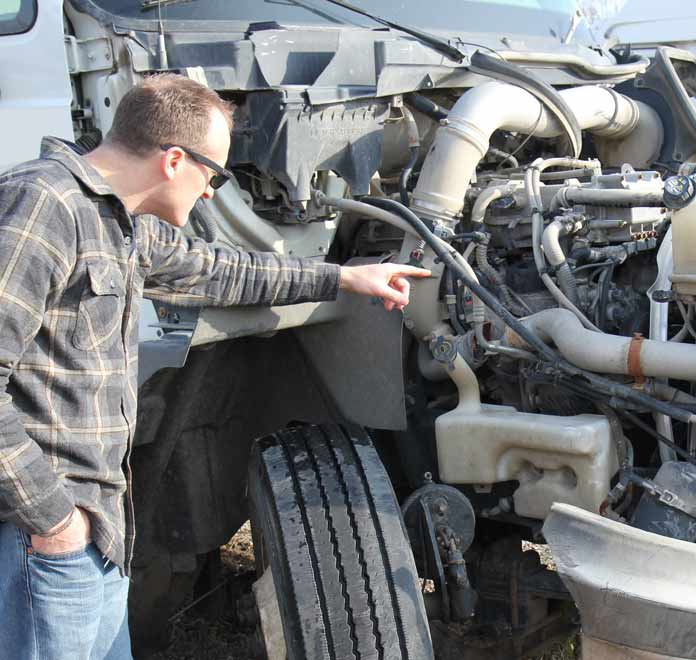
Attorney Eric Hageman investigating a semi-truck involved in a serious accident.
The “Mega” Carriers: High Volume, High Risk
The Federal Motor Carrier Safety Administration (FMCSA) identifies the most dangerous companies by analyzing both the total volume and the relative frequency of crashes. Industry trucking giants like FedEx, UPS, and Amazon consistently stand out due to the sheer scale of truck crashes related to their delivery operations. Together they log millions and millions of road miles a year in semi-trucks, box trucks and vans.
As of early 2026, federal data reveals staggering figures – regardless of fault – for a two-year period:
FedEx: Three FedEx ground operations, combined, were involved in crashes that killed 186 people and injured 1,974. Tow trucks were required to deal with wreckage at more than 3,800 crash sites. The total number of crashes in the two year period was around 6,000. FedEx trucks come under inspection roughly 45,000 to 50,000 times every two years across all divisions. In the recent 24-month period reviewed for this article, safety inspectors cited about 14,500 violations. One of the nation’s largest-ever truck accident lawsuits involved FedEx.
UPS: Involved in crashes that killed 52 people and injured 818. Tow trucks were required to help clean up the wreckage at more than 1,400 crashes. UPS trucks came under inspection almost 20,000 times in the two-year period. Drivers were cited for about 1,850 unsafe driving violations. Another 3,400 violations were cited for vehicle maintenance violations.
Amazon: Amazon truck accident data is difficult to pinpoint, but a CBS News analysis of six years of federal data (FMCSA) found that Amazon’s trucking contractors had unsafe driving rates (such as speeding and texting) that were much higher than other carriers in every single month analyzed. The investigation aired in December 2024. It revealed that in a recent two-year period, at least 57 people died in more than four dozen crashes involving federally regulated carriers shipping for Amazon. The company disputed the news team’s methodology and said they operate with safety standards stricter than federal requirements.
Truck Accident Lawsuits Involving Mega Carriers
When a catastrophic crash involves large delivery networks such as FedEx, UPS, and Amazon, the legal battle that follows often focuses on what risks were visible before the collision and whether they were addressed. In lawsuits grounded in crash reports, inspection records, internal logs, and sworn testimony, plaintiffs frequently argue that the harm was connected to preventable breakdowns in oversight or safety practices. In the most severe cases, publicly reported outcomes can climb into the tens of millions, reflecting long-term medical care, lost income, and ongoing support needs after death or permanent injury.
Patterns that may arise in litigation involving mega carriers include:
Driver screening and supervision: hiring criteria, training, discipline, and whether warning signs were documented and addressed.
Safety policy enforcement: how companies monitor compliance, and whether standards are applied consistently across routes, terminals, and contractors.
Maintenance and inspections: the condition of brakes, tires, lights, and other safety-critical systems, and what inspection histories reveal.
Evidence of risky driving: allegations such as speeding, phone distraction, or fatigue, sometimes supported by telematics, citations, video, or witness accounts.
Contractor control and accountability: disputes over the degree of direction or control a company exercised over third-party delivery operations and how that may affect liability after a crash.
Trucking Crashes and the Data Gap: Mid-Sized vs. Large Haulers
Beyond the mega carriers with household names, federal regulators monitor two primary tiers of trucking: large haulers (500+ drivers) and mid-sized haulers (250–500 drivers). Recent data analysis shows a troubling trend: mid-sized carriers are often far more dangerous on a per-driver basis than their larger counterparts. While the raw data doesn’t indicate who was at fault in the crashes, it’s true overall that occupants of passenger vehicles account for 70% to 76% of truck crash deaths. In the United States, a standard fully loaded 18-wheeler can weigh up to 80,000 pounds (40 tons). That’s a factor making large trucks endlessly dangerous to everyday motorists, especially when companies neglect equipment protocols or hire under-trained, unsafe drivers.
In a November 2025 industry ranking of trucking companies in the large category, the following companies were listed as most dangerous on the basis of crashes year-to-date per number of drivers. For the large haulers (see below), the rates were generally in the range of 5 to 6 percent. Regardless of fault, a total of 10 people died within the year as a result of these crashes.
The same data analysis, using the same crash rate metric, showed that midsize carriers are far more likely to be in a crash than their larger counterparts. In the same one-year period as analyzed for the larger trucking companies, five people died in a total of 264 truck crashes. In the listing below, AD Express Trucking leads the pack with a crash rate of 11.87%. AD Express provides long-haul interstate freight handling out of its base in Pennsylvania. Here’s the ranking based on November 2025 year-to-date federal data published by FreightWaves.
Top 10 Mid-Sized Carriers by Crash Rate (Nov 2025):
Unsafe Trucking Companies Uncovered During Roadside Inspections
The perils tied to trucking are exposed day in and day out by roadside inspectors who force vehicles and drivers off the road for a wide range of violations. This past year, nearly one in five roadside inspections—19.98%—resulted in an “Out-of-Service” order, according to data from FMCSA’s Safety Measurement System. A violation of this kind triggers an immediate, on-the-spot mandate to stop operating. It functions as a legal “timeout” that sidelines either the driver, the vehicle, or both until the specific safety hazard is corrected. While the total number of inspections increased by only 5.6% from 2021 to 2025, the number of out-of-service violations jumped by 12.1%.
Most recently, a three-day enforcement crackdown on major freight corridors in 26 states resulted in nearly 2,000 unqualified truckers and vehicles being removed from American roads. During the joint state-and-federal effort from Jan. 13-15, officials carried out 8,215 inspections that put 704 drivers out of service for safety violations. The operation also placed 1,231 unsafe trucks out of service.
Vehicle Violations: Maintenance and equipment issues account for 59.6% of all recorded violations. When truck inspectors from agencies like the Commercial Vehicle Safety Alliance (CVSA) or state transportation departments conduct roadside inspections, they look for mechanical defects that could compromise road safety. Based on 2024 and 2025 inspection data, what follows is a rundown of the most common equipment violations found on large trucks, starting with brakes.
Dangerously unsafe brakes are the most frequent cause for a vehicle to be placed out-of-service. If 20% or more of a vehicle’s service brakes are defective the truck is immediately sidelined. Inspectors routinely find air leaks from hoses, thin brake linings, cracked drums and rotors and other worn components.
Tires are the second most common violation, starting with insufficient tread. Equipment violations also apply to under-inflated tires and tires with deep cuts or exposed nylon cords. Also problematic are wheels with cracked rims, missing lug nuts or leaking hub oil seals.
Lighting failures also contribute to truck crashes, including inoperative headlights, tail lights and brake lights. Broken turn signals, especially on the rear of the trailer, are frequently cited.
Loose cargo on a truck bed is another threat to motorists. Inspectors check to ensure loads won’t shift or fall during transit. Load failures and flying debris have proven deadly to drivers in trailing vehicles.
Attorney Eric Hageman represented the family of a Minnesota man killed by a heavy object that fell from a moving garbage truck and crashed through the man’s windshield. The Pritzker-Hageman truck lawsuit team investigated the incident and won a multi-million settlement for the man’s family. The lawyers found that the object that fell from the truck was fastened with the wrong nut.
Roadside truck inspectors work to prevent similar deaths by issuing citations for the following violations:
Loose Tie-downs:
Straps or chains that aren’t tight enough.
Damaged Equipment: Straps with cuts or tears, or chains with cracked links.
Insufficient Tie-downs: Not using enough straps for the weight or length of the cargo.
Coupling Devices: Issues with the fifth wheel coupler.
Fuel and Exhaust Systems: Leaking fuel tanks or exhaust leaks that could seep into the cab.
Cracked or missing leaf springs and loose U-bolts in the suspension.
Missing or discharged fire extinguishers or failing to carry three reflective triangles.
Driver violations: While driver-related issues make up only 21% of violations, they carry a much higher risk of an immediate shutdown. Of all roadside inspections that cite at least one driver violation, the out-of-service rate is 25.6%. The reason? Truck drivers in violation of safety laws pose a more significant threat to public safety. The threats range from speeding, driving while over-tired, lack of training because of fraudulent licensing schools, under-reporting service hours, hiding dangerous medical conditions and illicit drug use.
As a truck accident lawyer representing crash survivors, Hageman said the dangerous behaviors are induced by a shortage of well-trained drivers and intense pressure to keep up with delivery demands.
“One of the biggest things that I’ve seen is over-tired operators… drivers falling asleep at the wheel,’’ Hageman said.
Here’s a snapshot of driving problems from 2025 federal data.
Operating without a valid CDL: Inspectors cited 60,600 such violations, nearly all warranting out-of-service enforcement.
Driver fatigue: Failing to maintain honest and proper drive-time logs resulted in 37,421 violations and a 93% out-of-service rate.
Medical certificate violations: These accounted for 68,643 citations, with some specific types of medical non-compliance.
Bogus training: Even the U.S. Transportation Department admits to a clear safety gap from unfit driving schools ushering in new drivers with minimal preparation. A 2025 DOT audit found 44 percent of driver training programs across the country are not meeting safety standards. So-called CDL mills fast-track unprepared candidates by abusing a 2022 rule allowing schools to “self-certify’’ that they meet federal requirements. In one horrific case, three people in a minivan died when a poorly trained driver made an illegal U-turn on Florida’s Turnpike.
Drugs: In the year that ended in June 2025, some 25,000 licensed truck drivers were caught driving under the influence of drugs. Marijuana violations dominated the statistics, followed by cocaine, meth and amphetamine taken without a medical prescription. Trucking companies are obligated to check a federal clearinghouse at least once a year for evidence of any drug or alcohol violations by each of their drivers. The system is far from foolproof.
Truck Crash Lawsuits Holding Carriers Responsible
For families impacted by preventable truck crash tragedies, the legal system is the proven path to accountability. Data from the American Transportation Research Institute (ATRI) shows that verdicts over $1 million against motor carriers rose sharply over the last decade. Average awards in large truck crash cases grew from a few million dollars to well over $20 million in some years, the report said. Fatal crashes and major injuries like traumatic brain injuries strongly correlate with larger commercial truck accident settlements.
The report analyzed tractor-trailer tort cases from 2014 through 2023. The number of cases rose 33 percent in that 10-year period, or at an average annual rate of 3.7%, ATRI found. Four types of negligence led to significantly higher awards:
Substance Abuse.
Improper Hiring/Poor Training.
Gross Negligence.
Speeding.
UPS, FedEx, Amazon crashes persist despite calls to end dangers
The U.S. Transportation Department has released its Fiscal Year 2026 oversight report, outlining major safety failures in the trucking industry. If you merged the operations of UPS, FedEx and Amazon, they (along with their subcontractors) would control more than half of America’s fast-growing parcel delivery market. The report from the Office of Inspector General points to ongoing problems in the industry. The same failures are cited in semi-truck accident lawsuits. The 2026 oversight report said crash numbers remain above pre-pandemic levels. As such, safety experts are concerned that many drivers lack legitimate licenses and that drivers aren’t allowed proper rest. Other ongoing threats to safety are fraudulent medical certificates, avoidable rear-end collisions and widespread distracted driving.
The National Transportation Safety Board (NTSB) has been urging serious reforms. The safety board has been calling for a set of actions to reduce the frequency and severity of truck crashes. Here’s a partial list:
The safety board wants transportation agencies to require hi-tech, automatic emergency braking systems on heavy trucks. Carriers should voluntarily deploy the crash-avoidance technology if federal trucking regulators don’t mandate them, the NTSB said.
The U.S. should require driver monitoring systems to detect distracted driving in all fleets. Drowsiness, inattention, and distraction (by hand-held devices) are major factors in fatal truck crashes. Some carriers already use in-cab monitoring systems for surveillance and for driver training purposes. But NTSB officials want monitoring systems to become standard. Driver-facing surveillance could prevent crashes before they happen.
Driver fatigue remains a systemic, unresolved risk as intense delivery demands can push drivers to the edge of their abilities. The NTSB wants to improve enforcement of hours-of-service limits to stop manipulation of log books and ease scheduling pressure.
NTSB wants speed-limiting technology on heavy trucks to mitigate crash severity.
Shippers and logistics companies have the ability to review carriers’ safety ratings. NTSB says it’s time for FMCSA to modernize those ratings with real-time data to make the rating more useful and predictive for shippers. Why does it matter? The current system can mask high-risk carriers because ratings are based on past results; not real-time data.
Marijuana, other drugs and alcohol continue to plague the trucking industry, a danger that has prompted the NTSB to call for regulators to modernize drug and alcohol testing in order to measure impairment and enforce the law.
America’s annual body count from truck crashes would shrink if the industry rid itself of fly-by-night operators and moved on from compliance-only norms. Checking boxes doesn’t stop crashes. Instead, the NTSB has said, trucking companies must adopt proactive safety management systems. Officials want companies to feel pressure from within to achieve safety by fostering a culture that emphasizes injury prevention and driver support.
A Mandate for Accountability and Reform
The data is clear: the current state of trucking safety in America is rife with preventable loss. While “mega” carriers like FedEx, UPS, and Amazon dominate the market, their sheer scale has brought with it a staggering volume of crashes and fatalities that has resulted in landmark legal verdicts. Simultaneously, the high crash rates among mid-sized carriers and the proliferation of “CDL mills” and “out-of-service” violations suggest a culture apt to prioritize safety over speed.
As truck accident lawyer Eric Hageman notes, the incentive to prioritize logistics over the rules of the road has created an environment where safety is too often an afterthought. However, the sharp rise in truck crash lawsuits and multi-million dollar settlements sends a powerful message to the industry: negligence carries a heavy price. Whether it is through the adoption of hi-tech braking systems, stricter driver monitoring, or more rigorous drug testing as urged by the NTSB, the path forward requires moving beyond compliance-only norms.
Ultimately, reducing the “annual body count” on American highways depends on a fundamental shift in industry culture—one that values human life as much as the $700 billion in freight moved annually. Until trucking companies fully embrace proactive safety management and federal regulators close existing oversight gaps, the legal system remains the primary tool for holding dangerous carriers accountable and seeking justice for the families they impact.