
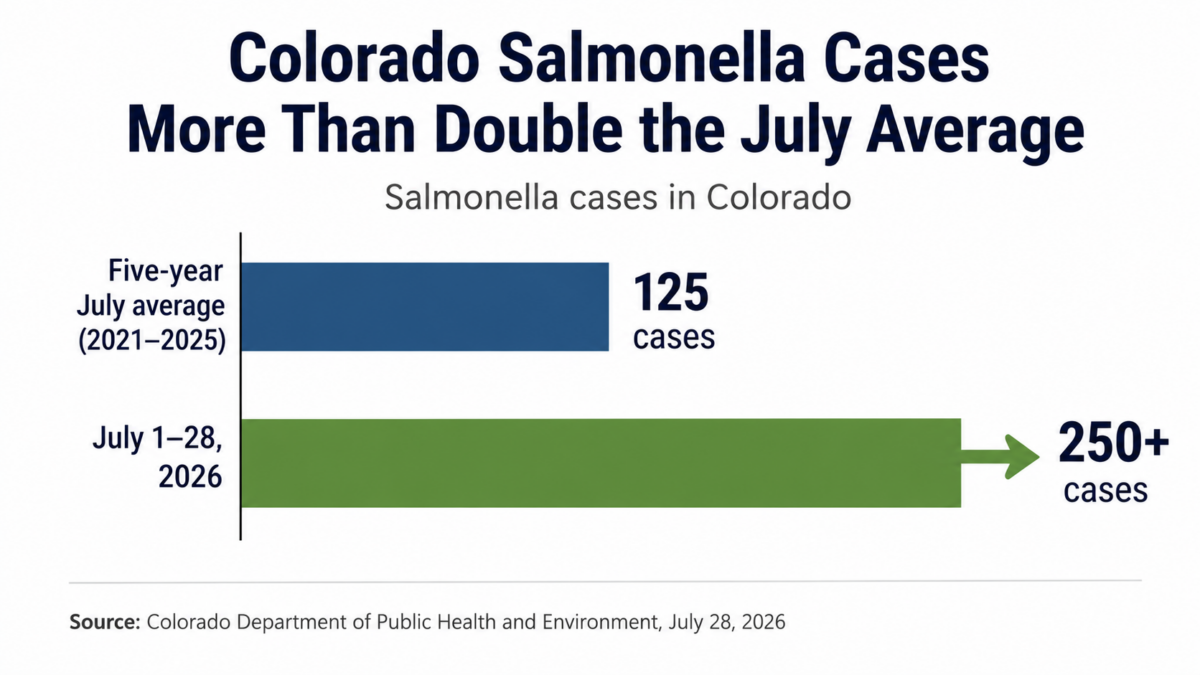
Colorado has reported more than 250 Salmonella cases in the first 28 days of July, more than twice the state’s five-year average for the entire month.
The increase, announced July 28 by the Colorado Department of Public Health and Environment (CDPHE), has prompted an investigation into whether the illnesses are connected by a common source.
So far, health officials have not publicly linked the cases to a food, restaurant, grocery store, supplier, or other cause. Investigators are comparing laboratory results, interviewing patients, and looking for patterns in what people ate, where they shopped, and how products moved through the supply chain.
Pritzker Hageman’s Salmonella lawyers are monitoring the investigation. In major foodborne illness cases, the source often emerges after genetic testing, patient histories, purchase records, and supply-chain evidence begin to point in the same direction.
Do You Need a Salmonella Lawyer?
Colorado Salmonella Surge: Key Facts
- More than 250 cases were reported from July 1 through July 28, 2026.
- Colorado’s five-year average for the full month of July is 125 cases.
- The case total is more than twice the state’s typical July count.
- Health officials are using WGS, patient interviews, and traceback work to determine whether the illnesses are connected.
- No food, restaurant, grocery store, supplier, animal exposure, or other source has been publicly linked to the surge.
Colorado Salmonella Cases More Than Double the July Average
Colorado typically receives reports of about 125 Salmonella cases during the full month of July. By July 28, the state had already reported more than 250, pushing the total to more than twice the five-year average before the month had ended.
That increase is significant, but the case count alone does not establish a single outbreak. Investigators must determine whether the illnesses are part of one large cluster, several smaller outbreaks, or a broader rise involving unrelated exposures.
Public health laboratories use whole genome sequencing (WGS) to compare the genetic fingerprints of Salmonella samples. WGS helps investigators identify clusters of genetically related illnesses. A close genetic match can reveal that patients may share an exposure, but it does not identify the source by itself. Patient interviews, receipts, loyalty-account records, distribution data, and traceback evidence are still needed to determine what caused the illnesses.
How Investigators Trace a Salmonella Surge
Colorado’s public health laboratory is comparing samples from people who tested positive. CDPHE is also working with local health departments, the CDC, the FDA, and health officials in other states to determine whether Colorado’s increase is part of a wider pattern.
When laboratory results reveal related cases, epidemiologists compare what patients ate, where they shopped or dined, recent travel, animal contact, and other exposures. If a food begins to stand out, traceback investigators follow it through restaurants, retailers, distributors, processors, and growers.
A reliable source finding usually depends on several forms of evidence lining up. Genetic matches can identify a cluster. Interviews and purchase records can reveal a common product. Distribution records can show whether that product reached the places where patients ate or shopped. Environmental or product testing can provide additional confirmation.
No Food, Restaurant, or Supplier Has Been Identified
The July 28 alert did not name a Salmonella strain, county cluster, restaurant, grocery store, food product, producer, or distributor. Salmonella can spread through contaminated food, contact with animals or their environments, contaminated water, and unwashed hands. At the research cutoff, health officials had not identified any of those routes as the cause of Colorado’s increase.
Colorado has seen serious Salmonella outbreaks before. In 2021, a multistate investigation linked illnesses to seafood and sushi sold in Colorado. That outbreak ended years ago and has not been connected to the July 2026 surge.
How the 2026 Egg Outbreak Fits Into the Colorado Investigation
A separate federal investigation involves a Salmonella Enteritidis outbreak linked in part to shell eggs recalled by Midwest Poultry Services. The FDA egg outbreak investigation includes 98 illnesses in 17 states, including one Colorado resident. Publicly reported illness-onset dates range through June 30, 2026.
Health officials have not said whether any of the illnesses included in Colorado’s July increase are part of the egg outbreak. The federal investigation currently includes one publicly reported Colorado case, while the state alert describes more than 250 Salmonella cases reported beginning July 1.
Based on the information released so far, the egg outbreak does not explain Colorado’s broader surge. It is still possible, however, that one or more individual Colorado cases could overlap with the federal investigation. Whole genome sequencing, patient interviews, and food-purchase histories will be needed to determine whether any connection exists.
Consumers should continue checking for recalled eggs and follow FDA instructions while the federal investigation remains active.
Salmonella Symptoms and Serious Complications
Salmonella symptoms usually begin six hours to six days after exposure and typically last four to seven days. Common symptoms include:
- Watery diarrhea that may contain blood or mucus
- Severe stomach cramps
- Fever
- Nausea or vomiting
- Headache
- Loss of appetite
Salmonella can also cause serious and sometimes life-threatening complications. The infection can lead to bloodstream infections, meningitis, sepsis, reactive arthritis, and other long-term health problems. Children younger than five, adults 65 and older, and people with weakened immune systems face the greatest risk of severe illness.
What to Do If You Test Positive for Salmonella in Colorado
- Get medical care. A stool test can confirm Salmonella and help public health officials determine whether your illness is connected to other Colorado cases.
- Report your illness. Contact your local public health agency or the Colorado Department of Public Health and Environment. Your report may help investigators identify a cluster or common source.
- Write down what you ate and where you went. Reconstruct the week before symptoms began, including restaurant meals, grocery purchases, catered events, travel, and foods shared with others.
- Save receipts and purchase records. Keep grocery loyalty-account histories, restaurant orders, credit card statements, delivery-app records, photographs, food labels, lot codes, and packaging.
- Keep medical and financial records. Save test results, discharge papers, bills, medication information, photographs, symptom notes, and records of missed work or school.
- Contact a Salmonella lawyer if the illness was serious. A lawyer can help preserve evidence and investigate whether your infection may be connected to a contaminated food product, restaurant, retailer, supplier, or other responsible company.
Can I Sue for Salmonella in Colorado?
You may be able to file a Salmonella lawsuit if evidence connects your infection to a contaminated food product, restaurant, retailer, supplier, distributor, or other responsible company.
That evidence often develops as investigators compare laboratory results, patient interviews, purchase records, and supply-chain information. Depending on how the contaminated food reached consumers, more than one company may be responsible.
Compensation may be available for medical expenses, lost income, pain and suffering, and future care related to serious or lasting complications. Families may also have a wrongful death claim when a Salmonella infection is fatal.
Contact Pritzker Hageman’s Salmonella Legal Team
Pritzker Hageman is a national food safety law firm with a record of success in Salmonella cases. Our lawyers investigate the laboratory, epidemiological, medical, and supply-chain evidence needed to identify responsible companies and build claims for people and families harmed by contaminated food.
If you or a family member tested positive for Salmonella during the Colorado surge and suffered a serious illness, contact the Pritzker Hageman Salmonella Legal Team for a free, confidential case review.
Call 1-888-377-8900, text 612-261-0856, or request a free consultation online. You pay nothing unless we recover compensation for you.
Colorado Salmonella Outbreak Investigation FAQ
As of July 28, 2026, Colorado had received reports of more than 250 Salmonella cases since July 1. The state’s five-year average for the full month of July is 125 cases.
Health officials have not identified a cause. No food, restaurant, grocery store, supplier, animal exposure, or other source has been linked to the increase. Laboratory comparisons, patient interviews, and traceback work are continuing.
Not necessarily. The elevated count does not prove that every illness is connected. Investigators use WGS and epidemiological evidence to determine whether the cases represent one outbreak, several clusters, or unrelated infections.
Symptoms usually begin six hours to six days after infection. Most people recover in four to seven days, but some infections become severe or cause long-term complications.
Contact a health care provider if you have concerning symptoms, especially bloody diarrhea, fever above 102°F, vomiting or diarrhea lasting more than two days, or signs of dehydration. Ask whether a stool test is appropriate.
Use the CDPHE foodborne illness reporting resources or contact your local public health agency. Your report may help investigators connect illnesses that share a source.
Health officials have not announced a connection. The federal egg outbreak includes one publicly reported Colorado case, while Colorado’s July alert covers more than 250 cases reported beginning July 1. The public data do not show that the egg outbreak explains the broader statewide increase, but additional laboratory and epidemiological evidence is needed to determine whether any individual cases overlap.
Possibly, but a claim ultimately needs evidence linking the infection to a responsible product, restaurant, supplier, retailer, or other party. Preserve medical records, purchase records, packaging, and leftovers while the investigation continues.
The Pritzker Hageman law firm and our attorneys have been recognized in:
U.S. News & World Report

Pritzker Hageman has been recognized as one of the best law firms for personal injury litigation by U.S. News & World Report every year the award has been given since 2012.
Super Lawyers®, Thomson Reuters

Attorneys at Pritzker Hageman have been awarded the peer selected Super Lawyers distinction every year since 2004.
America’s Top 100 Attorneys®
Lifetime Achievement selection to America’s Top 100 Attorneys®.
Three Time Attorneys of the Year

Pritzker Hageman lawyers have been named Attorneys Of The Year by Minnesota Lawyer three times.
We have obtained 100+ separate verdicts and settlements greater than $1 million:
Our client suffered substantial injuries after ingesting a defective product.
We obtained this settlement on behalf of a family whose children were sickened with E. coli.
We obtained a $12.15 million settlement on behalf of an 8-year old girl who was sickened in an E. coli outbreak.
We represented seven children who suffered intestinal injuries as a result of a defective food product.
We obtained this settlement on behalf of a 13-year old girl who was sickened with E. coli.
We won this verdict for a child with kidney damage from E. coli in contaminated food.
Our attorneys won this landmark verdict in a case against Foster Poultry Farms. Our client was a 5-year-old child who contracted Salmonella Heidelberg and, as a result, suffered brain damage.
We obtained a settlement from a company that sold contaminated food to our clients, causing the death of unborn children.
Our client suffered severe neurologic injuries as a result of Listeria monocytogenes, a food-borne pathogen.
On behalf of a client who was seriously sicked by food contaminated with Listeria monocytogenes.
See more settlements & verdicts.