
A woman was killed when a dump truck struck her near Ford Parkway and Cleveland Avenue South in St. Paul’s Highland Park neighborhood on Thursday morning, October 29, 2026. According to Bring Me The News, reporting information from St. Paul police, she was crossing Cleveland Avenue South just after 8 a.m. St. Paul Fire Department medics pronounced her dead at the scene.
Police said the man driving the dump truck stayed at the scene and was cooperating with investigators. Officers reported observing no signs of impairment. The intersection reopened by 11:45 a.m., according to the same report.
The available reporting does not establish the truck’s direction of travel, its speed or the pedestrian signal at the time of the collision. Those details matter when determining what happened and whether anyone is legally responsible.
Families who lose someone in a fatal dump truck crash can seek an independent investigation into the death. Pritzker Hageman offers a free consultation to explain the evidence that may need to be preserved and the family’s legal options.
Contact Eric today and find out how you can get compensation and justice
1-888-377-8900 (Toll-Free) | [email protected]

What investigators need to determine about the Highland Park crash
A fatal collision at an intersection can involve several movements occurring within seconds. The investigation needs to establish where the pedestrian and truck were before impact, what each person could see and which traffic controls applied.
Questions that may help explain this crash include:
- Was the truck traveling straight, turning or making another movement?
- Where was the woman crossing, and what did the traffic and pedestrian signals show?
- Did nearby cameras or witnesses capture the approach to the intersection and the collision?
- Was the driver keeping a proper lookout, and were mirrors or other visibility equipment correctly positioned and functioning?
- Did the truck’s condition, speed or operation contribute to the impact?
These are investigative questions. They are not findings that a particular violation or equipment problem occurred in this crash.
Minnesota law requires drivers to watch for pedestrians
Under Minnesota’s traffic signal law, drivers turning on a circular green light must yield to pedestrians lawfully within the intersection or adjacent crosswalk. A permitted right turn on red also requires a stop and yielding to pedestrians lawfully proceeding under the signals. Pedestrians must follow the signals that apply to them.
Minnesota’s pedestrian statute requires drivers to exercise due care to avoid colliding with pedestrians on a roadway. When traffic signals are absent or not operating, drivers must stop to yield to pedestrians in marked crosswalks or at intersections without marked crosswalks, subject to the statute’s conditions.
The signal sequence and the timing of each person’s movement must be established before applying these rules to the Ford Parkway crash. A news report saying someone was crossing a street does not, by itself, establish who had the right of way.
The Federal Motor Carrier Safety Administration’s guidance for truck drivers emphasizes checking blind spots, allowing adequate stopping distance and making turns carefully. Visibility limitations are a reason to investigate the driver’s lookout and the truck’s equipment, rather than assume the collision could not have been avoided.
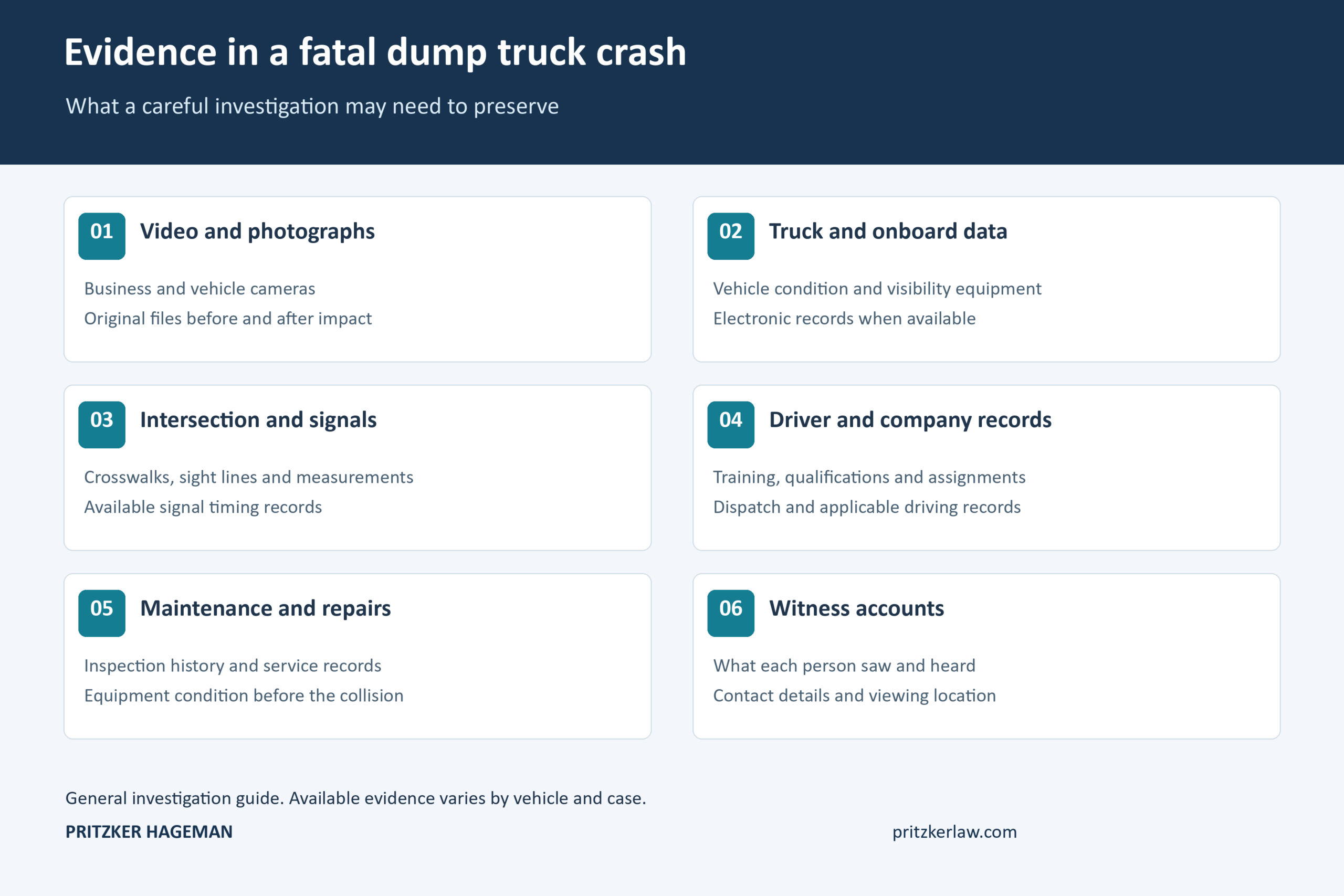
Evidence that can help explain a fatal dump truck crash
A police investigation and a family’s civil claim serve different purposes. An attorney can investigate potential compensation claims while law enforcement examines the collision. The civil investigation may require evidence beyond the initial public account.
- Video and photographs. Nearby business cameras, doorbell cameras or vehicle cameras may show movements before impact. Recordings should be identified promptly because storage systems can overwrite them.
- The truck and its electronic data. An inspection may document damage, mirrors, cameras, brakes and other equipment. Depending on the vehicle, available onboard systems may contain useful operating data. Not every dump truck records the same information.
- The intersection and signals. Scene measurements, sight lines, crosswalk markings and available signal timing records can help reconstruct the collision. A photograph of a signal after the crash does not establish what it showed at impact.
- Driver and company records. Training, qualifications, dispatch instructions, work assignments and applicable driving records may help explain how the truck was being operated.
- Maintenance and repair history. Inspection records and prior repairs can help determine whether a mechanical or visibility problem contributed.
- Witness accounts. Contact information and detailed recollections can help investigators compare different views of the collision.
A spoliation letter requesting preservation of evidence puts relevant companies on notice to preserve material connected to a claim. Obtaining records or inspecting a vehicle may require cooperation, formal discovery or a court order. Preservation requests should identify the evidence at issue and the parties who control it.
Who may be responsible for a dump truck pedestrian death
Depending on the evidence, a claim may involve the driver, an employer, the truck’s owner or another company whose conduct contributed to the death. A maintenance company or equipment manufacturer may be involved if a negligent repair or defective component helped cause the collision.
Identifying a company is only the beginning. Its responsibility depends on its relationship to the truck or driver, its conduct and the applicable law. The public reports reviewed for this article do not establish the truck’s ownership or any company’s liability.
Minnesota wrongful death claims after a fatal pedestrian crash
When wrongful conduct causes a death, Minnesota Statutes section 573.02 allows a court-appointed trustee to bring a wrongful death action for the benefit of the surviving spouse and next of kin. A family member can contact an attorney before a trustee has been appointed.
Depending on the facts, recoverable losses may include funeral and medical expenses, lost financial support and the value of services, advice, care and companionship the person would have provided. Current Minnesota law also permits recovery for damages the person suffered from the injury before death when supported by the evidence. The recoverable damages must be evaluated for the particular case.
Most Minnesota wrongful death actions must begin within three years after the death and within six years after the wrongful act or omission. Exceptions and other deadlines can apply. Evidence may disappear much sooner, so the filing deadline should not determine when an investigation begins.
Our experience investigating fatal dump truck collisions
Pritzker Hageman has represented Minnesota families in wrongful death claims involving dump trucks. In a prior dump truck wrongful death case, a driver turned right and struck a woman riding in a marked bicycle lane in Minneapolis. Attorneys Fred Pritzker and Eric Hageman used accident reconstruction specialists to investigate the driver’s claim that he had not seen her and obtained a settlement for her family.
That case involved a bicyclist and a different collision. Its relevance is the need to test a driver’s account against physical evidence. Our pedestrian accident lawyers investigate crashes involving people on foot, and our wrongful death attorneys help families pursue claims supported by the evidence. Every case depends on its own facts and law.
Questions families often ask after a fatal truck crash
No. A civil claim does not depend on a criminal charge or conviction. It requires evidence of legally actionable conduct that caused the death and recoverable losses. A report that the driver showed no signs of impairment does not resolve whether the driver or another party acted negligently.
The family can consult a lawyer while the investigation continues. An attorney can identify evidence to preserve, explain the trustee process and communicate with insurers. The initial consultation does not require the family to know who caused the crash.
Preserve the original files and contact the investigating police department. Keep the original recording, including footage before and after the collision, rather than replacing it with an edited clip. Note when and where it was recorded and provide your contact information to investigators.
Speak with Pritzker Hageman about a fatal pedestrian crash
If your family lost someone in a dump truck or other commercial vehicle crash in St. Paul or elsewhere in Minnesota, Pritzker Hageman can review the circumstances and explain possible next steps. Our truck accident team is led by attorney Eric Hageman. We can discuss evidence preservation, the companies that may need to be investigated and the process for bringing a wrongful death claim.
Call 1-888-377-8900, text 612-261-0856 or request a free consultation. There is no charge for the consultation. We are not paid unless we recover compensation for you.
The Pritzker Hageman law firm and our attorneys have been recognized in:
U.S. News & World Report

Pritzker Hageman has been recognized as one of the best law firms for personal injury litigation by U.S. News & World Report every year the award has been given since 2012.
Super Lawyers®, Thomson Reuters

Attorneys at Pritzker Hageman have been awarded the peer selected Super Lawyers distinction every year since 2004.
America’s Top 100 Attorneys®

Lifetime Achievement selection to America’s Top 100 Attorneys®.
Three Time Attorneys of the Year

Pritzker Hageman lawyers have been named Attorneys Of The Year by Minnesota Lawyer three times.