
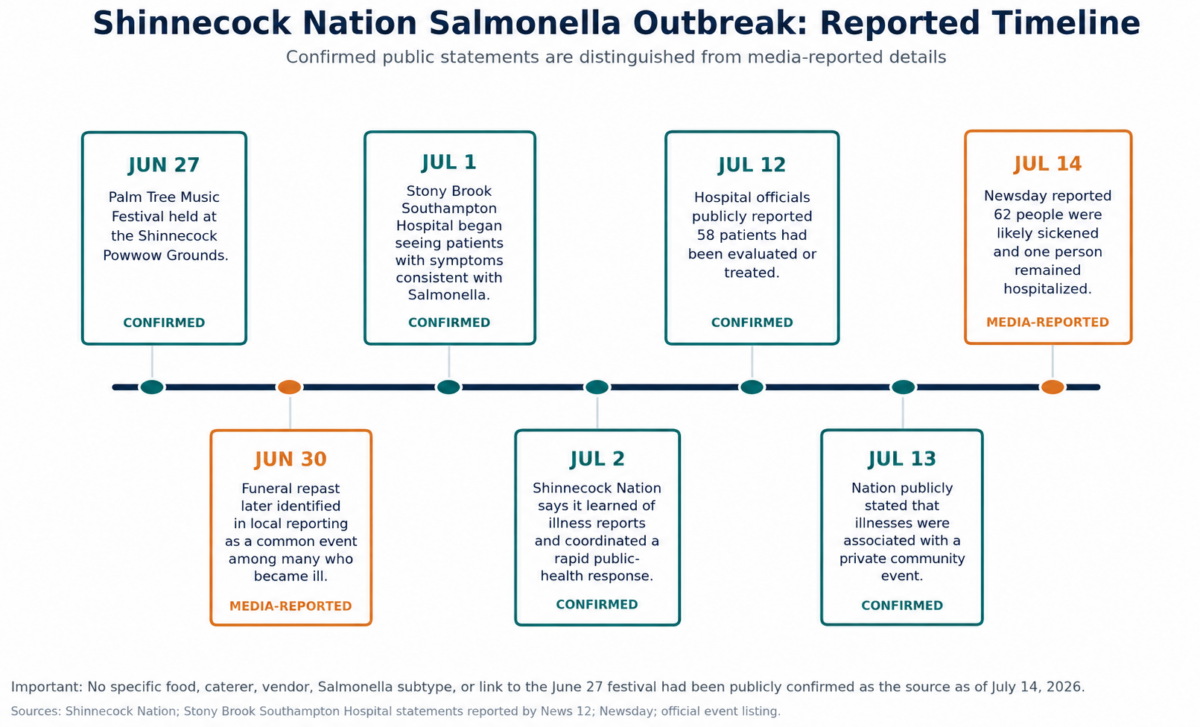
Public-health officials are investigating a substantial Salmonella outbreak centered in the Shinnecock Nation community near Southampton, New York. Newsday reported on July 14 that 62 people were likely sickened and one person remained hospitalized. Stony Brook Southampton Hospital officials told News 12 that 58 patients with symptoms consistent with Salmonella had been seen since the beginning of July; most were evaluated, treated, and discharged.
The Shinnecock Nation Council of Trustees says the illnesses were associated with a private event in the community and that the Nation began coordinating a public-health response on July 2. As of this update, officials had not publicly identified a specific food, caterer, vendor, Salmonella subtype, or confirmed connection to the June 27 Palm Tree Music Festival as the outbreak source.
Anyone who became ill after attending a Shinnecock Nation community event, a funeral repast, the Palm Tree Music Festival, or another gathering in the Southampton area should seek medical advice, ask whether stool testing is appropriate, and report the illness to public-health officials. People with a laboratory-confirmed infection or serious complications may also benefit from speaking with an experienced Salmonella lawyer while evidence is still available.
Shinnecock Nation Salmonella Outbreak: Current Facts
- Reported illness count: Newsday reported on July 14 that the number of people likely sickened had grown to 62.
- Hospital care: Stony Brook Southampton Hospital reported that 58 patients had been evaluated or treated since the beginning of July. Most were discharged after evaluation and treatment.
- Current hospitalization: Newsday reported that one person remained hospitalized on July 14.
- Event association: The Shinnecock Nation says illnesses were associated with a private community event.
- First response: The Nation says it became aware of illness reports on July 2 and contacted healthcare professionals supporting the Shinnecock Health Center.
- Reported funeral connection: Local reporting has identified a June 30 funeral repast as a common event attended by many people who became ill. This detail has not yet been set out in a public county or state outbreak report.
- Reported festival-food theory: News 12 reported that unnamed sources said food left over from the June 27 Palm Tree Music Festival was consumed at a later event. No public-health agency has confirmed that festival food caused the outbreak.
- Source status: No specific food, ingredient, food business, caterer, vendor, or Salmonella subtype had been publicly identified as the confirmed source as of July 14.
- Investigation: The Suffolk County Department of Health Services is collecting information. The Nation also identified state, county, hospital, emergency-management, and federal partners involved in the response.
Do you need a Salmonella Lawyer?
What Happened at the Shinnecock Nation?
The outbreak became publicly known after a large number of people from the East End sought care for gastrointestinal illness. In its public statement, the Shinnecock Nation Council of Trustees said it was deeply concerned for everyone affected and that it had worked with healthcare and emergency-response partners after learning of illnesses on July 2. The Nation thanked Stony Brook Southampton Hospital, the Shinnecock Health Committee, the Suffolk County Department of Health Services, the New York State Department of Environmental Conservation, the Suffolk County Office of Emergency Management, and FEMA for assistance.
The Nation stated that the illnesses were associated with a private event held within the community. It did not name that event, identify a meal or vendor, or announce a specific contaminated food. The statement also noted that community members received care through Stony Brook Southampton Hospital, Northwell Health facilities, and private medical providers.
A Food Poisoning Bulletin report summarized local accounts that many patients had attended a funeral repast on June 30. That reporting also described testing of leftover food. These details are important investigative leads, but they should remain clearly attributed until the Suffolk County Department of Health Services, the New York State Department of Health, or another responsible authority publishes findings.
Was the Palm Tree Music Festival the Source?
It is too early to say. The official event listing confirms that the Palm Tree Music Festival was held at the Shinnecock Powwow Grounds on June 27. News 12 later reported that unnamed sources said some people consumed food left over from the festival at a later private event. Local reporting has also suggested that some festival attendees became ill.
Those reports do not establish that food prepared for or served at the festival was contaminated. A credible source determination would usually require a combination of patient interviews, laboratory results, food or environmental testing when available, and traceback evidence. Possible explanations could include a food served only at the later event, an ingredient used at more than one event, unsafe storage or handling after the festival, person-to-person spread, or another exposure entirely. Until investigators release findings, the festival, its organizers, vendors, and any particular food should not be described as the cause.
Was the June 30 Funeral Repast the Exposure Event?
Local reporting indicates that many affected people attended a funeral repast on June 30 and began experiencing symptoms afterward. The timing is compatible with Salmonella because symptoms commonly begin between six hours and six days after exposure. But attendance at a common event is only one piece of an outbreak investigation. Investigators must still compare what sick and well attendees ate, determine whether patient samples are related, test available food or environmental samples, and trace ingredients and handling practices.
The most accurate public description at this stage is that officials have associated illnesses with a private Shinnecock Nation community event, while media reports have identified the funeral repast as a likely common exposure under investigation.
How Many People Were Sickened?
Case counts can differ during an active investigation because agencies and hospitals are counting different populations. A hospital may count everyone evaluated with compatible symptoms, while a health department may count only confirmed or probable cases that satisfy a formal case definition. People who went to other hospitals, saw private doctors, or never sought care may not appear in one facility’s total. Duplicate records and negative tests may later be removed.
As of July 14, the most useful public figures were: 62 people reportedly likely sickened; 58 patients evaluated or treated at Stony Brook Southampton Hospital; and one person reportedly still hospitalized. These figures may be revised as interviews and laboratory testing continue.
Is There an Ongoing Risk to the Public?
Newsday reported that officials characterized the outbreak as isolated, and no general food recall or public warning naming a continuing commercial food source had been announced as of July 14. That does not mean the investigation is complete. People who attended relevant events, shared food from those events, or had close contact with someone who became ill should watch for symptoms and follow medical and public-health advice.
Salmonella can continue to be shed in stool after symptoms improve. Careful handwashing is especially important after using the bathroom, changing diapers, and before preparing food. Anyone with diarrhea should avoid preparing food for others and should follow a healthcare provider’s guidance about returning to food service, healthcare, childcare, or other high-risk work.
What Is Salmonella?
Salmonella are bacteria that can cause an intestinal infection called salmonellosis. People can become infected by eating contaminated food, drinking contaminated water, touching contaminated surfaces, or having contact with infected people or animals. The bacteria can spread when microscopic amounts of fecal material contaminate hands, food, equipment, or shared environments. Read more about how Salmonella spreads and Pritzker Hageman’s overview of salmonellosis.
Many infections resolve without antibiotics, but Salmonella can cause severe dehydration, colitis, bloodstream infection, meningitis, infection of bones or joints, and other life-threatening complications. The burden can be especially serious for infants, older adults, pregnant people, and people whose immune systems are weakened by illness or medication.
Salmonella Symptoms and Incubation Period
According to the Centers for Disease Control and Prevention, symptoms usually begin six hours to six days after infection and often last four to seven days. Common symptoms include:
- Diarrhea, which may be watery or contain blood or mucus
- Abdominal or stomach cramps
- Fever
- Nausea or vomiting
- Headache
- Loss of appetite
- Chills, fatigue, and body aches
People should contact a healthcare provider for diarrhea or vomiting lasting more than two days, bloody stool or urine, fever above 102°F, or signs of dehydration. Signs of dehydration include very little urination, dark urine, dry mouth, intense thirst, dizziness, or unusual sleepiness. Severe weakness, confusion, fainting, trouble breathing, a stiff neck, or rapidly worsening illness warrants urgent evaluation.
For a more detailed discussion, see Pritzker Hageman’s guide to Salmonella symptoms.
Who Is at Higher Risk of Severe Salmonella Infection?
Anyone can develop serious illness, but the CDC clinical overview identifies several groups at greater risk of invasive disease or complications:
- Infants and young children
- Adults age 65 and older
- People with weakened immune systems, including those receiving chemotherapy, transplant medicines, high-dose steroids, or other immunosuppressive treatment
- People with certain chronic diseases or conditions that reduce stomach acidity
- People who cannot replace fluids adequately because of vomiting, diarrhea, frailty, or another illness
Invasive Salmonella occurs when bacteria spread beyond the intestines into the bloodstream or another normally sterile part of the body. The CDC estimates that invasive infections occur in about 8 percent of laboratory-confirmed cases overall, with the highest risk among young children, older adults, and immunocompromised people.
Possible Long-Term Complications
Even after the initial gastrointestinal illness resolves, some patients experience lasting harm. Potential complications include:
- Severe dehydration and kidney injury: Prolonged diarrhea and vomiting can require intravenous fluids or hospitalization.
- Salmonella colitis: Inflammation of the colon can cause severe pain, bloody diarrhea, and prolonged recovery. Learn more about Salmonella colitis.
- Bacteremia and sepsis: Salmonella entering the bloodstream can spread to organs and become life-threatening.
- Meningitis: Infection around the brain and spinal cord can cause permanent neurological injury or death.
- Bone, joint, heart, or blood-vessel infection: Salmonella can seed vulnerable tissues, implants, aneurysms, or atherosclerotic vessels.
- Reactive arthritis: Joint pain, eye irritation, and urinary symptoms may develop after the infection and can persist. Read about reactive arthritis after food poisoning.
- Post-infectious bowel problems: Some people report prolonged diarrhea, abdominal pain, or altered bowel habits after the acute infection.
- Death: Severe Salmonella infection can be fatal, particularly in high-risk patients. Pritzker Hageman represents families in Salmonella wrongful-death cases.
How Is Salmonella Diagnosed?
A healthcare provider may order a stool culture or a molecular test such as a PCR gastrointestinal panel. The CDC calls culture the diagnostic gold standard because it confirms the organism and produces an isolate that can be characterized further. When a PCR test is positive, a reflex culture can help public-health laboratories perform serotyping, antimicrobial-susceptibility testing, and whole genome sequencing.
Whole genome sequencing can show whether Salmonella isolates from different patients are closely related genetically. A match does not by itself identify the food source, but it can help define the outbreak and connect cases that might otherwise seem unrelated. A negative test does not always rule out prior infection, especially if testing occurred late, after antibiotics, or after the bacteria were no longer detectable.
How Is Salmonella Treated?
Most people recover with rest and fluids, but diarrhea and vomiting can cause dangerous dehydration. Oral rehydration solutions can replace water and electrolytes more effectively than plain water alone. People who cannot keep fluids down, are urinating very little, feel faint, or have other warning signs may need intravenous fluids and hospital care.
The CDC treatment guidance says most people do not need antibiotics. Antibiotics are generally considered for severe infection and for people at higher risk of invasive disease. Unnecessary antibiotics can cause side effects, contribute to resistance, and may lengthen the time Salmonella is carried in stool. Patients should not use leftover antibiotics or another person’s prescription.
Anti-diarrheal medicines may make illness last longer and can be unsafe in some circumstances, especially with fever or bloody diarrhea. A healthcare provider should guide their use. Infants, older adults, immunocompromised patients, and anyone with severe symptoms should receive individualized advice rather than relying only on home treatment.
What Should Affected People Do Now?
- Get medical care and ask about testing. Tell the provider the dates and locations of relevant events, when symptoms began, and whether other attendees became ill. Ask whether stool culture or PCR testing is appropriate.
- Seek urgent care for warning signs. Severe dehydration, blood in stool, persistent vomiting, high fever, fainting, confusion, severe weakness, or worsening symptoms should not wait.
- Report the illness. Contact the Suffolk County Department of Health Services, especially if you attended a common event or know others who became ill.
- Write down a detailed food and event history. Record everything eaten and drunk during the week before symptoms began, including the June 27 festival, June 30 repast, private gatherings, takeout meals, groceries, and food shared at home.
- Preserve invitations and communications. Keep event invitations, funeral notices, text messages, emails, social-media posts, photographs, menus, vendor lists, payment records, and messages discussing who became ill.
- Save receipts, packaging, and leftovers. Do not consume suspected leftovers. Keep items isolated and refrigerated or frozen only if public-health officials advise you to preserve them. Do not send or discard food before asking investigators what they need.
- Request complete medical records. Save discharge papers, laboratory reports, bills, pharmacy records, photographs, work notes, and records of follow-up care.
- Track losses and symptoms. Keep a daily record of pain, diarrhea, fatigue, dehydration, missed work, childcare needs, travel for treatment, and out-of-pocket costs.
- Protect other people. Wash hands carefully, clean contaminated bathroom surfaces, avoid preparing food for others while ill, and follow medical guidance for high-risk jobs.
- Speak with a foodborne-illness lawyer before evidence disappears. A lawyer can send preservation notices, obtain contracts and insurance information, coordinate testing, and investigate possible suppliers and non-tribal vendors. See Pritzker Hageman’s 10 crucial steps after food poisoning.
| HOW TO REPORT A SUSPECTED CASE IN SUFFOLK COUNTY The Suffolk County Bureau of Epidemiology and Disease Control lists 631-854-0333 for calls during business hours and 631-853-6311 for urgent after-hours communicable-disease concerns. New York directs foodborne-illness complaints to the local health department for the county where the affected person lives. You may also review the state’s foodborne-illness complaint guidance. |
How Investigators Determine the Outbreak Source
Foodborne-outbreak investigations combine three categories of evidence: epidemiology, laboratory science, and traceback. Investigators may interview patients, compare exposures among sick and well attendees, collect stool specimens, test leftover food or environmental samples, and examine purchasing and distribution records. The strongest conclusions usually rest on multiple lines of evidence rather than a single recollection or positive sample.
The CDC’s explanation of how outbreak causes are confirmed describes the process of connecting illnesses to foods and using laboratory and traceback evidence to support control measures. Suffolk County’s epidemiology bureau likewise investigates cases and clusters, interviews patients, and works to identify food handlers, vendors, or suppliers when appropriate.
Can People Sickened in This Outbreak Bring a Lawsuit?
Potentially. A viable case generally requires proof of an actual Salmonella infection or compatible illness, evidence connecting the illness to the outbreak or contaminated product, and legally recoverable damages. A positive stool test and a genetic match to the outbreak strain can be powerful evidence, but they are not the only possible forms of proof. Timing, common-event attendance, food histories, epidemiological findings, medical records, and witness accounts may also matter. Read more about how a food poisoning lawyer proves a claim.
Because the source has not been publicly identified, it is premature to say who may be responsible. Depending on the investigation, potential defendants could include a caterer, food-service contractor, event vendor, ingredient supplier, distributor, manufacturer, premises operator, or another person or company whose conduct contributed to contamination or unsafe handling. The evidence may also show that a suspected entity was not responsible.
Contact the Pritzker Hageman Lawyers Today
Phone: 1-888-377-8900 | Text: 612-261-0856
The consultation is free and you never pay anything until we win for you.
Does the Shinnecock Nation’s Tribal Status Affect Legal Claims?
The Shinnecock Indian Nation is federally recognized. That fact can make the legal analysis more complex, but it does not answer who caused the outbreak or whether an affected person has a claim. Tribal sovereign immunity, jurisdiction, forum, contractual waivers, insurance, and the identity of the real party in interest can all matter.
A claim involving a tribal government or tribal entity may be treated differently from a claim against a non-tribal caterer, vendor, distributor, manufacturer, insurer, or individual. The correct approach is to investigate every potentially responsible party, review contracts and insurance policies, and avoid assumptions about liability or immunity. People considering a claim should obtain advice promptly from counsel able to address both foodborne-illness evidence and the tribal-law issues that may arise.
What Compensation May Be Available?
Damages depend on the facts and applicable law. A Salmonella claim may seek compensation for:
- Emergency-room, hospital, ambulance, physician, laboratory, pharmacy, rehabilitation, and future medical expenses
- Lost wages, lost business income, diminished earning capacity, and employment benefits
- Physical pain, nausea, diarrhea, dehydration, fatigue, and emotional distress
- Long-term complications such as reactive arthritis, kidney injury, bowel dysfunction, neurological injury, or invasive infection
- Out-of-pocket expenses, travel, home assistance, and caregiving needs
- Permanent disability, disfigurement, or reduced quality of life
- Funeral expenses, lost financial support, loss of services, and other wrongful-death damages when an infection is fatal
Pritzker Hageman’s food safety lawyers have handled hundreds of Salmonella cases and have obtained major results, including a $6.5 million verdict for a child who suffered permanent brain injury after Salmonella infection. Prior results do not guarantee a future outcome; every case depends on its facts, evidence, defendants, and governing law.
How Long Do People Have to File a Claim?
New York’s general limitations period is often three years for a personal-injury action under CPLR 214 and two years for a wrongful-death action under EPTL 5-4.1. Those are general rules, not a deadline calculation for any particular person.
A different or shorter period may apply depending on the defendant, the forum, tribal law, governmental-notice requirements, contractual terms, the injured person’s age, the type of claim, and other facts. Evidence can disappear long before a limitations period expires. Anyone considering a claim should seek individual legal advice as soon as possible rather than relying on a general deadline.
Why Contact Pritzker Hageman?
Pritzker Hageman is a national food poisoning law firm that represents people with serious foodborne illnesses throughout the United States. The firm’s Salmonella legal team investigates outbreak evidence, works with experts, traces food through complex supply chains, and pursues claims against restaurants, food companies, distributors, and other responsible parties.
- Experience investigating Salmonella outbreaks and severe complications
- Access to epidemiologists, microbiologists, physicians, food-safety experts, and supply-chain evidence
- Ability to coordinate individual medical proof with public-health and laboratory findings
- Nationwide representation and resources for complex, multi-party litigation
- Free, confidential consultations
- No attorney fee unless compensation is recovered
Contact Eric today and find out how you can get compensation and justice
1-888-377-8900 (Toll-Free) | [email protected]

Frequently Asked Questions
Newsday reported on July 14, 2026, that 62 people were likely sickened. Stony Brook Southampton Hospital reported evaluating or treating 58 patients with compatible symptoms since the beginning of July. These numbers measure different groups and may change as the investigation continues.
The Shinnecock Nation says the illnesses were associated with a private event in the community. Local reporting has identified a June 30 funeral repast as a common event among many people who became ill, but a public county or state outbreak report had not yet named the event or source as of July 14.
That has not been confirmed. News 12 reported an allegation that food left over from the June 27 festival was consumed at a later event. No public-health agency had identified festival food, an organizer, a vendor, or a particular dish as the source.
No specific food or ingredient had been publicly confirmed. Investigators may be testing leftover food and comparing patient food histories, laboratory results, and supplier records.
Symptoms usually begin six hours to six days after infection. Most illnesses last four to seven days, although severe disease and long-term complications can occur.
People with significant symptoms or a possible outbreak exposure should contact a healthcare provider and ask whether testing is appropriate. Culture is especially useful because it can provide an isolate for public-health comparison.
Report suspected foodborne illness to the local health department where you live. In Suffolk County, the Bureau of Epidemiology and Disease Control lists 631-854-0333 during business hours and 631-853-6311 for urgent after-hours communicable-disease concerns.
Possibly, but proof may be more difficult. Medical records, timing, common-event attendance, epidemiological findings, witness accounts, and other evidence may support a claim. A lawyer should evaluate the full record.
The answer depends on the source investigation. Possible parties could include a caterer, vendor, food-service contractor, supplier, distributor, manufacturer, premises operator, or another entity. No particular party should be blamed without evidence.
No categorical answer is appropriate. Claims involving a tribal government or tribal entity can raise sovereign-immunity and jurisdiction questions, while claims against non-tribal vendors or other parties may present a different analysis. The contracts, insurance, defendant identity, and facts must be reviewed.
Keep test results, medical records, bills, food histories, event invitations, texts, emails, photos, receipts, menus, packaging, work-loss records, and the names of other people who became ill. Ask public-health officials before discarding or transferring suspected leftovers.
Not typically. Foodborne-illness claims are usually pursued individually because medical harm, lost income, complications, and damages vary widely. Cases may be coordinated for efficiency, but an individual claim can preserve each person’s specific damages.
Routine testing of people without symptoms is not usually recommended unless a healthcare provider or public-health investigator advises it. Attendees should monitor for symptoms during the six-day incubation window and respond promptly to requests from investigators.
Yes. Salmonella can spread when microscopic fecal contamination reaches another person’s mouth through unwashed hands, food preparation, diaper changing, bathrooms, or contaminated surfaces. Careful handwashing and avoiding food preparation while ill are important.
The answer depends on symptoms, occupation, age, and public-health rules. Food workers, healthcare workers, childcare workers, and young children may face special clearance requirements. Follow the treating provider and local health department rather than relying on a fixed number of days.
The consultation is 100% free. The Pritzker Hageman Salmonella Lawyers handle qualifying cases on a contingency-fee basis, meaning there is never any fees of any kind unless compensation is recovered for our client.
Official and Authoritative Sources for Updates
- Shinnecock Nation Council of Trustees outbreak statement
- Suffolk County Bureau of Epidemiology and Disease Control
- New York State foodborne-illness complaint information
- New York State Salmonellosis Fact Sheet
- CDC Salmonella symptoms and warning signs
- CDC clinical overview for healthcare professionals
- CDC explanation of foodborne-outbreak source confirmation
We have obtained 100+ separate verdicts and settlements greater than $1 million:
Our client suffered substantial injuries after ingesting a defective product.
We obtained this settlement on behalf of a family whose children were sickened with E. coli.
We obtained a $12.15 million settlement on behalf of an 8-year old girl who was sickened in an E. coli outbreak.
We represented seven children who suffered intestinal injuries as a result of a defective food product.
We obtained this settlement on behalf of a 13-year old girl who was sickened with E. coli.
We won this verdict for a child with kidney damage from E. coli in contaminated food.
Our attorneys won this landmark verdict in a case against Foster Poultry Farms. Our client was a 5-year-old child who contracted Salmonella Heidelberg and, as a result, suffered brain damage.
We obtained a settlement from a company that sold contaminated food to our clients, causing the death of unborn children.
Our client suffered severe neurologic injuries as a result of Listeria monocytogenes, a food-borne pathogen.
On behalf of a client who was seriously sicked by food contaminated with Listeria monocytogenes.
See more settlements & verdicts.
The Pritzker Hageman law firm and our attorneys have been recognized in:
U.S. News & World Report

Pritzker Hageman has been recognized as one of the best law firms for personal injury litigation by U.S. News & World Report every year the award has been given since 2012.
Super Lawyers®, Thomson Reuters

Attorneys at Pritzker Hageman have been awarded the peer selected Super Lawyers distinction every year since 2004.
America’s Top 100 Attorneys®

Lifetime Achievement selection to America’s Top 100 Attorneys®.
Three Time Attorneys of the Year

Pritzker Hageman lawyers have been named Attorneys Of The Year by Minnesota Lawyer three times.