
A 55-year-old De Pere, Wisconsin, truck driver was airlifted after a head-on collision between two semi-trucks on U.S. Highway 151 in Manitowoc County on October 27, 2026. A preliminary investigation found that an eastbound Mack semi crossed the centerline and struck the driver’s westbound Freightliner near Lower Falls Road in the town of Cato.
The Freightliner driver was removed from the damaged cab and flown to a hospital for treatment. The Mack driver, a 44-year-old man from Illinois, died at the scene. Wisconsin State Patrol is conducting a full crash reconstruction to determine how the collision occurred and what caused the Mack to enter the opposing lane.
Pritzker Hageman’s semi-truck accident lawyers represent people seriously injured in commercial truck crashes, including truck drivers struck by another semi-truck. Our attorneys investigate driver negligence, trucking company safety violations and other factors contributing to serious collisions to identify responsible parties and pursue compensation for injured clients.
Were You Injured in an Truck Crash?
What Happened in the U.S. 151 Semi-Truck Crash Near Valders?
The Manitowoc County Sheriff’s Office said emergency crews responded at approximately 1:50 p.m. Tuesday to U.S. 151 at Lower Falls Road, about two miles east of Valders. The preliminary findings identify the eastbound vehicle as a 2022 Mack semi and the westbound vehicle as a 2014 Freightliner semi.
The 55-year-old Freightliner driver, from De Pere, was extricated and transported by ThedaStar helicopter to ThedaCare Regional Medical Center. The 44-year-old Mack driver was pronounced dead at the scene. These details were reported by WBAY, citing the Manitowoc County Sheriff’s Office.
Why Did the Mack Semi Cross the Centerline on U.S. 151?
Wisconsin State Patrol is reconstructing the head-on collision to determine why the eastbound Mack crossed the centerline and struck the westbound Freightliner. Investigators have not yet established what caused the truck to enter oncoming traffic.
Crash reconstruction can help establish the sequence of events leading up to the collision. Investigators may examine tire marks, debris patterns, vehicle damage, and the final positions of both trucks to determine where the impact occurred and how the vehicles were moving beforehand. Available electronic data, vehicle inspection findings, and other evidence may help investigators determine whether driver actions, mechanical problems, or roadway conditions contributed to the crash.
How Can a Legal Investigation Determine Liability for a Truck Crash?
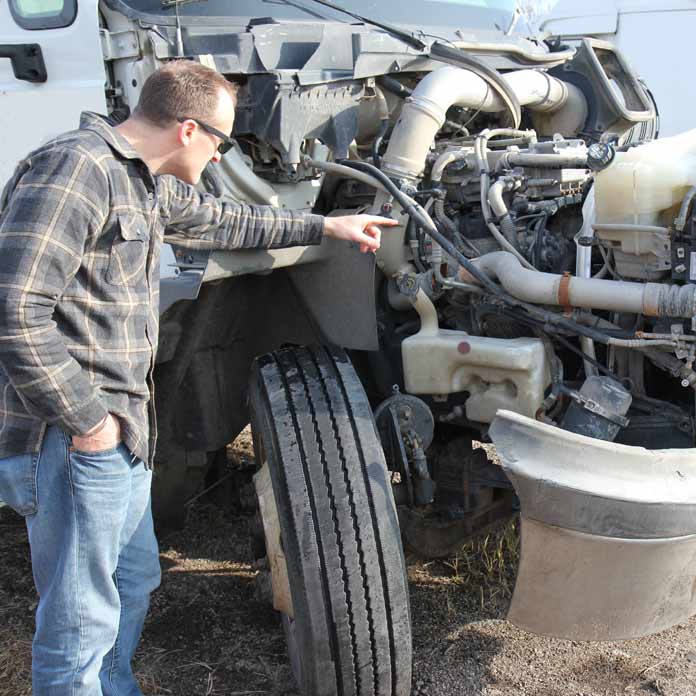
A semi-truck accident investigation examines how a crash occurred, what caused it and whether driver negligence or trucking company safety violations contributed to the collision. While police focus on reconstructing the crash, an independent legal investigation also examines the trucking companies, drivers and safety practices involved.
Determining which trucking company is responsible is a critical part of investigating a serious commercial truck collision. The truck’s owner, motor carrier, driver and maintenance provider can be different businesses. Identifying these relationships helps establish which companies were responsible for operating, maintaining and supervising the truck at the time of the crash.
A thorough 18-wheeler accident investigation includes examining physical evidence, vehicle damage, electronic crash data and trucking company records. Key evidence includes driver qualification and training files, vehicle inspection and maintenance records, electronic logging device data, dispatch communications and company safety policies. These records help identify negligent hiring or supervision, unsafe driving practices, mechanical failures and violations of federal trucking safety regulations.
Preserving evidence after a serious semi-truck crash is essential. Electronic data can be overwritten, damaged vehicles can be repaired or returned to service, and critical records can be held by multiple companies. Early evidence preservation protects information needed to establish the cause of the collision and determine whether a trucking company can be held liable for the resulting injuries.
What Can Electronic Truck Data Reveal About a Semi-Truck Crash?
Electronic truck data provides evidence of a semi-truck’s speed, braking activity and movements before a collision. Accident reconstruction experts compare recoverable engine-control and crash-event data with physical evidence, vehicle damage, dash-camera footage and GPS records to reconstruct the sequence of events leading up to impact.
Electronic logging devices (ELDs) record when commercial truck drivers are driving, on duty or off duty. Comparing these records with dispatch communications and delivery schedules helps establish whether a driver exceeded federal driving limits, received sufficient time off duty or was operating under a schedule that contributed to fatigue.
ELD records serve a different purpose from crash-event data. The Federal Motor Carrier Safety Administration (FMCSA)’s electronic logging device requirements for commercial truck drivers do not require the devices to record braking or steering activity. Reconstructing a driver’s actions immediately before a collision involves examining other available vehicle data alongside physical evidence.
Cellphone records, dispatch communications and onboard camera footage provide additional evidence of driver activity. Together, these records help establish whether distracted driving, safety violations or trucking company practices contributed to a collision.
Could Distracted Truck Driving Have Contributed to the Crash?
Distracted driving and driver fatigue can cause a semi-truck to drift across the centerline into oncoming traffic. Wisconsin State Patrol is investigating why the eastbound Mack crossed into the westbound Freightliner’s lane on U.S. 151 in Manitowoc County. Authorities have not determined whether distraction, fatigue or another factor caused the collision.
Personal cellphone use is a serious distraction for commercial truck drivers. Texting, scrolling through social media, making calls or looking at a phone diverts attention from the roadway. According to FMCSA research on distracted commercial truck driving, drivers who text while driving have 23.2 times greater odds of experiencing a safety-critical event, including a crash, near-crash or unintended lane departure. Drivers engaged in texting took their eyes off the forward roadway for an average of 4.6 seconds during a six-second interval.
Driver fatigue presents another serious risk. Insufficient sleep, extended driving hours and inadequate rest can impair alertness, judgment and reaction time. An exhausted truck driver can drift out of a travel lane, experience a brief episode of involuntary sleep or fall asleep completely behind the wheel, putting other motorists at risk of a catastrophic head-on collision.
Federal regulations prohibiting texting and restricting hand-held cellphone use by commercial truck drivers establish safety requirements for covered drivers. Separate hours-of-service regulations limit driving time and require off-duty periods to address fatigue-related risks.
Investigating whether negligent semi-truck driving contributed to a serious collision involves examining cellphone records, electronic logging data, onboard video, witness statements and physical crash evidence. These records help establish whether a driver was distracted, fatigued or asleep before the collision.
Why Are Head-On Collisions Between Two Semi-Trucks So Dangerous?
Head-on collisions between two semi-trucks are especially dangerous because both drivers are positioned near the front of vehicles weighing thousands of pounds. When two heavy commercial trucks collide at highway speeds, the impact can crush the cabs, trap drivers inside and cause catastrophic injuries.
Data from the Insurance Institute for Highway Safety (IIHS) demonstrates the risks to commercial truck occupants. In 2024, 60% of large-truck occupants killed in multivehicle crashes were involved in collisions with another large truck. The National Safety Council also reported that truck occupants accounted for 26% of the 161,201 people injured in large-truck crashes that year.
In the October 27, 2026, crash on U.S. 151 in Manitowoc County, preliminary findings indicate that an eastbound Mack semi-truck crossed the centerline and struck a westbound Freightliner. The Freightliner driver, a 55-year-old man from De Pere, Wisconsin, had to be extricated from his cab before being airlifted to ThedaCare Regional Medical Center. His condition and the full extent of his injuries have not been publicly reported.
Determining why a semi-truck entered an opposing lane is central to establishing responsibility for the resulting injuries. Investigations into head-on collisions between two tractor-trailers examine driver conduct, vehicle condition and trucking company safety records to identify the cause of the collision.
Can an Injured Semi-Truck Driver Sue the Other Trucking Company?
Yes. A commercial truck driver injured in a collision caused by another semi-truck driver can pursue a personal injury claim against the other trucking company when the evidence establishes its legal responsibility. Being injured while driving for work does not prevent a claim against a negligent third party.
A trucking company can be held responsible for its driver’s negligence while performing job duties. Depending on the circumstances, liability can also arise from the company’s own negligence, including:
- Hiring or retaining an unqualified or unsafe driver.
- Failing to provide adequate driver training or supervision.
- Allowing violations of federal hours-of-service or other safety regulations.
- Failing to properly inspect, repair or maintain a commercial truck.
A personal injury claim against a trucking company can provide compensation for medical expenses, lost wages, diminished earning capacity, pain and suffering, and other losses caused by the collision.
Can an Injured Truck Driver Bring a Third-Party Claim While Receiving Workers’ Compensation?
In some cases, yes. A truck driver injured while working can qualify for workers’ compensation benefits and also pursue a separate personal injury claim if another trucking company’s negligence caused the collision.
Workers’ compensation generally provides benefits for work-related injuries. A third-party personal injury claim for a truck driver injured on the job can provide additional compensation for losses such as medical expenses, lost income, and pain and suffering.
Whether both claims are available and how they interact depends on the circumstances and applicable law.

How Can Our Lawyers Help You?
1-888-377-8900 (Toll-Free) | [email protected]
Legal Help After a Serious Wisconsin Semi-Truck Crash
Pritzker Hageman’s Wisconsin semi-truck accident attorneys represent people seriously injured in commercial truck collisions, including truck drivers struck by another semi-truck.
Our attorneys investigate driver negligence, trucking company safety violations and the circumstances surrounding serious crashes. We work to identify all legally responsible parties, preserve critical evidence and pursue compensation for our clients’ injuries and financial losses.
If you or a family member was seriously injured in a collision involving two semi-trucks, contact Pritzker Hageman for a free consultation, call 1-888-377-8900, or text 612-261-0856.
We have obtained 100+ separate verdicts and settlements greater than $1 million:
We obtained this settlement for a man who lost his arm and leg in a gas pipeline explosion.
Our client suffered substantial injuries after ingesting a defective product.
Our client suffered burn injuries over 60% of his body in an explosion caused by improperly-odorized propane.
We represented seven children who suffered intestinal injuries as a result of a defective food product.
Our client suffered burn injuries over 50% of her body when a compressed natural gas line ruptured in a factory, causing an explosion.
We won this verdict for a child with kidney damage from E. coli.
See more settlements & verdicts.
The Pritzker Hageman law firm and our attorneys have been recognized in:
U.S. News & World Report

Pritzker Hageman has been recognized as one of the best law firms for personal injury litigation by U.S. News & World Report every year the award has been given since 2012.
Super Lawyers®, Thomson Reuters

Attorneys at Pritzker Hageman have been awarded the peer selected Super Lawyers distinction every year since 2004.
America’s Top 100 Attorneys®

Lifetime Achievement selection to America’s Top 100 Attorneys®.
Three Time Attorneys of the Year

Pritzker Hageman lawyers have been named Attorneys Of The Year by Minnesota Lawyer three times.