
Updated August 28, 2026: A catastrophic hazardous materials incident at the Nippon Dynawave Packaging facility in Longview, Washington, has caused multiple serious injuries and fatalities after a chemical tank containing “white liquor” ruptured or imploded on Tuesday morning. Emergency officials said the incident occurred at approximately 7:15 a.m. at the pulp and paper mill, where a large tank containing white liquor—a caustic chemical mixture used in the paper-making process—failed.
Eleven Nippon Dynawave Packaging employees were fatally injured and three others were seriously injured when the tank failed, according to an investigation update the U.S. Chemical Safety and Hazard Investigation Board (CSB) published on August 28, 2026. Five more employees and one firefighter were injured but did not require inpatient hospitalization.
The CSB investigation update raises serious questions about why the tank remained in service. The CSB says an inspection approximately 10 months before the disaster found significant portions of the tank wall thinner than the calculated minimum safe thickness. The inspection report said the tank was not fit for continued service unless repaired and warned of a high likelihood and consequence of failure. Despite those findings and two subsequent inspections, the CSB says Nippon Dynawave did not internally inspect or repair the tank shell, remove the tank from service, or reduce its operating conditions before the failure.
At Pritzker Hageman, our national explosion lawyers and burn injury lawyers represent workers, contractors, firefighters, visitors, and families after industrial explosions, fires, chemical releases, and catastrophic burn injuries. Our legal team investigates the root cause of explosions and chemical incidents to determine whether a company, contractor, manufacturer, maintenance provider, engineering firm, or other third party failed to prevent the disaster.
What Happened at the Nippon Dynawave Facility in Longview?
The Nippon Dynawave Packaging facility is located at 3401 Industrial Way in Longview, Washington, near the Columbia River. The Washington Department of Ecology describes the site as a kraft pulp and paper mill and liquid packaging plant. Ecology states that it regulates the facility’s air, water, and hazardous waste activities, and that the pulp and paper mill makes approximately 280,000 tons of bleached liquid packaging paperboard and wetlap and slush pulp each year.
According to the CSB’s August 28 investigation update, the following events occurred in the hours leading up to the failure:
- At approximately 1:55 a.m., a process upset occurred in the mill’s digestor.
- By about 4:08 a.m., white liquor had stopped flowing from G Tank to the digestor, while white liquor continued entering the tank from the recausticizing process.
- By approximately 6:22 a.m., G Tank had filled to about 90% of its capacity.
- Around 7:00 a.m., employees gathered for morning meetings in nearby electrical and mechanical maintenance shops.
- At approximately 7:09 a.m., G Tank catastrophically failed, releasing an estimated 900,000 gallons of white liquor into the surrounding courtyard and nearby buildings.
What Is “White Liquor” and Why Is It Dangerous?
White liquor is a strongly alkaline chemical solution used in kraft pulping. In the pulp and paper industry, it helps break down wood chips by separating lignin and hemicellulose from cellulose fibers. The solution commonly contains sodium hydroxide, often known as caustic soda, and sodium sulfide. Officials also identified disodium carbonate as part of the chemical mixture involved in the Nippon Dynawave incident.
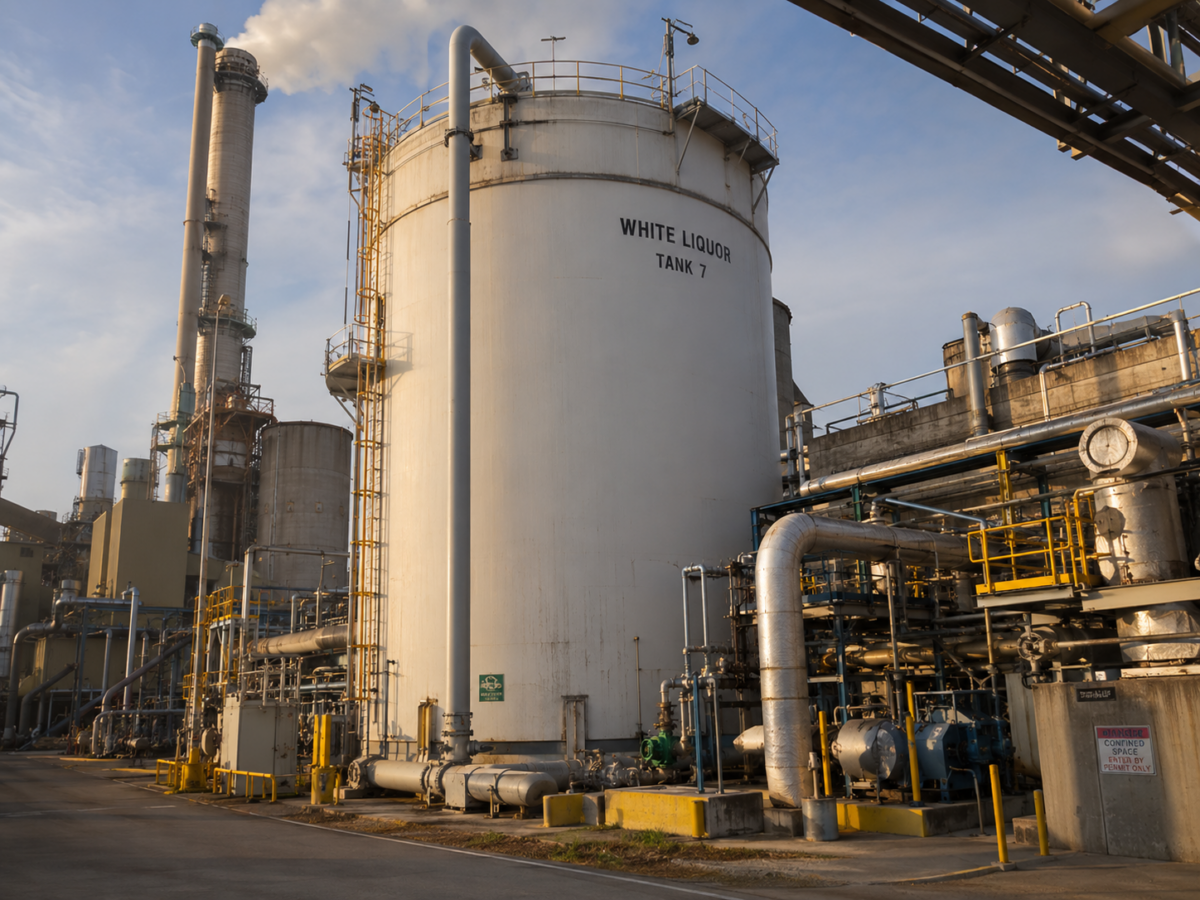
The danger is not just that white liquor is used in an industrial process. The danger is the combination of caustic chemistry, large storage volumes, industrial piping and tanks, possible pressure or vacuum conditions, heat, confined or semi-confined work areas, and the number of workers who may be nearby during normal operations. A sudden tank rupture can release a large volume of corrosive liquid and vapors, injure people with chemical exposure, create inhalation hazards, damage surrounding equipment, and complicate rescue efforts.
Chemical burns are different from thermal burns caused by flame. A caustic chemical can continue damaging skin, eyes, and tissue until it is removed or neutralized through proper emergency decontamination and medical care. Victims may need specialized treatment at burn centers, repeated surgeries, skin grafting, respiratory support, eye care, infection treatment, and long-term rehabilitation. Our law firm has more information for people suffering from chemical burn injuries and chemical inhalation injuries.
CSB Says G Tank Was Deemed “Not Fit for Continued Service” 10 Months Before the Failure
The CSB’s August 28 investigation update shows that concerns about G Tank’s condition had been documented months before the catastrophic failure.
In July 2025, an external visual inspection and ultrasonic thickness testing found that significant portions of the tank’s carbon-steel shell had thinned below the calculated minimum safe thickness. According to the CSB, the inspection contractor recommended an internal inspection and repairs to the lower shell courses and classified several findings as the highest priority. The report stated that the tank was not fit for continued service unless the identified deficiencies were corrected and warned of a high likelihood and consequence of failure.
Additional external inspections in October 2025 and February 2026 again found substantial areas of the tank shell below the calculated minimum safe thickness.
Despite those findings, the CSB says G Tank remained in service. Between the July 2025 inspection and the May 26, 2026 failure, the tank was not internally inspected or repaired, removed from service, or operated under reduced conditions.
The CSB has not yet issued its final conclusions about why the tank failed or why it remained in service. Those questions are now central to the agency’s ongoing investigation.
What Is the CSB Still Investigating After the Nippon Dynawave Tank Failure?
The CSB has not yet determined the final cause of the catastrophic G Tank failure, but the August 28 investigation update answers several questions that were open immediately after the incident.
Investigators have documented significant thinning of the tank’s carbon-steel shell below the calculated minimum safe thickness. They have also found that an inspection report issued about 10 months before the failure recommended an internal inspection and repairs, stated that the tank was not fit for continued service unless deficiencies were corrected, and warned of a high likelihood and consequence of failure. Later inspections in October 2025 and February 2026 again found substantial areas below the calculated minimum safe thickness.
The CSB is now investigating why G Tank remained in service without the recommended internal inspection or shell repairs and without being removed from service or operated under reduced conditions. Investigators are also examining the tank’s failure mode, Nippon Dynawave’s mechanical integrity practices, decisions involving inspection and repair, management of change, emergency response procedures, hazard evaluation, and applicable industry standards and regulatory requirements.
Those questions matter because determining how a catastrophic tank failure occurred is only part of an investigation. It is also important to understand what information was available before the failure, who received it, what actions were recommended, what decisions were made in response, and whether additional companies were involved in the tank’s inspection, engineering, maintenance or repair.
A civil legal investigation may examine many of the same records while serving a different purpose. Evidence can include the failed tank and components, inspection and thickness-testing reports, engineering recommendations, maintenance and repair records, process data, alarms, operator logs, internal communications, contractor records, safety audits, photographs, video and witness statements. Preserving that evidence early can be critical to determining what happened and whether a company may be legally responsible.
Pritzker Hageman’s fire and explosion injury lawyers work with engineers and other technical experts to investigate catastrophic industrial incidents involving serious burns and wrongful death. Our discussion of how burn injury lawyers investigate explosions nationwide explains why an independent legal investigation can begin while government agencies are still determining the cause.
Why Minimum Tank Wall Thickness Matters
One of the most important issues identified by the CSB is the condition of G Tank’s steel shell before the failure.
Industrial storage tanks are designed with minimum thickness requirements so that the tank wall can safely contain its contents under expected operating conditions. Over time, corrosion and other deterioration can reduce the thickness of the steel. When measurements show that portions of a tank have fallen below the calculated minimum safe thickness, engineers must determine whether repairs, replacement, reduced operating conditions or removal from service are necessary.
The CSB reports that ultrasonic testing of G Tank in July 2025 found significant portions of the lower tank shell below the calculated minimum safe thickness. Additional testing in October 2025 and February 2026 again identified substantial thinning.
The agency is examining Nippon Dynawave’s mechanical integrity practices and why the tank continued operating after those findings. The CSB is also evaluating applicable industry guidance, including standards used to assess whether an atmospheric storage tank can safely remain in service and whether operating restrictions are needed when its shell has deteriorated.
Mechanical integrity is especially important at facilities that store large quantities of hazardous or corrosive materials. Inspection programs must do more than identify deterioration. Facilities must also have systems for evaluating inspection findings, determining what corrective action is necessary and making sure serious deficiencies are addressed before equipment fails.
How Many People Were Killed or Injured in the Nippon Dynawave Tank Failure?
Eleven Nippon Dynawave Packaging employees were killed and three others were seriously injured when G Tank catastrophically failed on May 26, 2026, according to the CSB. Five additional employees and one firefighter were injured but did not require inpatient hospitalization.
The failed 1.2-million-gallon tank released approximately 900,000 gallons of white liquor at about 200 degrees Fahrenheit. White liquor is a highly alkaline chemical solution used in the kraft pulping process. The combination of its corrosive properties, high temperature and the enormous volume released created multiple hazards for workers in and around the tank area.
The release flooded the surrounding courtyard and entered nearby buildings where employees had gathered for morning meetings. The CSB also reports that an emergency responder suffered serious chemical burns after entering liquid he believed was water while attempting to reach an injured worker. The agency is examining the facility’s emergency response procedures as part of its ongoing investigation.
People who survive catastrophic chemical releases may face chemical and thermal burns, eye and respiratory injuries, traumatic injuries and lasting complications. Severe burns can require lengthy hospitalization, skin grafts, reconstructive surgery and extensive rehabilitation. Survivors may also need ongoing treatment for scarring, impaired mobility and the psychological effects of a catastrophic workplace incident.
Pritzker Hageman represents people with serious explosion and burn injuries and helps survivors understand whether another company may be legally responsible for their injuries. Families who lose a loved one may also have questions about whether they can pursue an explosion wrongful death lawsuit.
Can Injured Workers Sue After the Nippon Dynawave Explosion?
Many people injured in industrial disasters are workers. After a workplace injury in Washington, workers’ compensation may provide certain benefits regardless of fault. However, workers’ compensation may not fully compensate a worker or family for all losses caused by a catastrophic chemical burn, explosion injury, or wrongful death.
In many workplace disaster cases, an injured worker may also have a third-party claim if someone other than the worker’s employer or co-worker caused or contributed to the incident. Washington L&I explains that if someone other than the employer or co-worker caused a workplace injury or illness, the worker may be able to take legal action against that third party. In an industrial chemical tank failure, potential third parties may include outside maintenance contractors, inspection companies, engineering firms, equipment manufacturers, valve manufacturers, instrumentation suppliers, construction contractors, chemical suppliers, or other companies responsible for unsafe work at the site.
The facts matter. A third-party claim depends on evidence showing that another company or entity had a legal duty and failed to meet that duty. That is why it is important for injured workers and families to speak with lawyers who understand industrial explosions, chemical burns, and workplace third-party claims.
Pritzker Hageman’s explosion injury lawyers investigate whether victims have claims beyond workers’ compensation. In some cases, a lawsuit can seek compensation for pain and suffering, past and future medical expenses, lost income, loss of earning capacity, disability, disfigurement, emotional distress, loss of companionship, and other damages not fully addressed by workers’ compensation benefits.
Who Could Be Responsible for a Chemical Tank Explosion or Rupture?
It is too early to say who may be legally responsible for the Nippon Dynawave incident. Any responsible-party analysis must wait for a careful review of physical evidence, maintenance records, inspection history, engineering data, witness accounts, and regulatory findings. However, in chemical tank rupture cases, investigators often examine whether one or more parties failed to prevent a known or foreseeable hazard.
Potentially responsible parties in industrial explosion and chemical burn cases can include the facility operator, a parent company, a tank manufacturer, a tank installer, an engineering firm, an inspection company, a maintenance contractor, a valve or instrumentation manufacturer, a chemical process consultant, or another contractor working at the facility. In some cases, liability may involve defective design, defective equipment, negligent maintenance, inadequate inspections, improper repairs, failure to warn, poor training, unsafe procedures, or failure to follow industry standards.
An independent legal investigation may also uncover evidence that differs from early public statements. Initial explanations after an explosion are often incomplete. Evidence can reveal a preventable chain of events involving ignored warnings, inadequate tank inspections, missing safeguards, poor communication between contractors and facility personnel, or management decisions that allowed unsafe conditions to continue.
Our explosion lawyers understand that catastrophic industrial incidents are rarely “just accidents.” They are often the result of preventable failures that only become clear after a thorough investigation.
Why Families Should Act Quickly After a Chemical Explosion
After a catastrophic explosion or chemical release, companies and insurers often begin investigating immediately. They may send experts to the site, secure documents, interview witnesses, and develop their defense while injured people are still hospitalized and families are grieving. Victims and families deserve their own investigation.
Acting quickly can help preserve key evidence, including the failed tank, damaged valves and piping, inspection records, process data, safety meeting notes, contractor records, photographs, video, and witness testimony. Delay can make a case harder to prove because physical evidence can be altered, memories can fade, and critical documents can become more difficult to obtain.
Families should also be careful about giving recorded statements, signing documents, accepting quick payments, or communicating with insurance representatives before speaking with an experienced lawyer. After a severe burn injury or wrongful death, the full value of a case cannot be understood until the medical prognosis, long-term care needs, lost income, and liability evidence are carefully evaluated.
Pritzker Hageman Represents Explosion, Tank Rupture and Chemical Burn Victims in Washington State and Nationwide
Pritzker Hageman has decades of experience representing people injured in fires, explosions, chemical incidents, and catastrophic burn cases throughout the United States. Our burn injury legal team has recovered hundreds of millions of dollars for clients, including some of the largest burn injury recoveries in American history. Attorney Eric Hageman and our team understand the medical, financial, and emotional challenges burn survivors and families face after an industrial disaster.
We work with respected experts to investigate the cause of explosions and chemical releases. We also help clients and families deal with the practical problems that follow a disaster: medical care, insurance questions, income loss, disability, housing, transportation to burn centers, and long-term recovery planning.
If you or someone you love was injured in the Nippon Dynawave explosion, or if your family lost a loved one in the Longview chemical tank rupture, contact Pritzker Hageman for a free consultation. You can learn more about our work as explosion lawyers, chemical burn injury lawyers, and wrongful death explosion lawyers.
Contact a Nippon Dynawave Explosion Lawyer
The Nippon Dynawave chemical tank disaster is still under investigation. Families deserve answers about why the white liquor tank failed, whether warning signs were missed, whether the tank and related equipment were properly inspected, and whether preventable safety failures caused the injuries and deaths.
Pritzker Hageman is available to investigate claims involving the Nippon Dynawave explosion in Longview, Washington. Call us at 1-888-377-8900 or contact us online for a free, confidential consultation.
Related Pritzker Hageman resources:
Explosion Lawyer Helps Explosion Injury Victims Get Compensation and Justice
Explosion Burns Lawyer
Chemical Burn Injury Lawsuits
Chemical Inhalation Burn Lawsuit
Injured in an Explosion
Explosion Wrongful Death Lawsuit
Fire Lawsuit Attorney
The Pritzker Hageman Burn Injury Legal Team
Burn Injury Lawsuit FAQ