
Updated September 11, 2026: New York City has one of the country’s most detailed cooling-tower rulebooks. Yet the 2026 Upper East Side Legionnaires’ disease outbreak reached 93 confirmed cases and eleven reported deaths.
NYC tested 183 cooling towers at 160 buildings. Seventy-seven towers at 75 buildings tested PCR positive, 59 towers at 58 buildings tested culture positive for live Legionella, and 124 towers tested culture negative. All culture testing is complete.
On July 31, NYC Health declared that exposure associated with the Upper East Side Legionnaires’ disease cluster had ended. No cluster-related symptoms began during the previous two weeks, the disease’s two-to-14-day incubation period has passed, and there is no longer an elevated exposure risk in ZIP codes 10028, 10075, and 10128. The cluster stands at 93 cases and eleven deaths. As of September 9th, the city investigation had not identified the tower responsible for the outbreak.
NBC New York reported that the city issued more than 110 violations and found compliance issues at 60% of the cooling towers that had a positive outbreak test. The overlap does not show which cooling tower caused the outbreak or that any violation led to an illness. It does, however, give investigators a clear reason to look closely at whether the towers were properly maintained and tested, whether results were reported, and whether building owners, contractors, and city regulators did enough to prevent the outbreak.
On August 5, Governor Kathy Hochul signed Chapter 206. The law requires owners and operators to file cooling-tower certifications twice a year, act more quickly after dangerous microbial test results, keep inspection and testing records for 10 years, and face higher civil penalties.
NYC Health is now investigating a second community Legionnaires’ disease cluster this summer, this time in parts of Melrose and Morrisania in the South Bronx. The new South Bronx investigation makes the city’s 2026 testing, maintenance, and remediation requirements immediately relevant again.
Why so many positive cooling-tower results are a serious public-safety warning
Cooling towers are designed to bring air and recirculating water into close contact. That process releases tiny water droplets outdoors. The CDC explains that cooling towers release aerosolized water and that, when Legionella is present, those aerosols can carry bacteria far beyond the roof where the tower is located.
That makes a broad contamination signal fundamentally different from a problem confined to a private pipe or a single mechanical room. A tower can potentially affect people who live, work, attend school, receive medical care, shop, exercise, or simply walk nearby. The risk is determined by the amount and type of bacteria, tower operation, weather, plume movement, duration of exposure, and the vulnerability of exposed people. It is not limited to occupants of the listed building.
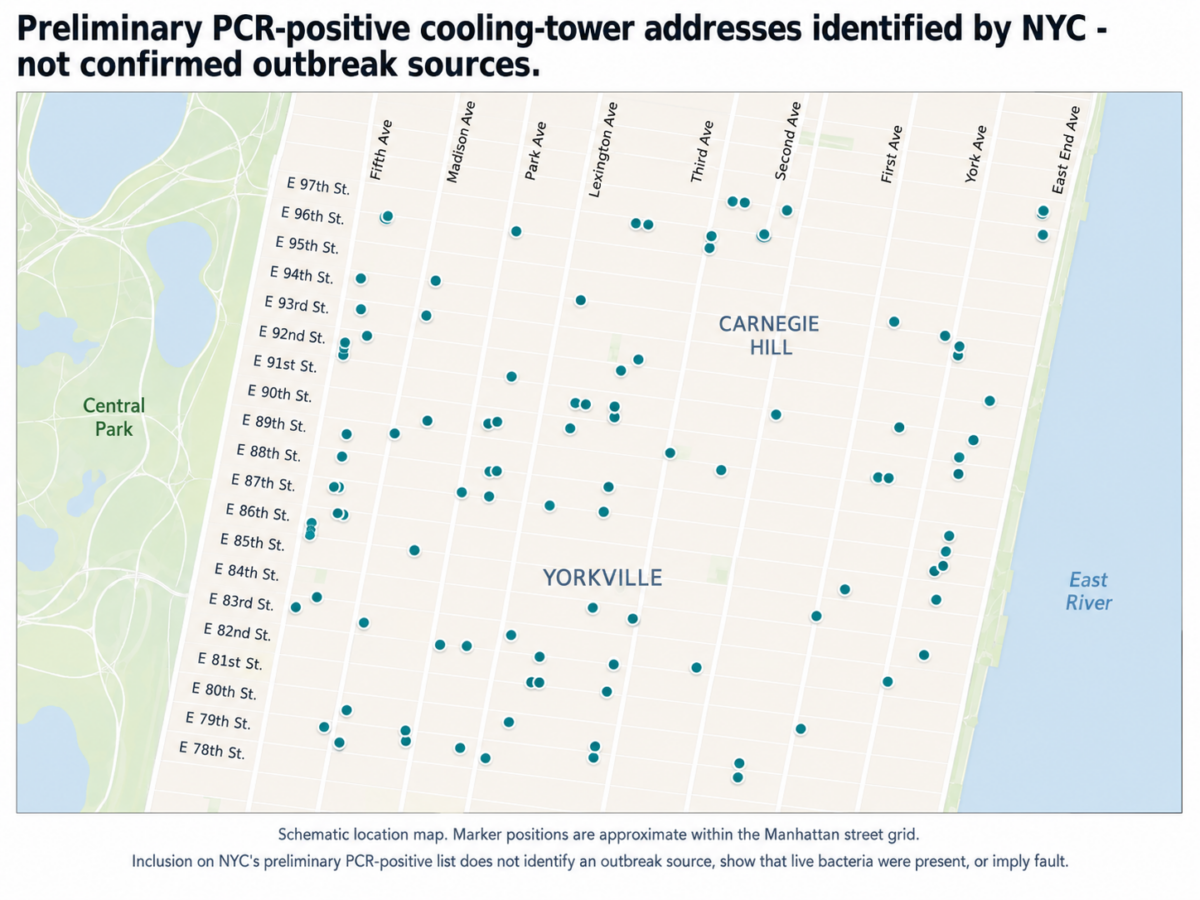
The scale matters because NYC tested 183 cooling towers at 160 buildings. The current city outbreak page reports that 77 towers at 75 buildings tested PCR positive in initial screening. Confirmatory culture testing found live Legionella in 59 towers at 58 buildings. In total, 124 towers tested culture negative. Those figures account for every tower tested, so no culture results remain pending.
A well-functioning regulatory system does not promise that every water sample will always be sterile. Legionella is common in natural and built water environments. It should, however, keep growth and aerosolization under control, identify deteriorating conditions before illness occurs, and trigger corrective action before an outbreak forces public-health officials to inspect an entire neighborhood.
The scale of the findings is too large to dismiss as a technical footnote
NYC’s July 29 culture-results list marks five towers that tested PCR negative and culture positive. That result shows why PCR and culture cannot be treated as interchangeable. PCR rapidly detects Legionella genetic material and may detect living or dead bacteria. Culture determines whether live bacteria were present when the sample was collected.
Across both methods, 82 towers at 80 buildings produced a positive result and were ordered to clean and disinfect. All completed remediation. The final culture results separated those towers into 59 culture-positive towers and 23 culture-negative towers. The live city page also reports 101 additional towers that were culture negative and are not included in the address-level PDF, bringing the investigation-wide culture-negative total to 124.
The city treated the testing signal as operationally significant before every culture result was available because an outbreak was already underway. The later enforcement findings add a second and independent reason for concern. NBC New York reported that inspectors found compliance issues at 60% of towers with a positive outbreak test. The responsible conclusion is not that all listed buildings caused the outbreak. It is that an unusually broad group of regulated systems required emergency remediation, and a substantial share also had documented compliance problems. That combination warrants tower-by-tower review of maintenance, testing, reporting, water treatment, corrective actions, and contractor oversight.
Diagnosed after spending time in the affected area?
Eleven reported deaths make the accountability questions more urgent
As of September 8, the NYC Health Department reported eleven deaths among 93 people diagnosed in the Upper East Side cluster. As of July 31, five people were currently hospitalized, 67 were no longer hospitalized, and 13 were not hospitalized. NYC says the July 29 culture-results list identifies the cooling tower at 300 E 83rd Street as unregistered. The tower tested PCR negative and culture negative. Those negative results do not erase the registration issue. Registration is a threshold legal requirement and a prerequisite for routine identification, inspection, and oversight.
The deaths raise the stakes for evidence preservation and accountability. Owners, managers, water-treatment vendors, maintenance contractors, laboratories, and other responsible parties should preserve water-management plans, test results, chemical-feed records, alarms, inspection reports, remediation records, communications, and contractor files.
Families and investigators need those records to determine what was known, what should have been known, whether warning signs were missed, and whether preventable failures contributed to the illnesses and deaths.
New York’s cooling-tower requirements are detailed, specific, and mandatory
New York City’s Cooling Tower Health Code does not merely tell owners to “keep the tower clean.” It assigns owners a detailed prevention system. New York State’s cooling-tower regulations add registration, maintenance, testing, certification, and enforcement requirements.
| Required protection | What the rule demands |
| Site-specific maintenance program and plan | Each system must have a written plan prepared by a qualified person. The plan must identify the owner, responsible personnel, contractors, tower components, operating conditions, risk factors, control measures, corrective actions, and communication procedures. |
| Weekly owner monitoring | A responsible person must inspect the system at least weekly while it is in use, document visible contamination and equipment conditions, and report anomalies for corrective action. |
| Qualified compliance inspections | A qualified person must conduct and certify a compliance inspection at least every 90 days while the system is operating. |
| Cleaning and aerosol control | The system must be cleaned when monitoring indicates a need and at least twice each year. Owners must maintain drift eliminators and operate towers to minimize aerosol release. |
| Ongoing water treatment | Operating towers must receive effective biocide treatment, with quantities and combinations sufficient to control Legionella, biofilm, scale, and corrosion. |
| Monthly Legionella culture testing | The current city code requires Legionella culture testing at least monthly, with no more than 31 days between sampling events during operation. |
| Rapid corrective action | Under the new law, microbial levels indicating a maintenance deficiency must be addressed as soon as possible and no later than 48 hours. Levels presenting a serious health threat require city notification and cleaning and disinfection as soon as possible and no later than 24 hours. |
| Summertime hyperhalogenation | Unless fully shut down and drained for the entire period, a system must undergo an annual higher-dose disinfection between July 1 and August 31, followed by culture sampling. |
| Records and twice-yearly certification | Owners must preserve maintenance, inspection, treatment, testing, cleaning, disinfection, and corrective-action records. Chapter 206 increases required inspection and testing record retention from three years to 10 years and requires owner or operator certifications in January and July, or on other dates set by the NYC Department of Buildings. |
| Stronger civil penalties | The new maximum penalties are $2,500 for a first violation, $7,000 for a second or later violation, and $12,500 when a violation is accompanied by or results in serious injury or death. |
These are not aspirational best practices. They are legal duties directed at the conditions that allow Legionella to multiply and spread: stagnant water, biofilm, sediment, scaling, corrosion, poor disinfectant control, inadequate cleaning, and uncontrolled aerosols.
What New York’s August 2026 cooling-tower law changes
Chapter 206 adds four major requirements to the rules governing cooling towers in New York City:
1. Twice-yearly certification. Owners or operators must file certifications in January and July, or on other dates set by the New York City Department of Buildings. The city must send an electronic reminder at least 30 days before each deadline.
2. Faster action after concerning test results. A maintenance deficiency must be addressed as soon as possible and no later than 48 hours after the owner knows or reasonably should know of the result. A serious health threat requires city notification and cleaning and disinfection as soon as possible and no later than 24 hours.
3. Longer record retention. Owners must keep inspection and testing records for at least 10 years instead of three. Longer retention can help regulators, patients, and independent investigators determine whether a tower had repeated warning signs or recurring control problems.
4. Higher civil penalties. The maximum penalty increases to $2,500 for a first violation, $7,000 for a second or later violation, and $12,500 when a violation is accompanied by or results in serious injury or death.
The 24-hour and 48-hour response provisions take effect 30 days after the law was signed. Most other changes take effect after 90 days.
Twice-yearly certification does not mean that a government inspector must visit every cooling tower twice a year. It means the owner or operator must file two statements certifying that required inspection, testing, cleaning, disinfection, and planning duties were completed.
Existing 90-day qualified-person inspections, monthly Legionella testing, weekly monitoring, and city enforcement remain separate protections.
The problem is not a lack of knowledge
The mechanics of prevention are not mysterious. The CDC cooling-tower control guidance identifies sediment, biofilm, temperature, water age, and disinfectant residual as key factors. It recommends automated treatment, control of stagnation, regular monitoring, cleaning and disinfection, high-efficiency drift eliminators, and detailed records. The CDC also calls an effective Legionella water management program the primary strategy for preventing growth and spread.
When a large building claims that Legionella risk was unforeseeable, the rulebook answers that claim. New York’s laws identify the hazard, assign responsibility, specify the people who must act, define testing and cleaning intervals, and require documentation. The open question is whether owners and their contractors actually perform the work with enough rigor, whether regulators verify that performance, and whether noncompliance carries consequences large enough to change behavior.
High Line Hotel water system tests positive for Legionella
A separate Legionella finding at The High Line Hotel in Chelsea shows that New York City’s Legionella concerns are not limited to cooling towers.
The New York Post reported on August 7 that testing at the hotel found Legionella at 170 colony-forming units per milliliter (CFU/mL), followed by a later result of 700 CFU/mL. CFU/mL is a laboratory measurement of the amount of live bacteria capable of growing from a water sample.
The High Line Hotel is located at 180 Tenth Avenue in Chelsea, outside the three Upper East Side ZIP codes involved in the 2026 community outbreak. The New York City Health Department confirmed to the Post that it received a complaint concerning the hotel and was working with the hotel and the Hotel & Gaming Trades Council to ensure compliance.
The distinction between a cooling tower and a building’s plumbing system matters. Cooling towers can release contaminated mist into the outdoor air and expose people beyond the building itself. Legionella can also grow inside a hotel’s plumbing, particularly hot-water systems, where people may be exposed by breathing in mist from showers, faucets, and other water fixtures.
Hotels require careful water management because guests regularly use showers, faucets, and other fixtures that can create water mist. A positive Legionella result makes the hotel’s testing history, water-management practices, corrective actions, and response to the positive results important to understand. People who develop Legionnaires’ disease after a hotel stay may also need to reconstruct where they stayed and when so that medical and environmental evidence can be compared as part of a hotel Legionnaires’ disease investigation.
Prominent names do not reduce the seriousness of the findings
The city’s preliminary list includes addresses publicly associated with the Metropolitan Museum of Art, the Solomon R. Guggenheim Museum, the Chapin School, the Dalton School, the Spence School, Ramaz Middle School, Trevor Day School, Asphalt Green, Whole Foods Market, luxury apartment buildings, and many other residential and institutional properties. The official city list and public reporting about the expanded list provide the current address-level information.
Again, being listed does not establish that any named institution caused an illness or broke the law. The prominence of the locations matters for a different reason. These are not obscure systems operating beyond the reach of professional building management. Many are properties with substantial resources, sophisticated facilities teams, outside consultants, and large populations of residents, students, workers, members, or visitors.
Prestige is not a water management program. A famous museum, elite school, luxury building, or national retailer does not receive a biological exemption. In fact, a high-profile institution with substantial resources should be capable of setting a higher standard for preventive maintenance, documentation, contractor oversight, and public communication.
A plan on paper is not the same as a controlled cooling tower
Legionella regulation can fail when compliance becomes a paperwork exercise. A building can possess a binder labeled “water management plan” while failing to act on the plan’s control limits, alarms, test results, and recurring warning signs. Logs can be incomplete, copied forward, filled in late, or accepted without meaningful review. Contractors can perform scheduled visits without fixing the underlying hydraulic or treatment problem.
A twice-yearly certification can still describe compliance while the day-to-day system is drifting out of control if the filing is not supported by accurate records, competent work, and meaningful verification.
That is why a real Legionnaires’ disease liability investigation does not stop at asking whether a plan existed. It asks whether the plan was site-specific, scientifically adequate, followed in practice, updated when the system changed, and supported by authentic contemporaneous records.
Owners also should not be allowed to outsource accountability. A water-treatment vendor, facilities manager, engineer, pesticide applicator, and property manager may each have assigned tasks. The owner still controls the premises and selects, supervises, and pays the team. A contract can allocate work. It cannot make the public-health duty disappear.
City inspection findings make the positive tower results more concerning
NBC New York reported that the Health Department issued more than 110 violations during its Upper East Side cooling-tower inspections and found compliance issues at 60% of the towers that had a positive outbreak test. More than fifteen buildings received at least one violation in the most serious public health hazard category. More than fifty of the over 110 violations were classified as critical, including failures to report testing results. General violations included late submissions.
The 60% figure is the clearest city-scale measure currently available of the overlap between a positive outbreak test and documented noncompliance. It does not establish that every violation involved contamination, that every positive tower violated the same rule, or that any listed tower caused a patient’s illness. It does show that compliance problems were not isolated to one or two systems.
At 1520 York Avenue, the tower was initially PCR positive and later culture negative. NBC reported nine public health hazard violations and $9,000 in fines involving failures to test for Legionella every 31 days and the absence of the required cooling-tower maintenance plan. The culture-negative result means live Legionella was not recovered from that sample. It does not make the violations irrelevant to whether the system was being managed as the law required.
The new 60% figure should not be confused with the earlier approximately 59% figure from a New York Post review of prior city records. The earlier analysis covered cooling towers across the three affected ZIP codes and violations issued between March 2025 and March 2026. The newer figure concerns towers with a positive result during the 2026 Upper East Side outbreak and compliance issues identified by the Health Department.
A violation is not automatically evidence that a tower caused this outbreak. It can still matter. Requirements for monthly testing, a site-specific maintenance program, timely reporting, water treatment, cleaning, and corrective action exist to identify and control the conditions in which Legionella can grow and spread. When a tower has both a positive outbreak test and documented compliance failures, investigators should preserve and examine the full record rather than treating remediation as the end of the inquiry.
The city had previously reported nearly 1,600 cooling-tower inspections during the first six months of 2026, a 35% increase over the same period in 2025. For Fiscal Year 2025, it reported 1,337 cooling-tower violations and approximately $680,000 in collected fines. The current over 110 violations show that compliance and enforcement remained active issues inside the outbreak investigation itself.
City inspection gaps are an enforcement concern, not a transfer of the owner’s duty
A Gothamist analysis of public data and Health Department figures reported that, as of late June, city employees had inspected 1,306 of nearly 6,000 cooling towers since the start of 2026. The Health Department told Gothamist that 114 additional June inspections were not yet reflected in the shared data, which would have brought the total to 1,420. Gothamist also reported that 48% of the 179 towers in the three outbreak ZIP codes had gone more than a year without a city inspection and that about 26% had no owner-submitted 2026 Legionella test on record.
Those findings justify scrutiny of city staffing, inspection capacity, and enforcement. They do not shift the building owner’s legal duties to the city. New York City Health Code Chapter 8 applies directly to owners. It requires an owner to maintain a site-specific program and plan, designate a responsible person to monitor the system at least weekly, retain a qualified person to perform a compliance inspection at least every 90 days while the tower is operating, preserve records, and complete required corrective actions.
City inspections are an additional enforcement backstop. They are not a substitute for the owner’s day-to-day duty to register, monitor, test, treat, clean, disinfect, document, and correct the cooling-tower system. An owner may assign tasks to a property manager, facilities team, engineer, or water-treatment contractor, but a contract cannot make the owner’s public-health duty disappear.
The city’s later report of nearly 1,600 inspections during the first half of 2026 and Gothamist’s earlier late-June data snapshot may reflect different reporting cutoffs or completed-inspection datasets. Both support careful scrutiny of how quickly the city can verify compliance across the regulated inventory, without excusing an owner’s failure to perform the maintenance and testing duties imposed directly on the owner.
The correct next step is a tower-by-tower review of maintenance plans, laboratory reports, water-treatment logs, inspection records, chemical-feed data, alarms, prior positive results, corrective actions, contractor invoices, and communications. The public should be told whether each listed system was in full compliance before the outbreak, not merely whether it was cleaned after investigators arrived.
The current culture-results list still identifies an unregistered cooling tower
NYC’s July 29 culture-results list identifies the cooling tower at 300 E 83rd Street as unregistered. The tower tested PCR negative and culture negative. Those negative results do not erase the registration issue. Registration is a threshold legal requirement and a prerequisite for routine identification, inspection, and oversight. The owners of 300 E 83rd Street were issued eleven violation citations and $11,000 in fines.
Four-figure penalties are not enough for wealthy or repeat offenders
The new penalties are higher, but enforcement still determines whether they prevent harm
Chapter 206 raises the maximum civil penalties for cooling-tower violations to $2,500 for a first violation and $7,000 for a second or later violation. A violation that is accompanied by or results in serious injury or death can carry a maximum penalty of $12,500.
Those increases are meaningful, especially for repeat violations and violations connected with severe harm. Penalties only deter unsafe practices, however, when regulators detect violations, issue them promptly, require correction, and escalate the response when an owner repeatedly fails to comply.
For a large institution, luxury property, or major commercial building, even a five-figure penalty may be small compared with the cost of rigorous prevention or major system repairs.
A strong enforcement system should also use technical audits, public reporting, repeat-offender consequences, and operational restrictions when a tower cannot be safely controlled.
New York has already had a decade of warnings
The 2015 South Bronx outbreak led New York City and New York State to create cooling-tower registration, maintenance, testing, and inspection requirements. Those reforms were adopted because cooling towers had demonstrated their ability to spread a dangerous pathogen through a dense urban community.
The warning was renewed in 2025. A Central Harlem outbreak caused 114 diagnosed illnesses and seven deaths. The city ultimately identified cooling towers at Harlem Hospital and a nearby city public-health laboratory construction site as sources, according to Associated Press reporting on the official findings. Politico reported that the cooling tower at the public-health laboratory construction site had not been registered before the city inspected it.
A cooling tower at a public-health laboratory construction site should not reach an outbreak investigation before basic registration is completed. That failure is especially troubling because registration is the foundation for inspection and accountability. If a tower is absent from the system that regulators use to find towers, every later safeguard becomes harder to enforce.
The 2025 outbreak prompted discussion of more frequent testing, larger penalties, and additional technical staff. The 2026 Upper East Side outbreak now tests whether those lessons produced a genuinely stronger system or only another round of promises after people became sick.
Why the problem keeps coming back
1. Responsibility is fragmented, but risk is not
Modern properties divide cooling-tower work among owners, managers, engineers, water-treatment firms, maintenance contractors, laboratories, and pesticide applicators. Each may assume someone else is watching the whole system. Legionella exploits the gaps between those assignments. A strong owner identifies one accountable management team, verifies performance, and treats contractor reports as evidence to review rather than assurances to file away.
2. Testing is only a snapshot
A culture result describes a sample collected at a particular place and time. Conditions can change quickly with heat, heavy cooling demand, shutdowns, water stagnation, disrupted chemical feed, construction, debris, or a failed pump. Monthly testing is an improvement over longer intervals, but it cannot replace continuous process control and competent weekly monitoring.
3. Self-certification is vulnerable without aggressive verification
The rules rely heavily on owners and retained professionals to create plans, keep logs, conduct inspections, submit results, and certify compliance. That model can work when owners are diligent and regulators conduct meaningful audits. It fails when incomplete records are accepted, inspections become predictable, violations remain open, or regulators lack enough specialized staff to examine whether a tower is truly controlled.
4. Low penalties can normalize noncompliance
When the financial consequence of missing testing, cleaning, or corrective-action obligations is small compared with the cost of operating a major Manhattan property, enforcement loses its preventive force. Owners who invest in safety should not be placed at a competitive disadvantage against owners who defer work and pay occasional fines.
5. Heat, aging equipment, and dense development increase the challenge
Warm weather, older infrastructure, high cooling demand, and dense clusters of towers create favorable conditions for bacterial growth and community exposure. The city health commissioner has discussed climate-related risk, and reporting on the outbreak’s climate context describes how warmer conditions may increase the challenge. Climate is a risk multiplier, not an excuse. A foreseeable increase in risk requires stronger prevention, not lowered expectations.
6. Source confirmation is slow, which can postpone accountability
PCR provides fast screening, but culture testing can take up to two weeks. Matching a patient isolate to an environmental isolate may take longer and may be impossible if clinicians did not collect a respiratory specimen before antibiotics. During that delay, records can be lost, systems can be altered, and public attention can move on. Owners and regulators must preserve evidence immediately, even while the final source determination remains open.
Publishing the addresses is a major and overdue change
In prior community outbreaks, New York City’s public-facing communications generally identified the affected neighborhood, the number of positive towers, and eventually a confirmed source when laboratory and epidemiologic evidence supported one. Based on our review of prior public notices, the city did not routinely publish a contemporaneous address-by-address list of every tower with a preliminary positive screening result.
That changed during the Upper East Side investigation. Public pressure for greater transparency grew as the case count rose. City Council Speaker Julie Menin called for immediate action and greater disclosure. The Health Department first published 31 addresses and then expanded the official list to 76 addresses.
The Health Department later added a separate confirmatory culture-results list. The July 28 version identifies 59 culture-positive cooling towers at 58 buildings and marks five addresses with towers that tested PCR negative and culture positive. Publishing culture results is important because it distinguishes a preliminary genetic-material screen from confirmation that live Legionella was present when the sample was collected. NYC says, as of July 31, all 183 culture tests have been completed.
The city may previously have had legitimate concerns about unfairly stigmatizing a building before a source was confirmed. That concern can be addressed with precise labels and repeated caveats. It should not require withholding information that can help sick people, physicians, investigators, journalists, and the public understand a fast-moving neighborhood outbreak.
Why address-level transparency matters
- It helps patients reconstruct exposure. A person may not remember every building name, but an address list can help identify work, appointments, school visits, shopping, exercise, caregiving, deliveries, or time spent near a tower during the incubation window.
- It gives clinicians a more specific reason to test. A patient who says “I was on the Upper East Side” may be overlooked. A patient who can describe repeated time near an active investigation area may prompt a more focused Legionella evaluation and respiratory culture.
- It allows inspection history to be examined. Address disclosure lets the public compare preliminary findings with registration, sampling, violation, and remediation records.
- It prevents quiet remediation from becoming the end of the story. Emergency cleaning is necessary, but it should not erase questions about what happened before the outbreak and whether warning signs were missed.
- It improves accountability without deciding causation. Transparency does not require the city to accuse every listed owner. It requires the city to disclose what it found, explain what the finding means, and update the public as culture and epidemiologic evidence develops.
- It helps independent investigations. Attorneys, epidemiologists, engineers, and industrial hygienists can identify records that must be preserved before documents disappear and systems are materially changed.
The old secrecy created real disadvantages
When addresses were not published during an active investigation, property owners and government investigators possessed information that patients did not. Sick people had to reconstruct exposure with an incomplete map. Physicians had less context. Nearby workers and residents could not tell whether a tower they passed every day was among the systems under investigation. Journalists and lawyers had to rely on delayed record requests or unofficial leaks.
That information imbalance also protected poor performers. A property could complete remediation without public scrutiny of its prior testing, maintenance, violations, or contractor oversight. If the tower was not ultimately identified as the outbreak source, the public might never learn that it required emergency disinfection during the investigation.
Public disclosure changes that balance. It does not establish legal fault, but it makes it harder for owners, contractors, and regulators to treat a broad contamination signal as a private operational problem.
Transparency must remain accurate and fair
Address publication should not become a substitute for scientific source identification. Every list should clearly distinguish PCR screening from viable culture results, identify the sample date, report remediation status, explain whether the tower was operating, and state whether the building has been linked to any patient exposure.
The city should also correct errors quickly. Address aliases, shared cooling-tower systems, mixed-use properties, and neighboring lots can create confusion. A public dashboard should identify the registered tower system, building identification number, owner or responsible entity, sample type, culture result when available, remediation date, and current operating status.
The answer to incomplete information is better information, not silence.
What meaningful accountability should look like
- Immediate preservation orders. Owners and contractors should preserve original electronic logs, controller data, alarm histories, service reports, laboratory submissions, invoices, emails, photographs, and access records from before and during the outbreak.
- Independent audits of every listed tower. A post-cleaning certificate should not replace a review of whether the pre-outbreak program complied with law and controlled risk.
- A real-time public cooling-tower dashboard. Registration, test dates, violation status, corrective actions, and outbreak-related findings should be searchable without specialized record requests.
- Automatic escalation for missing data. A missed Legionella result, expired certification, unregistered tower, or overdue corrective action should trigger rapid inspection and meaningful enforcement.
- Penalties proportionate to the operator. Fines should be large enough that compliance is always cheaper than delay, especially for repeat offenders and large institutions.
- Accountability across the contracting chain. Owners, managers, water-treatment companies, engineers, laboratories, and maintenance contractors should each be answerable for the work they controlled.
- Public after-action reports. When the investigation ends, the city should publish what went wrong, which systems contained viable outbreak strains, what violations or control failures were found, and what changes will prevent recurrence.
Questions every listed owner and operator should be prepared to answer
- Was the cooling tower registered and accurately described in the city system before the outbreak?
- Was the maintenance program truly site-specific, current, implemented in practice, and accurately reflected in every required certification?
- Were all monthly Legionella cultures collected on time and submitted to the city?
- Did weekly inspections identify biofilm, sediment, scaling, corrosion, low chemical supply, equipment problems, or stagnant zones?
- Were disinfectant residuals maintained throughout operation, and do controller data support the written logs?
- Were prior positive cultures or elevated biological indicators followed by timely corrective action and retesting?
- Was the annual summertime hyperhalogenation completed properly, documented, and followed by required culture testing?
- Did the owner audit its water-treatment contractor, or simply accept service reports without verification?
- Were drift eliminators, fill material, basins, sumps, nozzles, and low-flow components physically inspected and cleaned?
- What changed between the last “compliant” certification and the emergency cleaning ordered during this outbreak?
These are the kinds of questions our Legionnaires’ disease legal team examines when determining who controlled a contaminated water system, what prevention measures were required, and whether failures contributed to illness.
What the address list means for people who became sick
People who developed pneumonia after living, working, or spending time in Carnegie Hill or Yorkville should not wait for the city to announce a final source before preserving evidence. The relevant exposure period generally precedes symptom onset, and the investigation can change as new cases, culture results, and patient interviews are added.
Seek medical care promptly and tell the provider about the Upper East Side outbreak. Ask whether both urinary antigen testing and a respiratory culture are appropriate. Our Legionnaires’ disease symptoms and diagnosis resource explains common symptoms and testing issues.
Write down every place you lived, worked, visited, exercised, shopped, received care, attended school, or spent substantial time during the two weeks before symptoms. Save calendars, receipts, transit records, delivery records, work schedules, phone location history, photographs, and names of witnesses. See what to do after contracting Legionnaires’ disease and the five steps our lawyers use to prove a Legionnaires’ disease case.
A preliminary positive address is not enough to prove a lawsuit. A final government source announcement is not always required before an independent investigation begins. Medical evidence, exposure history, epidemiology, wind and plume analysis, environmental testing, maintenance records, and evidence of regulatory noncompliance can all become important.
Property owners and contractors have immediate access to records that victims may need months later. Early legal action can help preserve those records and identify applicable deadlines, including shorter notice requirements that may apply to government entities. Learn more about Legionnaires’ disease lawsuits and compensation or contact Pritzker Hageman for a free consultation. Our national Legionnaires’ disease team handles serious illness and wrongful-death cases across the United States.
Contact the Pritzker Hageman Legionnaires’ legal team and find out how you can get compensation and justice
1-888-377-8900 (Toll-Free) | [email protected]

The broader lesson: prevention cannot begin after the ambulance arrives
New York deserves credit for testing every known cooling tower in the investigation zone, ordering rapid cleaning based on PCR screening, and finally publishing the addresses. NYC Health says those actions eliminated the source of exposure and, while late, eventually provided the public with information it should have had earlier.
But emergency response is not the same as prevention. The purpose of a water management program, routine testing, inspections, corrective actions, registration, recordkeeping, and enforcement is to control Legionella before a cluster of pneumonia cases exposes the failure.
Chapter 206 addresses several weaknesses by requiring twice-yearly certification, faster action after concerning microbial results, 10 years of inspection and testing records, and higher penalties. Those changes can improve accountability, but they do not replace continuous water treatment, competent weekly monitoring, accurate laboratory reporting, independent verification, or prompt city enforcement.
The Upper East Side findings should end any comfortable assumption that detailed regulations automatically produce safe towers. Rules matter only when owners follow them, contractors perform competent work, records reflect reality, inspectors verify performance, violations are corrected, and penalties are large enough to deter neglect.
If the final investigation identifies a specific source, the responsible parties should be held accountable. If it identifies several sources or a broader pattern of unsafe tower conditions, the response must be broader still. New Yorkers should not have to wait for another deadly outbreak to find out whether the city’s cooling-tower safety system works.
Frequently asked questions about NYC’s PCR-positive cooling-tower findings
Cooling towers aerosolize recirculating water into the outdoor air. NYC tested 183 towers at 160 buildings. Seventy-seven towers tested PCR positive, and confirmatory culture found live Legionella in 59 towers. All 183 culture results are now complete: 59 towers tested positive and 124 tested negative. The outbreak reached 93 cases and eleven deaths. NBC New York reported that inspectors found compliance issues at 60% of towers with a positive outbreak test.
No. PCR can detect DNA from living or dead Legionella. Investigators use culture testing, patient information, environmental evidence, and epidemiology to determine whether viable bacteria were present and whether a particular source is linked to cases.
It is possible for a sensitive PCR test to detect Legionella DNA even when a system has been treated, and a positive result alone is not proof of a violation. The key legal and technical questions are whether the owner maintained effective control, followed required testing and corrective-action rules, responded to warning signs, and kept accurate records.
NBC New York reported that the Health Department found compliance issues at 60% of the cooling towers that had a positive result during the outbreak investigation. The city issued more than 110 violations. This does not mean 60% of the towers caused illness. It means documented noncompliance overlapped with a substantial share of the systems that triggered emergency public-health action.
The law requires the owner or operator to file a certification twice each year stating that the cooling tower was inspected, tested, cleaned, and disinfected as required and that a maintenance program and plan is in place. Existing rules separately require qualified-person compliance inspections at least every 90 days while a tower is operating, and city health officials can conduct enforcement inspections.
Potentially responsible parties can include the property owner, building manager, cooling-tower operator, water-treatment contractor, maintenance company, engineer, consultant, or another entity that controlled the system or failed to perform assigned safety work. Responsibility depends on the evidence.
The city released address lists during a high-profile, expanding investigation after growing public pressure for transparency. The lists allow residents, workers, clinicians, and investigators to understand which systems required emergency remediation, while repeated warnings make clear that the addresses are not confirmed outbreak sources.
Detailed rules can fail when owners treat compliance as paperwork, responsibility is fragmented among contractors, testing misses rapidly changing conditions, regulators lack sufficient specialized oversight, or penalties are too small to deter delay. Heat, aging equipment, and dense development increase the challenge but do not excuse preventable maintenance failures.
Preserve medical records, laboratory results, the date symptoms began, a two-week location history, work and school schedules, receipts, transit and phone location data, photographs, witness names, and communications from buildings or employers. Early preservation can be important because towers may be cleaned and records may change during an investigation.
Yes. An attorney can begin preserving evidence, reviewing exposure history, monitoring public-health findings, and identifying deadlines before the source investigation is complete. A preliminary address list does not prove a claim, but waiting can make evidence harder to obtain.
Key sources and supporting resources
- New York Governor: August 5, 2026 cooling-tower legislation signing announcement
- New York State Assembly: A.9058-A full bill text, memorandum, and legislative history
- NYC Health Department: Current Upper East Side case count, testing totals, and public guidance
- Pritzker Hageman: Current New York Legionnaires’ disease outbreak update and address directory
- Pritzker Hageman: Determining liability for a Legionnaires’ disease outbreak
- Pritzker Hageman: Legionnaires’ disease lawsuits and compensation
- NYC Health Department: Cooling Tower Confirmatory Culture Results, updated July 29
- NYC Health Department: Cooling Tower Confirmatory Culture Results, updated July 28
- NYC Health Department: Cooling Tower Confirmatory Culture Results, updated July 27
- NYC Health Department: July 21 update on the fifth death, 82 cases, confirmatory culture results, inspections, and remediation
- NYC Health Department: Cooling Tower Confirmatory Culture Results, updated July 21
- NYC Health Department: July 20 preliminary PCR-positive cooling-tower address list
- Gothamist: NYC Legionella inspections rose only gradually before the latest Manhattan cluster
- New York City Council: July 21 announcement of September oversight hearing and possible legislative changes
- New York City Health Code Chapter 8: Cooling Towers
- New York State Subpart 4-1: Cooling Towers
- CDC: Controlling Legionella in Cooling Towers
- CDC: Legionella control toolkits and water management programs
- NYC Health Department: July 18 outbreak update on remediation completion, testing status, enforcement data, and the second death
- Associated Press: Second death reported in the Upper East Side Legionnaires’ disease outbreak
- Associated Press: Confirmed sources of the 2025 Central Harlem outbreak
- Gothamist: NYC Legionella inspections rose only gradually before latest Manhattan cluster
- Gothamist: NYC doubles Legionnaires’ inspectors, triples testing frequency ahead of summer
- NYC Health Department: New 31-day testing rules and planned expansion to 56 inspectors
- Pritzker Hageman: Current New York Legionnaires’ disease outbreaks and address directory
Additional Information About Legionnaires’ Disease
- Legionnaires’ Disease Frequently Asked Questions (FAQs)
- Where Does Legionnaires’ Disease Come From?
- Legionnaires’ Disease: Symptoms and Diagnosis
- What to do if You Contract Legionnaires’ Disease
- Legionnaires’ Disease: Determining Liability
- Legionnaires’ Disease: Lawsuits and Compensation
- Legionnaires’ Disease: Wrongful Death Cases
- Finding a Legionnaires’ Disease Lawyer
- Filing a Legionnaires’ Disease Lawsuit
- The Importance of Water Management Plans
We have obtained 100+ separate verdicts and settlements greater than $1 million:
We obtained this result on behalf of three people sickened in a Legionnaires’ disease outbreak at a resort hotel.
We obtained this settlement on behalf of six people impacted by a Legionnaires’ disease outbreak linked to a hotel hot tub.
Our client contracted Legionnaires’ disease at a hotel and was hospitalized for eight weeks.
We obtained this settlement on behalf of the family of a woman who died after contracting Legionnaires’ Disease.
We obtained this result on behalf of clients who contracted Legionnaires’ disease from a hotel HVAC cooling tower.
On behalf of a client sicked from contaminated water at a senior care facility.
Our client contracted Legionnaires’ disease at a hotel and was hospitalized for over a month.
On behalf of a women hospitalized for over two months from a contaminated hotel hot tub in Myrtle Beach.
We obtained this settlement for a woman sickened with Legionnaires’ disease after being exposed in a hotel hot tub.
We obtained this settlement for the family of a 52-year old man who died of Legionnaires’ disease linked to a hotel.
We collected this on behalf of a client who contracted Legionnaires’ disease from contaminated water at a hotel.
We recovered this settlement for the family of a 50-year old man who died of Legionnaires’ disease after being exposed to legionella bacteria at a hotel.
Collected on behalf of the family of a man who died as a result of Legionnaires’ Disease contracted while staying at a Wisconsin resort.
We obtained this on behalf of a man hospitalized after Legionella bacteria exposure at a hotel.
See more settlements & verdicts.
The Pritzker Hageman law firm and our attorneys have been recognized in:
U.S. News & World Report

Pritzker Hageman has been recognized as one of the best law firms for personal injury litigation by U.S. News & World Report every year the award has been given since 2012.
Super Lawyers®, Thomson Reuters

Attorneys at Pritzker Hageman have been awarded the peer selected Super Lawyers distinction every year since 2004.
America’s Top 100 Attorneys®

Lifetime Achievement selection to America’s Top 100 Attorneys®.
Three Time Attorneys of the Year

Pritzker Hageman lawyers have been named Attorneys Of The Year by Minnesota Lawyer three times.