
Updated October 1, 2026. NYC Health says the elevated risk from the South Bronx Legionnaires’ disease cluster has ended, but the department has not yet identified which cooling tower caused the illnesses.
NYC Health has identified 23 people with Legionnaires’ disease. Two people died, two remain hospitalized, 17 have been discharged, and two did not require hospitalization.
The New York City Health Department announced on September 30 that the source of exposure in parts of Melrose and Morrisania had been eliminated.
All cooling towers that tested positive for Legionella were cleaned by September 15, and more than two weeks have passed without anyone associated with the cluster developing new symptoms. Because Legionnaires’ disease can take up to 14 days to develop after exposure, NYC Health says this confirms the elevated risk of exposure has ended.
The exact cooling tower responsible for the illnesses has not been identified. NYC Health is using whole genome sequencing to compare live Legionella recovered from cooling towers with bacteria found in patient samples. Results are expected by late fall.
The investigation centered on parts of Melrose and Morrisania in ZIP codes 10451 and 10456. During the response, NYC Health expanded community outreach to nearby ZIP codes 10455 and 10459.
What We Know About the South Bronx Legionnaires’ Cluster
- Cases: NYC Health has identified 23 people with Legionnaires’ disease associated with the cluster.
- Deaths: Two people died.
- Hospitalizations: Two people remain hospitalized, 17 have been discharged, and two people did not require hospitalization.
- Location: The cluster involved parts of Melrose and Morrisania in the South Bronx. The investigation centered on ZIP codes 10451 and 10456, with community outreach also extending into 10455 and 10459.
- Current risk: NYC Health says the elevated risk of exposure has ended.
- Cooling towers tested: NYC Health sampled 24 cooling tower systems.
- PCR results: Ten cooling towers initially tested positive for Legionella by PCR.
- Culture results: Seven of those towers tested culture positive, confirming live Legionella was present. The other three were culture negative. Overall, 17 of the 24 cooling towers tested culture negative.
- Remediation: All 10 cooling towers that initially tested positive were cleaned and disinfected.
- Has the exact source been identified? No. NYC Health has not publicly identified which cooling tower caused the illnesses. Whole genome sequencing is still underway.
Pritzker Hageman’s Legionnaires’ disease lawyers investigate exposure sources, environmental testing, water-management records, maintenance practices, and other evidence that can help determine how an outbreak occurred.
Call 1-888-377-8900, text 612-261-0856 or contact us online for a free, confidential consultation. You never pay anything unless we win for you.
Diagnosed after visiting the affected area?
Has the Source of the South Bronx Legionnaires’ Disease Cluster Been Found?
No. NYC Health says the source of exposure has been eliminated and the elevated risk has ended, but it has not publicly identified which cooling tower caused the South Bronx Legionnaires’ disease cluster.
During the investigation, initial PCR testing detected Legionella at 10 cooling towers. Follow-up culture testing confirmed live Legionella in seven of them. A positive culture means live Legionella was growing in the sampled water, but it does not by itself prove that a particular cooling tower caused anyone’s illness.
NYC Health is now using whole genome sequencing to compare live Legionella recovered from cooling towers with bacteria found in patient samples. Results are expected by late fall.
How Can Whole Genome Sequencing Help Identify the Source of a Legionnaires’ Disease Outbreak?
Whole genome sequencing allows investigators to compare the genetic makeup of Legionella found in patients with bacteria collected from suspected environmental sources. If the bacteria are closely related, that can provide important evidence connecting illnesses to a particular water system when considered with information about where patients spent time and other environmental findings.
This type of laboratory evidence has helped identify sources in previous Bronx outbreaks. During the 2022 Highbridge Legionnaires’ disease outbreak, investigators matched Legionella from a cooling tower at 1325 Jerome Avenue with bacteria recovered from two patients. During the 2015 South Bronx outbreak, investigators linked bacteria from the Opera House Hotel cooling tower with strains found in patients.
NYC Health has not publicly identified any specific building, cooling tower, water system, owner, or operator as the source of the 2026 South Bronx cluster.
What Does It Mean That NYC Health Says the Source Was Eliminated?
It means NYC Health no longer believes people in the area face an elevated risk from the exposure that caused the cluster. It does not mean the city has identified the exact cooling tower responsible.
All cooling towers that tested positive were cleaned by September 15. More than two weeks then passed without anyone associated with the cluster developing new symptoms. Because Legionnaires’ disease can take up to 14 days to develop after exposure, NYC Health says that time period confirms the exposure has ended.
The department’s investigation is continuing. Whole genome sequencing may help determine whether bacteria from patients can be linked to Legionella found in one of the cooling towers.
Which South Bronx Cooling Towers Tested Positive for Legionella?
NYC Health detected Legionella by PCR testing at 10 cooling towers during the South Bronx investigation. Follow-up culture testing confirmed live Legionella in seven of those towers.
| Cooling Tower Location | PCR Result | Culture Result |
| 567 Melrose Ave. | Positive | Positive for live Legionella |
| 3339 Park Ave. | Positive | Positive for live Legionella |
| 820 Concourse Village West | Positive | Positive for live Legionella |
| 470 E. 161st St. | Positive | Positive for live Legionella |
| 890 Washington Ave. | Positive | Positive for live Legionella |
| 1160 Teller Ave. | Positive | Positive for live Legionella |
| 1265 Franklin Ave. | Positive | Positive for live Legionella |
| 234 E. 149th St. | Positive | Negative |
| 1 E. 161st St. | Positive | Negative |
| 1085 Washington Ave. | Positive | Negative |
PCR testing can detect genetic material from living or dead Legionella bacteria. Culture testing determines whether live bacteria were growing when the water sample was collected.
All 10 cooling towers were cleaned and disinfected. NYC Health has not identified any individual tower as the source of the illnesses.
There is also no additional risk from simply being inside one of the buildings where a cooling tower tested positive. NYC Health says people can safely shower, drink tap water, and use home or window air conditioners.
Why Were Cooling Towers Investigated in Melrose and Morrisania?
Cooling towers were investigated because they can spread Legionella bacteria through contaminated water mist and have caused community Legionnaires’ disease outbreaks in New York City before.
As part of the South Bronx Legionnaires’ disease investigation, NYC Health tested 24 cooling tower systems in and around Melrose and Morrisania. Initial PCR testing detected Legionella at 10 towers. Follow-up culture testing confirmed live Legionella bacteria in seven of them. The other three were culture negative, and all 10 towers that initially screened positive were cleaned and disinfected.
NYC Health has concluded the investigation without publicly identifying any individual cooling tower as the source of the cluster.
How Can a Cooling Tower Spread Legionella?
Cooling towers are used in some large air-conditioning and refrigeration systems. They circulate water to remove heat and release tiny water droplets into the outdoor air.
If Legionella grows in that water, the bacteria can become airborne in the mist and be inhaled by people nearby. This means someone can potentially be exposed without ever entering the building where the cooling tower is located.
What Are New York City’s Cooling Tower Requirements?
Under the New York City cooling-tower rules, cooling towers must be registered, maintained, treated, inspected, and regularly tested for Legionella.
Since May 8, 2026, cooling tower systems have been required to collect Legionella samples at least every 31 days. When NYC Health announced the South Bronx investigation, it said eight of the 10 towers with positive PCR results were in compliance with that testing requirement. The cooling towers at 820 Concourse Village West and 1265 Franklin Ave. had not provided the required testing information at that time.
These requirements are intended to reduce the conditions that allow Legionella to grow and spread. A positive Legionella test, however, does not by itself prove that a cooling tower caused an outbreak.
Is It Safe to Use Tap Water and Air Conditioning in the South Bronx?
Yes. NYC Health says people in the affected area can continue to drink tap water, shower, and use home or window air conditioners. Home and window air-conditioning units do not use the type of cooling tower investigated in this cluster.
How Do You Determine Where Someone Was Exposed to Legionella?
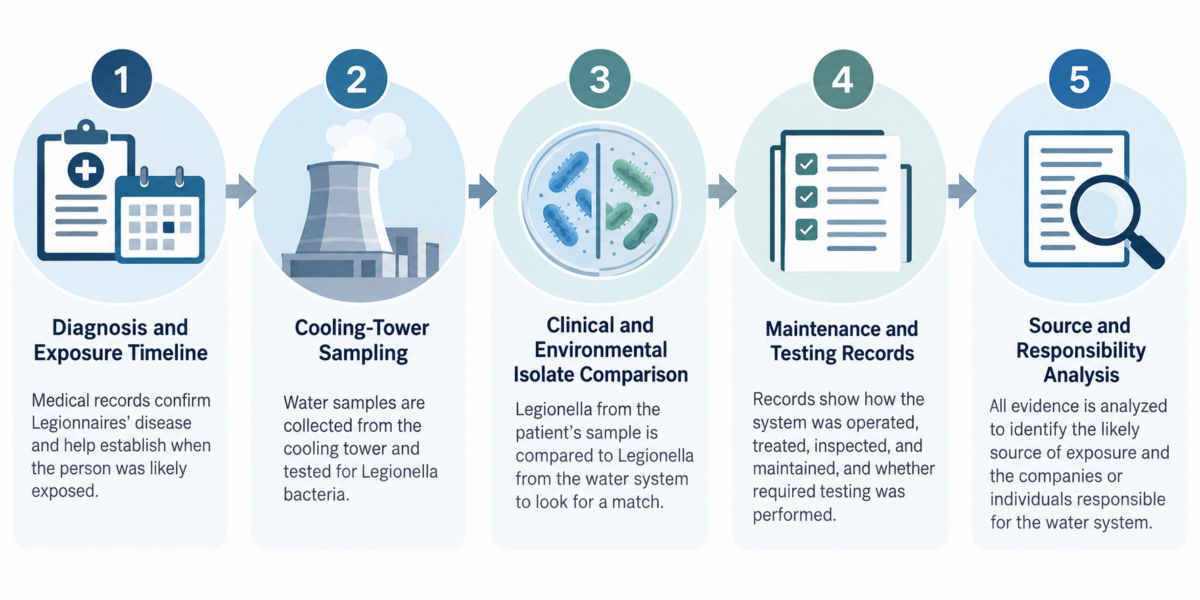
Determining where someone was exposed to Legionella requires looking at several pieces of evidence together. In a Legionnaires’ disease legal investigation, Pritzker Hageman reviews the patient’s diagnosis, Legionella test results, where they were before becoming sick, information about other outbreak cases, and findings from public health officials.
Key evidence can include:
- A confirmed Legionnaires’ disease diagnosis: Medical records, chest X-rays or other imaging, symptoms, hospital records, and test results help show that the patient had Legionnaires’ disease and when the illness began.
- Legionella test results: A positive Legionella test can confirm the infection. In some cases, doctors can collect a sample that allows the Legionella found in the patient to be compared with bacteria found in a suspected water source.
- Where the patient was before becoming sick: Legionnaires’ disease symptoms usually begin two to 14 days after exposure. Records showing where the patient lived, worked, stayed, received medical care, or spent time during that period can help determine whether a possible source fits the timing of the illness.
- Other cases linked by time and place: If other people became sick after spending time in the same area or near the same possible source, those cases can help show that the illnesses are part of the same outbreak.
- Public health findings: Health department records may identify where Legionella was found, whether a source has been confirmed, when the outbreak occurred, and whether laboratory testing connects patient samples with an environmental source.
Pritzker Hageman’s approach to investigating a Legionnaires’ disease case brings these pieces together to determine whether the evidence connects a client’s illness to a particular source.
History of Legionnaires’ Disease Outbreaks in the Bronx
The Bronx has experienced several significant Legionnaires’ disease outbreaks, including outbreaks linked to cooling towers. Those earlier investigations show why cooling towers are an important focus when health officials identify a new community cluster, although they do not establish the source of the current Melrose and Morrisania cases.
2022 Highbridge Legionnaires’ Disease Outbreak
Another Bronx cooling-tower outbreak occurred in the Highbridge neighborhood in 2022. Thirty people were diagnosed with Legionnaires’ disease, 28 were hospitalized, and two died.
During that investigation, NYC Health identified Legionella in several cooling towers. Further laboratory testing found that Legionella from a cooling tower at 1325 Jerome Avenue matched bacteria found in two patients, helping investigators identify the source of exposure.
The 2022 Highbridge Legionnaires’ disease outbreak illustrates how patient testing, environmental sampling, and genetic comparison of the bacteria can work together to identify the source of a community outbreak.
2015 South Bronx Legionnaires’ Disease Outbreak
In July and August 2015, the South Bronx experienced a major Legionnaires’ disease outbreak that sickened 138 people and caused 16 deaths. Public health investigators ultimately linked the outbreak to a cooling tower in the South Bronx.
Laboratory testing played an important role in identifying the source. Investigators found that Legionella from the cooling tower was genetically related to bacteria found in patients, helping connect the illnesses to the contaminated cooling system.
The outbreak also prompted major changes to New York City’s regulation of cooling towers, including requirements for registration, inspection, maintenance, testing, and disinfection.
What Should You Do After a Legionnaires’ Disease Diagnosis Linked to the South Bronx?
If you or a family member develops pneumonia symptoms after spending time in the affected South Bronx area, seek medical care and ask about testing for Legionnaires’ disease. If Legionnaires’ disease has already been diagnosed, there are also steps you can take to document the illness and information that may become important as health officials investigate the source.
- Ask for Legionella testing. If you have pneumonia symptoms and may have been exposed in the affected area, tell your healthcare provider and ask for Legionella testing. The CDC recommends testing for Legionnaires’ disease using both a urine test and a sample from the lungs when possible. Testing can help confirm the diagnosis, and a sample from the lungs may also help investigators compare the Legionella found in a patient with bacteria found in a suspected environmental source.
- Write down where the patient was before getting sick. Legionnaires’ disease symptoms usually begin two to 14 days after exposure. Make a list of places the patient spent time during that period, including home, work, medical facilities, hotels, gyms, stores, restaurants, and other regular stops. Investigators can compare this information with the locations reported by other patients.
- Save medical records, bills, and other important documents. Keep copies of Legionella test results, hospital records, medication information, medical bills, insurance statements, and records showing missed work. It can also help to keep notes about symptoms and any health problems that continue after hospitalization.
- Talk to a lawyer about your Legionnaires’ disease diagnosis. You do not have to wait for NYC Health to identify the source before talking to a Legionnaires’ disease lawyer. Taking the right steps after a Legionnaires’ disease diagnosis can also help preserve information that may be important as the investigation continues.
Can You Sue for Legionnaires’ Disease?
Yes. You may be able to sue for Legionnaires’ disease if evidence connects your illness to a specific source of Legionella exposure and shows that a person or company responsible for the water system failed to take reasonable steps to prevent the exposure.
A Legionnaires’ disease lawsuit can involve a hotel, apartment building, hospital, nursing home, workplace, cooling tower, hot tub, or another property with a contaminated water system. The legal investigation focuses on where the exposure occurred, who was responsible for the water system, and what testing, maintenance, treatment, and inspection records show.
Compensation can include medical expenses, lost income, pain and suffering, future medical needs, and lasting health problems. If someone dies from Legionnaires’ disease, eligible family members may be able to bring a Legionnaires’ disease wrongful death claim. The amount of Legionnaires’ disease lawsuit compensation depends on the facts of the individual case.
Why Does Legionnaires’ Disease Experience Matter in a Cooling Tower Lawsuit?
Experience matters because Legionnaires’ disease cases involve medical, scientific, and water-system evidence that is not part of a typical personal injury case. A lawyer handling a cooling-tower case needs to understand how Legionella is detected, how exposure is investigated, how cooling towers are operated and maintained, and what records can show about the system before an outbreak.
Pritzker Hageman represents people with Legionnaires’ disease across the United States and has obtained multimillion-dollar results in Legionnaires’ disease cases.
Contact Eric today and find out how you can get compensation and justice
1-888-377-8900 (Toll-Free) | [email protected]

Contact Pritzker Hageman About a Legionnaires’ Disease Case
If you or a family member has been diagnosed with Legionnaires’ disease after living, working, or spending time in the affected South Bronx area, Pritzker Hageman can evaluate the exposure history and investigate potential sources.
Our Legionnaires’ disease practice is national, and consultations are free. Call 1-888-377-8900, text 612-261-0856, or contact us online.
South Bronx Legionnaires’ Disease Cluster FAQ
NYC Health identified 23 people with Legionnaires’ disease associated with the 2026 South Bronx cluster. Two people died, two remain hospitalized, 17 have been discharged, and two did not require hospitalization.
The cluster involved parts of the Melrose and Morrisania neighborhoods in the South Bronx. NYC Health initially focused on ZIP codes 10451 and 10456 and expanded community outreach into nearby ZIP codes 10455 and 10459.
NYC Health says the elevated risk of exposure has ended. All cooling towers that tested positive were cleaned by September 15, and more than two weeks passed without anyone associated with the cluster developing new symptoms.
No. NYC Health says the source of exposure has been eliminated, but it has not identified which cooling tower caused the illnesses. Whole genome sequencing is underway to compare Legionella found in cooling towers with bacteria recovered from patients.
No. Finding live Legionella in a cooling tower does not by itself prove that the tower caused an illness or outbreak. Investigators consider patient exposure histories, environmental testing, laboratory results, and genetic comparisons of bacteria from patients and possible environmental sources.
Whole genome sequencing compares the genetic makeup of Legionella bacteria from different samples. Investigators can compare bacteria recovered from patients with Legionella found in cooling towers or other water systems. A close genetic relationship can help connect illnesses to a particular source when supported by other evidence.
Yes. NYC Health says the elevated risk from this cluster has ended. It is safe to shower, drink tap water, and use home or window air conditioners.
No. Legionnaires’ disease generally does not spread from person to person. People usually become sick after breathing in small water droplets containing Legionella bacteria.
Symptoms usually begin about two to 14 days after exposure. That is why a detailed record of where a patient spent time before symptoms started can be important in an outbreak investigation.
People age 50 and older, people who smoke or vape, people with chronic heart, lung, kidney, or liver disease or diabetes, and people with weakened immune systems as being at increased risk.
Additional Information About Legionnaires’ Disease
- Legionnaires’ Disease Frequently Asked Questions (FAQs)
- Where Does Legionnaires’ Disease Come From?
- Legionnaires’ Disease: Symptoms and Diagnosis
- What to do if You Contract Legionnaires’ Disease
- Legionnaires’ Disease: Determining Liability
- Legionnaires’ Disease: Lawsuits and Compensation
- Legionnaires’ Disease: Wrongful Death Cases
- Finding a Legionnaires’ Disease Lawyer
- Filing a Legionnaires’ Disease Lawsuit
- The Importance of Water Management Plans
We have obtained 100+ separate verdicts and settlements greater than $1 million:
We obtained this result on behalf of three people sickened in a Legionnaires’ disease outbreak at a resort hotel.
We obtained this settlement on behalf of six people impacted by a Legionnaires’ disease outbreak linked to a hotel hot tub.
Our client contracted Legionnaires’ disease at a hotel and was hospitalized for eight weeks.
We obtained this settlement on behalf of the family of a woman who died after contracting Legionnaires’ Disease.
We obtained this result on behalf of clients who contracted Legionnaires’ disease from a hotel HVAC cooling tower.
On behalf of a client sicked from contaminated water at a senior care facility.
Our client contracted Legionnaires’ disease at a hotel and was hospitalized for over a month.
On behalf of a women hospitalized for over two months from a contaminated hotel hot tub in Myrtle Beach.
We obtained this settlement for a woman sickened with Legionnaires’ disease after being exposed in a hotel hot tub.
We obtained this settlement for the family of a 52-year old man who died of Legionnaires’ disease linked to a hotel.
We collected this on behalf of a client who contracted Legionnaires’ disease from contaminated water at a hotel.
We recovered this settlement for the family of a 50-year old man who died of Legionnaires’ disease after being exposed to legionella bacteria at a hotel.
Collected on behalf of the family of a man who died as a result of Legionnaires’ Disease contracted while staying at a Wisconsin resort.
We obtained this on behalf of a man hospitalized after Legionella bacteria exposure at a hotel.
See more settlements & verdicts.
The Pritzker Hageman law firm and our attorneys have been recognized in:
U.S. News & World Report

Pritzker Hageman has been recognized as one of the best law firms for personal injury litigation by U.S. News & World Report every year the award has been given since 2012.
Super Lawyers®, Thomson Reuters

Attorneys at Pritzker Hageman have been awarded the peer selected Super Lawyers distinction every year since 2004.
America’s Top 100 Attorneys®

Lifetime Achievement selection to America’s Top 100 Attorneys®.
Three Time Attorneys of the Year

Pritzker Hageman lawyers have been named Attorneys Of The Year by Minnesota Lawyer three times.