
Updated September 11, 2026: NYC Health’s July 30 update reported 94 people diagnosed with Legionnaires’ disease in the Upper East Side cluster, and 11 deaths. The toll has risen since that update: on August 14, 2026, Health Commissioner Dr. Alister Martin announced two further deaths, bringing the total connected to this cluster to nine, and he announced two more on August 28, 2026. The patients in each of those announcements had been diagnosed weeks earlier.
The Health Department says no cases were diagnosed after July 21. On July 31, the Health Department announced that the incubation period for new cases has passed and there is no longer an elevated risk of exposure in ZIP codes 10028, 10075 and 10128. The department described the exposure as ended. It did not describe the investigation as finished, and it said it continues to investigate the source of the exposure. While the exposure risk has likely been eliminated, the investigation into the specific source or sources of the outbreak continues.
NYC tested 183 cooling towers at 160 buildings. Seventy-seven towers at 75 buildings tested PCR positive in initial screening. Confirmatory culture testing found live Legionella in 59 towers at 58 buildings. In total, 124 towers tested culture negative, which accounts for all 183 towers tested. No culture results remain pending.
During the outbreak response, the Health Department ultimately ordered 83 buildings to clean and disinfect their cooling towers, and every building complied. The department also completed inspections of all 82 cooling towers under its jurisdiction that tested positive through PCR screening or confirmatory culture testing. In its July 31 release, NYC Health reported that 60 percent of those inspections resulted in at least one violation, producing more than 110 violations in total. The department reported more than 15 public health hazards, more than 50 critical violations and more than 40 general violations. Public health hazards are the city’s most serious category of cooling-tower violation.
These findings do not identify the outbreak source. A positive test or a violation does not, by itself, establish that a tower caused an illness. NYC says it is confident the exposure source has been eliminated, but it has not publicly identified a specific cooling tower, building, or other system as the source. NYC continues to say the community cluster is not a building-plumbing problem and that residents may drink tap water, bathe, shower, cook, and use home or window air conditioners.
NYC Health is also investigating a separate likely community cluster of Legionnaires’ disease in parts of Melrose and Morrisania in the South Bronx, including ZIP codes 10451 and 10456.
Upper East Side Legionnaires’ Outbreak Quick Facts
- Investigation status: NYC says it is confident the source of Legionella exposure has been eliminated. The exact outbreak source has not been publicly identified. As of July 31, the outbreak has been officially declared over.
- Latest Official Figures: 94 cases and 11 deaths as of August 28, 2026. NYC said the later increase in the case count did not represent new transmission.
- Current patient status: As of August 28, no patients connected to the outbreak remained hospitalized.
- Diagnosis trend: NYC’s archived outbreak information says no cases were diagnosed after July 21, 2026. The diagnosis date is the date the positive patient specimen was collected.
- Affected areas: The outbreak affected Carnegie Hill and Yorkville on Manhattan’s Upper East Side, including ZIP codes 10028, 10128 and 10075.
- Current community risk: NYC says there is no longer an elevated risk of Legionella exposure in the affected ZIP codes. Health officials determined that the incubation period for new cases had passed and there was no evidence of ongoing transmission.
- Exact source: No building, cooling tower or other water system has been publicly confirmed as the outbreak source. NYC scientists have continued comparing Legionella samples from patients with bacteria recovered from cooling towers.
- Cooling-tower testing: NYC tested 183 cooling towers at 160 buildings. Initial PCR screening found Legionella genetic material in 77 towers at 75 buildings. Confirmatory culture testing found live Legionella in 59 towers at 58 buildings. In total, 124 towers tested culture negative, and all culture testing is complete.
- PCR-negative, culture-positive towers: The July 29 list identifies five addresses where a tower tested PCR negative but later culture positive. Those results confirmed that live Legionella was present when the samples were collected.
- Enforcement update: NYC Health inspected 82 cooling towers under its jurisdiction that tested positive through PCR or culture testing. Sixty percent of those inspections resulted in at least one violation, producing more than 110 violations overall, including more than 15 public health hazards, more than 50 critical violations and more than 40 general violations.
- Unregistered tower: The cooling tower at 300 E. 83rd Street tested PCR negative and culture negative, but NYC identified it as unregistered. Inspectors cited 11 violations and issued $11,000 in fines after finding problems that included the lack of a required maintenance program and plan, inadequate water-treatment documentation and no Legionella sampling for more than a year.
- New cooling-tower law: On August 5, 2026, Governor Hochul signed Chapter 206. The law adds twice-yearly owner or operator certifications, faster response requirements for certain microbial test results, 10-year record retention and higher civil penalties.
- Public guidance: NYC Health says tap water remains safe for drinking, bathing, showering and cooking. Home and window air-conditioning systems are also safe because they do not use cooling towers.
Diagnosed after spending time in the affected area?
Pritzker Hageman’s Legionnaires’ disease lawyers investigate exposure timelines, medical testing, environmental evidence, maintenance records, and the parties responsible for unsafe water systems.
Call 1-888-377-8900, text 612-261-0856 or contact us online for a free, confidential consultation. You never pay anything unless we win for you.
What has changed in the latest Upper East Side outbreak update
- The Upper East Side Legionnaires’ disease outbreak was officially declared over on July 31, 2026, and NYC says there is no longer an elevated risk of exposure in the affected area. The cluster has been closed, but the Health Department is still working to identify the specific source.
- The outbreak now includes 94 cases and 11 deaths. On August 28, NYC Health Commissioner Dr. Alister Martin announced that two additional deaths had been linked to the cluster. The increase does not represent new transmission. The last diagnosis occurred more than six weeks earlier.
- No patients connected to the outbreak remain hospitalized. NYC announced August 28 that the last hospitalized patient had recovered and returned home.
- NYC ultimately ordered 83 buildings to clean and disinfect their cooling towers, and every building complied.
- All cooling-tower culture testing is complete. Of 183 cooling towers tested at 160 buildings, 59 towers tested culture positive for live Legionella and 124 tested culture negative.
- Five cooling towers tested PCR negative but later culture positive, showing why PCR screening and culture testing cannot be treated as interchangeable. Culture testing determines whether live Legionella capable of growing from the sample was present.
- The Health Department completed inspections of 82 cooling towers under its jurisdiction that tested positive through PCR screening or confirmatory culture testing. Sixty percent of those inspections resulted in at least one violation, producing more than 110 violations, including more than 15 public health hazards, more than 50 critical violations and more than 40 general violations.
- At 1520 York Avenue, inspectors cited nine violations and issued $9,000 in fines. NYC says the violations included failure to develop the required maintenance program and plan, document water treatment and conduct newly required monthly Legionella sampling. The tower initially tested PCR positive but later tested culture negative.
- At 300 E. 83rd Street, investigators found an unregistered cooling tower that tested PCR negative and culture negative. Inspectors cited 11 violations and issued $11,000 in fines after finding that the owners had not developed the required maintenance program and plan, documented water treatment or conducted Legionella sampling for more than a year.
- NYC says it is confident the exposure source was eliminated, but no building or cooling tower has been publicly identified as the source of the outbreak. Scientists are comparing Legionella recovered from patients with bacteria recovered from culture-positive cooling towers. On August 28, the Health Commissioner said those findings are expected in September 2026.
- On August 5, Governor Hochul signed a new cooling-tower law for New York City. It adds twice-yearly owner or operator certifications, faster response requirements for specified microbial test results, 10-year record retention and higher civil penalties.
What is the current status of the 2026 Upper East Side Legionnaires’ disease outbreak?
The 2026 Upper East Side Legionnaires’ disease outbreak in Carnegie Hill and Yorkville is over, and New York City says there is no evidence of ongoing transmission. The outbreak ultimately included 94 cases and 11 deaths. On August 28, 2026, NYC Health Commissioner Dr. Alister Martin announced that two additional deaths had been linked to the cluster and that no patients remained hospitalized. The last remaining hospitalized patient had recovered and returned home.
NYC Health officially declared the outbreak exposure over on July 31 after the incubation period for new cases had passed. The city said there was no longer an elevated risk of Legionella exposure in ZIP codes 10028, 10075 and 10128 and that the source of exposure had been eliminated. However, the city has not publicly identified the specific building, cooling tower or other water system that caused the outbreak.
The investigation also identified significant cooling-tower compliance problems. NYC Health inspected 82 cooling towers under its jurisdiction that tested positive through PCR screening or confirmatory culture testing. Sixty percent of those inspections resulted in at least one violation, producing more than 110 violations overall, including more than 15 public health hazards, more than 50 critical violations and more than 40 general violations.
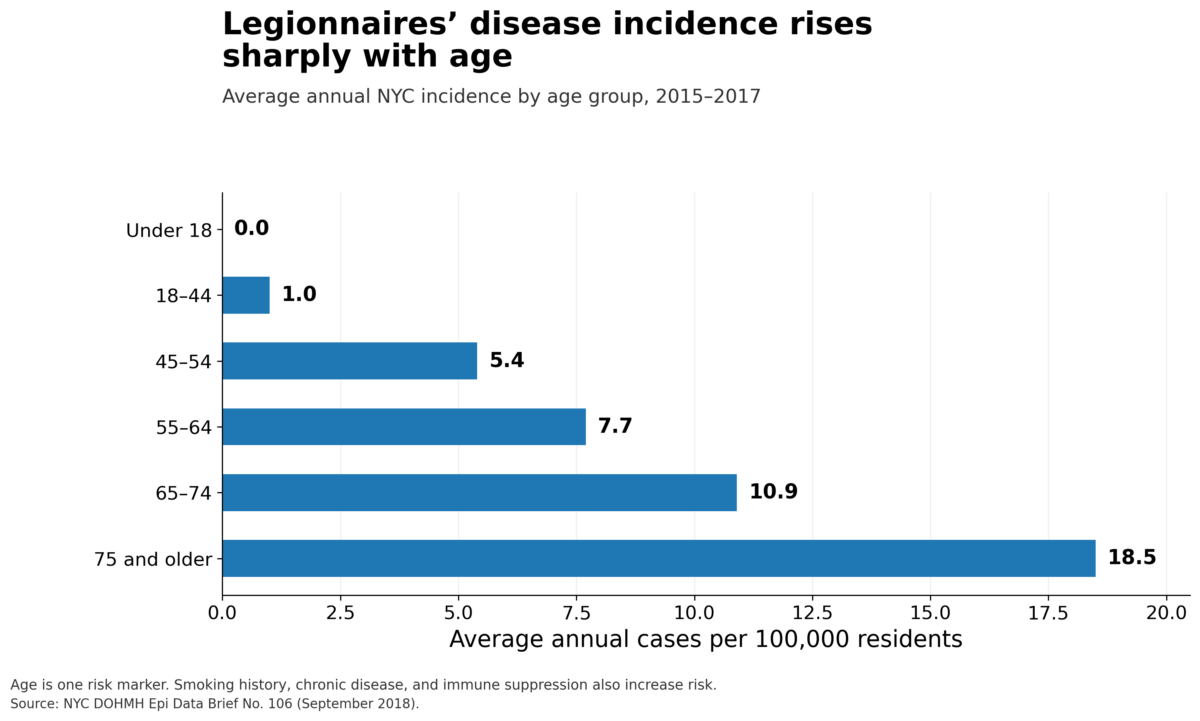
A “community cluster” means multiple people developed Legionnaires’ disease within a connected place and time. It does not mean everyone who entered the neighborhood was exposed or became sick. Most people exposed to Legionella do not develop Legionnaires’ disease. Risk is higher for adults age 50 and older, people who smoke or vape, and people with chronic illnesses or weakened immune systems.
New York City also investigates sporadic Legionnaires’ disease cases, building-related exposures, health-care-associated cases and smaller clusters that may not receive the same level of public attention.
Latest Upper East Side outbreak timeline
July 2, 2026: The city launches the investigation
The NYC Health Department announced two confirmed cases in Carnegie Hill and Yorkville, initially identifying ZIP codes 10028 and 10128. The Department issued a clinician alert, began community outreach, and started sampling all cooling-tower systems in the investigation area. Read the July 2 NYC Health Department announcement.
July 5: ZIP code 10075 and part of the Central Park perimeter are added
After a confirmed case involved a person who lived, worked, or visited ZIP code 10075, the city added that ZIP code to the investigation. The Health Commissioner also advised, out of caution, that people who had visited the east side of Central Park from East 76th Street to East 97th Street should monitor for symptoms. See the July 5 Health Commissioner statement.
July 7: Accelerated remediation and expanded response
The Mayor’s Office reported that more than 100 city staff were involved in the response. Approximately 160 cooling towers were registered within the three ZIP codes, although not all were operating or located inside the final investigation zone. By July 6, staff had sampled 139 towers. The city announced that owners of towers with preliminary positive PCR screening results would be ordered to drain, clean, and disinfect immediately rather than wait for slower culture results. Read the Mayor’s Office response update.
July 12: 59 cases, 15 current hospitalizations, and no deaths
The city’s current public page reported 59 diagnosed cases: 15 people currently hospitalized, 33 discharged, 11 not hospitalized, and no deaths. NYC notes that the numbers are preliminary and subject to change. The “diagnosis date” used in the city’s outbreak reporting is the date the patient’s positive specimen was collected, not necessarily the date symptoms began or the date the result was posted.
July 13: City lists 31 PCR-positive cooling-tower systems and reports cleaning complete
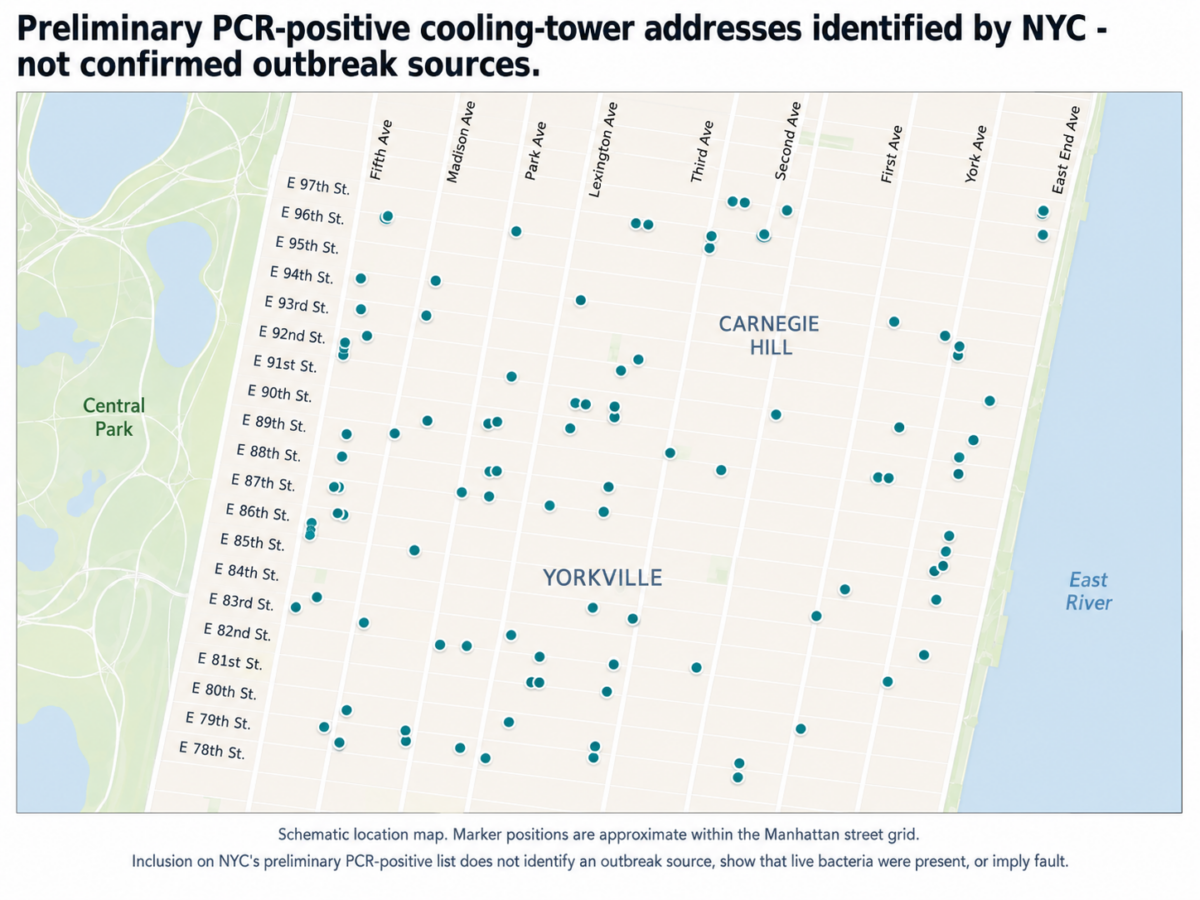
NYC published an address list for 31 cooling-tower systems with preliminary positive PCR screens. The July 13 version placed all 31 under “Cleaning Complete.” The city emphasized that PCR detects genetic material from living or dead Legionella and does not prove that any listed tower contained viable bacteria or caused the outbreak. Culture testing was continuing.
July 14: 63 cases and 76 preliminary PCR-positive cooling-tower addresses
NYC reported 63 cases and published an expanded list of 76 addresses with cooling-tower systems that returned preliminary PCR-positive screens. The list placed 57 addresses under “Cleaning Complete” and 19 under “Cleaning Pending.” The city said all 183 cooling towers in the affected area had been inspected. Officials also said the rate of new diagnoses appeared to be slowing, but the investigation remained active and no source had been identified. The official July 14 list explains that PCR may detect living or dead bacteria and that culture testing is being conducted for all sampled towers.
July 16: 67 cases with 12 current hospitalizations
NYC reported 67 total cases. Twelve people were listed as currently hospitalized, 43 as discharged, and 12 as not hospitalized. At the time of that update, the city’s public outbreak page reported no deaths. No additional PCR-positive cooling-tower addresses were added to the July 14 list.
July 17: First death reported in the Upper East Side cluster
New York City health officials announced the first death connected to the outbreak. The city did not release the person’s identity or additional personal information. The newest reported case total remained 67. The death does not identify the source of the outbreak, but it underscores why early diagnosis, appropriate antibiotic treatment, careful source investigation, and accountability for preventable Legionella exposure matter.
July 18: Second death, 72 cases, and all listed towers remediated
New York City health officials announced a second death connected to the cluster. The city reported 72 cases, with nine people still hospitalized and 50 discharged. Officials said new diagnoses had remained stable for a week and that the source of exposure had likely been eliminated. All 76 buildings on the preliminary PCR-positive list had completed required remediation by July 16. Initial PCR screening of all 183 sampled cooling-tower systems was complete, with no outstanding PCR results, while culture testing and inspections continued. The exact outbreak source had not been publicly identified.
July 19: Third death and 74 cases
The NYC Health Department’s current outbreak page reported 74 total cases, including eight people currently hospitalized, 51 discharged, 12 not hospitalized, and three deaths. The city did not release identifying details about the person who died. The exact outbreak source remained publicly unidentified.
July 20: Fourth death, 76 cases, and nine current hospitalizations
The NYC Health Department’s current outbreak page reported 76 total cases, including nine people currently hospitalized, 53 discharged, 12 not hospitalized, and four deaths. The city did not release identifying details about the person who died. The exact outbreak source remained publicly unidentified. The city’s July 20 PCR-positive cooling-tower list continued to identify 76 addresses, placed all of them under “Cleaning Complete,” and labeled the cooling tower at 300 E 83rd Street as unregistered.
July 21: Fifth death, 82 cases, and 34 culture-positive cooling towers at 33 buildings
The NYC Health Department reported 82 total cases, including eight people currently hospitalized, 56 discharged, 13 not hospitalized, and five deaths. The city said no new cases had been diagnosed in six days and no one had reported new symptoms in more than 10 days.
Confirmatory culture testing found live Legionella bacteria in 34 cooling towers at 33 buildings. Nine towers had negative culture results and 140 culture results remained pending. All 34 culture-positive towers had completed remediation. Four towers were culture-positive despite having tested PCR-negative.
The Health Department said it had completed full inspections of every positive tower and an unregistered tower, was finalizing compliance findings, and would issue summonses where inspectors found violations. Separately, the New York City Council announced a September oversight hearing focused on public communication, enforcement, and possible additional legislation.
A culture-positive result confirms that live bacteria were present when the sample was collected, but the tower may or may not have been the source of exposure in this outbreak. The exact source remains publicly unidentified.
July 22: 84 cases and 51 culture-positive cooling towers at 50 buildings
NYC Health updated the Upper East Side outbreak total to 84 cases. Nine people remained hospitalized, 59 had been discharged, 13 had not been hospitalized, and five had died.
The city’s environmental summary increased to 51 culture-positive cooling towers at 50 buildings. All culture-positive towers had been cleaned and disinfected. Nineteen cooling towers tested culture negative, and all other culture results were pending. NYC continued to report 77 PCR-positive cooling towers at 75 buildings. Four towers were PCR-negative but culture-positive. The exact outbreak source remained publicly unidentified.
July 27: 90 cases, no diagnoses after July 17, and 58 culture-positive cooling towers
NYC Health updated the Upper East Side outbreak total to 90 cases. Nine people remained hospitalized, 65 had been discharged, 13 had not been hospitalized, and five had died.
The city said no cases were diagnosed after July 17. NYC defines diagnosis date as the date the patient’s positive specimen was collected and notes that the data are preliminary and subject to change.
NYC’s environmental summary increased to 58 culture-positive cooling towers at 57 buildings. All culture-positive towers had been cleaned and disinfected. In total, 95 cooling towers tested culture negative, and all other results were pending. NYC continued to report 77 PCR-positive cooling towers at 75 buildings. The updated address list marks five addresses with towers that were PCR-negative but culture-positive. NYC says it is confident the exposure source has been eliminated. The city has not publicly identified a specific building, cooling tower, or other system as the source of the outbreak.
July 28: Sixth death and 59 culture-positive cooling towers at 58 buildings
NYC Health’s July 28 update kept the outbreak total at 90 cases and reported a sixth death. Six people were currently hospitalized, 65 had been discharged, and 13 had not been hospitalized. The city continued to say that no cases were diagnosed after July 17.
The environmental summary increased to 59 culture-positive cooling towers at 58 buildings and 106 culture-negative towers. All culture-positive towers were cleaned and disinfected. The updated culture-results PDF lists 58 culture-positive building addresses and marks five addresses with towers that were PCR negative but culture positive. All other results were pending. NYC says it is confident the exposure source has been eliminated. It has not publicly identified a specific tower or other system as the outbreak source.
July 29: 92 cases, all culture results complete, and 110 violations reported
NYC Health updated the cluster to 92 cases. Six people were currently hospitalized, 66 had been discharged, 13 had not been hospitalized, and six had died. The city said no cases were diagnosed after July 21.
The environmental investigation reached a final culture total of 59 positive towers at 58 buildings and 124 negative towers. Because those figures total 183, culture testing is complete. The July 29 address list continues to identify five towers that were PCR negative but culture positive.
NBC New York reported that the Health Department issued 110 violations and found compliance issues at 60% of towers that had a positive outbreak test. Fifteen buildings received at least one violation in the most serious public health hazard category, and 50 of the violations were classified as critical.
At 1520 York Avenue, which was initially PCR positive and later culture negative, NBC reported nine public health hazard violations and $9,000 in fines involving the 31-day testing requirement and the required cooling-tower maintenance plan. Neither the violations nor the test results identify 1520 York Avenue as the outbreak source. NBC reported that final DNA results were expected in August. NYC has not publicly identified a specific tower or other water system as the source.
July 30: Seventh death reported; case count remains at 92
NYC Health reported a seventh death connected to the Upper East Side cluster. The total number of diagnosed cases remained 92. Five people were currently hospitalized, 67 were no longer hospitalized, and 13 were not hospitalized. The city continued to report that no cases were diagnosed after July 21. The additional death does not represent a new diagnosis and does not identify the outbreak source.
July 31: NYC Health Department declares the outbreak officially over
NYC Health has declared that exposure associated with the Upper East Side Legionnaires’ disease cluster has ended. No cluster-related symptoms began during the previous two weeks, the disease’s two-to-14-day incubation period has passed, and there is no longer an elevated exposure risk
August 5: Governor Hochul signs new cooling-tower law for New York City
Governor Kathy Hochul signed S.8472-A/A.9058-A, now Chapter 206. The law changes the New York City Administrative Code to require cooling-tower owners and operators to file certifications in January and July, or on other dates set by the New York City Department of Buildings. Each certification must state that the tower was inspected, tested, cleaned, and disinfected as required and that a maintenance program and plan has been developed and implemented.
The full bill text also requires owners to address microbial results indicating a maintenance deficiency as soon as possible and no later than 48 hours. Results presenting a serious health threat require city notification and cleaning and disinfection as soon as possible and no later than 24 hours. Required inspection and testing records must be kept for 10 years instead of three. Maximum civil penalties increase to $2,500 for a first violation, $7,000 for a second or later violation, and $12,500 when a violation is accompanied by or results in serious injury or death. The 24-hour and 48-hour response provisions take effect 30 days after signing. Most other changes take effect 90 days after signing. The law may strengthen future prevention and preserve more evidence, but it does not identify the source of the 2026 Upper East Side outbreak.
August 14: Two additional deaths raise Upper East Side outbreak toll to nine
New York City Health Commissioner Dr. Alister Martin announced in a post on X that two more people have died in connection with the Upper East Side Legionnaires’ disease cluster, bringing the outbreak death toll to nine. Both people had been diagnosed with Legionnaires’ disease weeks earlier. The Health Department said there had been no new diagnoses or reported symptoms for more than three weeks and that one person connected to the outbreak remained hospitalized.
August 28: Two more deaths bring the Upper East Side outbreak to 94 cases and 11 deaths
New York City Health Commissioner Dr. Alister Martin announced two additional deaths connected to the Upper East Side Legionnaires’ disease cluster, bringing the outbreak to 94 cases and 11 deaths. Everyone who had been hospitalized has been discharged, and no one connected to the cluster remains in hospital. The last case was diagnosed more than six weeks ago, and residents of ZIP codes 10028, 10075 and 10128 are no longer considered at risk of exposure.
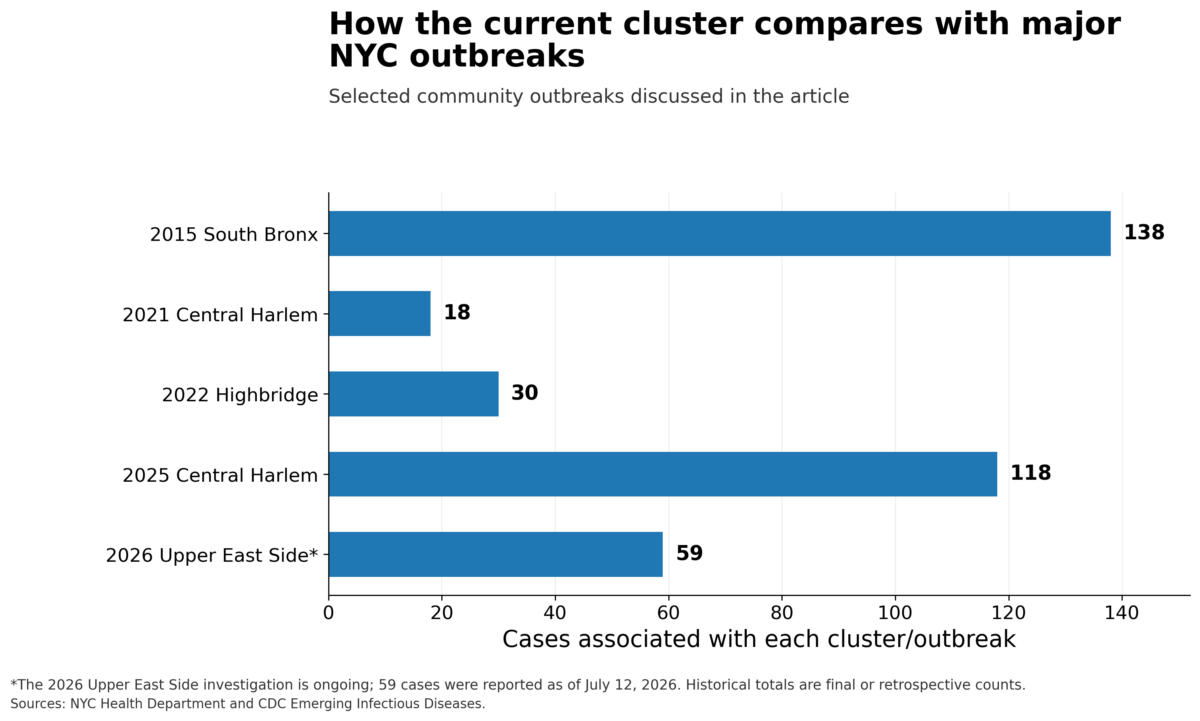
Health officials said they expect the final results of the source investigation in September. The city has still not publicly identified the specific cooling tower or other water system responsible for the outbreak. This is the deadliest Legionnaires’ cluster in New York City since the 2015 outbreak in the South Bronx.
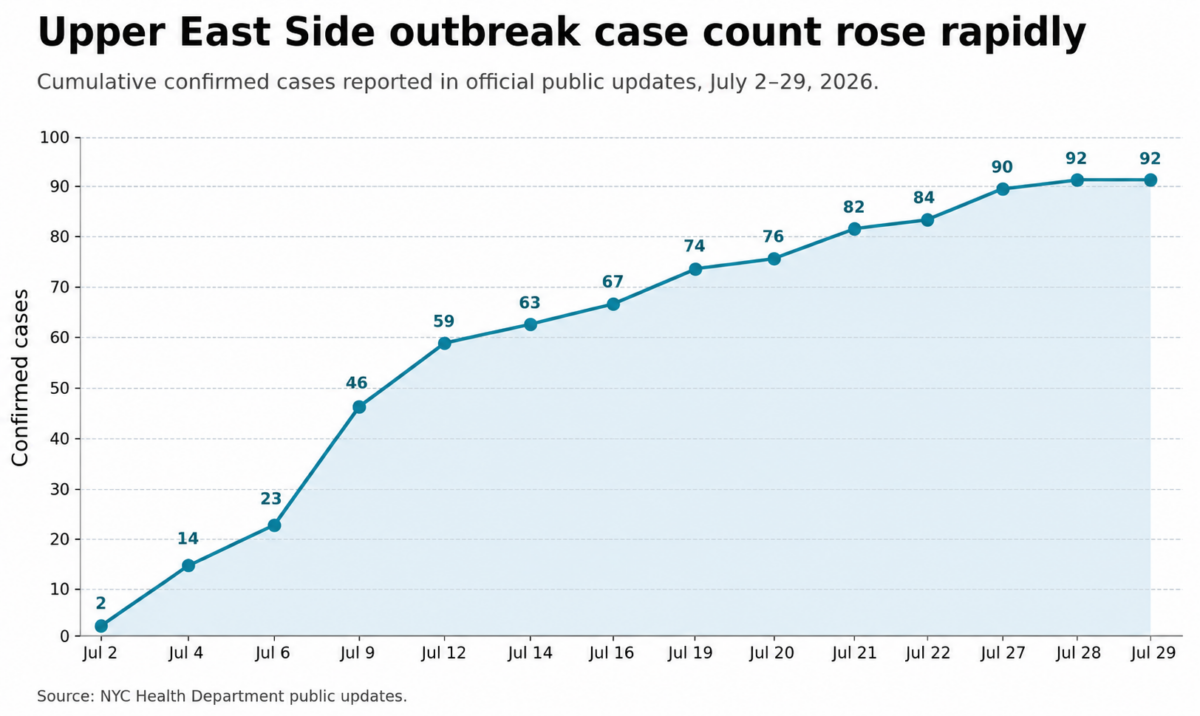
Why the case count may continue to change
Legionnaires’ disease symptoms usually begin 2 to 14 days after exposure, and diagnosis can take additional time. People exposed before a tower was disinfected may not be diagnosed until days later. Health officials may also revise the count as they confirm cases, refine the exposure area, or determine that an illness belongs to a different source. A rising case count after remediation does not, by itself, prove that exposure is continuing.
Who may have been exposed?
The city’s guidance applies to people who have lived, worked, or visited the affected area since late June 2026. A person does not need to reside in one of the three ZIP codes to have a relevant exposure history. Workers, visitors, patients, delivery drivers, building staff, tourists, caregivers, and people who traveled through the area may all have spent meaningful time there.
ZIP codes help health officials organize surveillance and outreach, but they are not physical barriers. Investigators consider where people spent time, when they were there, how long they were present, and how those locations relate to weather, cooling-tower operation, and the symptom-onset window. The city has not announced a single confirmed source or a final exposure boundary.
Anyone who visited the east side of Central Park between East 76th and East 97th Streets during the relevant period should also monitor for symptoms, according to the July 5 city statement.
What people in the affected area should do now
- Seek medical care promptly if symptoms develop. Call a health care provider immediately for fever, cough, shortness of breath, chest discomfort, confusion, or other pneumonia-like symptoms. Call 911 for severe breathing difficulty, blue or gray lips, new confusion, fainting, or another medical emergency.
- Tell the provider about the Upper East Side exposure. Give the dates and places where you lived, worked, visited, received care, or spent significant time in Carnegie Hill, Yorkville, ZIP codes 10028, 10128, or 10075, or the identified Central Park perimeter.
- Ask whether Legionella testing is appropriate. Legionnaires’ disease cannot be reliably distinguished from other pneumonia based only on symptoms or a chest X-ray. A clinician decides which tests are appropriate, but urine antigen testing plus a lower respiratory specimen can provide important information.
- Follow the city’s current safety guidance. NYC says tap water, normal bathing and showering, cooking, cooling centers, and home or window air conditioning are safe during this community investigation.
- Write down a detailed exposure timeline. Preserve calendars, phone-location history, transit or rideshare records, work schedules, appointments, receipts, photos, lodging information, and the names of people who were with you.
- Preserve medical and financial records. Keep test results, discharge paperwork, medication lists, bills, insurance statements, wage-loss records, and communications from employers, buildings, health officials, or insurers.
- Get legal advice early if Legionnaires’ disease is diagnosed. Cooling towers and water systems can be drained, disinfected, repaired, or altered quickly. Prompt investigation can help identify records, witnesses, contracts, samples, and other evidence before it becomes harder to obtain. See our guide on what to do after contracting Legionnaires’ disease.
Medical information This page provides general information, not medical advice. Treatment should never be delayed while waiting for an environmental investigation or legal review. Follow the instructions of your health care team.
Symptoms of Legionnaires’ disease
Legionnaires’ disease is a serious type of pneumonia caused by Legionella bacteria. Symptoms usually begin 2 to 14 days after exposure, although longer intervals can occur. Common symptoms include:
- Cough
- Fever or chills
- Shortness of breath
- Headache
- Muscle aches
- Fatigue or weakness
- Loss of appetite
- Confusion or other changes in mental status
- Diarrhea, nausea, or other gastrointestinal symptoms
Because these symptoms overlap with other respiratory illnesses, a specific diagnostic workup is important. Learn more on our page about Legionnaires’ disease symptoms and diagnosis.
Who is at higher risk of severe illness?
Most healthy people who encounter Legionella do not become ill. The NYC Health Department identifies the following groups as having increased risk:
- Adults age 50 or older
- People who smoke or vape, including former smokers
- People with chronic heart, lung, kidney, or liver disease
- People with diabetes
- People with weakened immune systems because of a medical condition or medication
Risk factors help clinicians decide when to test, but younger people and people without known risk factors can also develop Legionnaires’ disease. No one with compatible symptoms and a relevant exposure history should assume the illness is “just the flu.”
The Upper East Side cluster has resulted in 11 reported deaths. Health officials have not released identifying details about the people who died. The deaths underscore why prompt diagnosis, appropriate antibiotics, respiratory-specimen collection when possible, careful source investigation, and accountability for preventable exposure matter.
Legionnaires’ disease can be fatal, although most people recover with appropriate treatment. The CDC reports that about one in ten people who become ill die from complications; the estimated fatality rate is higher for infections acquired during a stay in a health-care facility. Those figures describe populations, not the prognosis for any individual patient, and early diagnosis and treatment matter.
How Legionnaires’ disease is diagnosed
A chest X-ray or CT scan can show pneumonia, but imaging does not identify the bacterium that caused it. Legionella-specific testing is needed. The CDC recommends pairing a Legionella urinary antigen test with testing of a lower respiratory specimen by culture or a molecular method when Legionnaires’ disease is suspected.
Urinary antigen test
The urine antigen test is rapid and widely used, but it usually detects only Legionella pneumophila serogroup 1. A negative urine antigen test does not rule out every Legionella species or serogroup. The test also does not produce a bacterial isolate that can be compared with an environmental source.
Lower respiratory PCR or other molecular testing
PCR can detect Legionella genetic material in sputum, a bronchoscopy specimen, a tracheal aspirate, or another lower respiratory sample. Some molecular assays can detect types that a urine antigen test misses and may remain useful after antibiotics begin. Availability and exact test performance vary by laboratory.
Lower respiratory culture
Culture can detect a broader range of Legionella and can yield a living bacterial isolate. That isolate may be compared with Legionella recovered from cooling-tower or plumbing samples. Culture can take up to about 14 days and requires specialized media, so clinicians and laboratories may need to request it specifically. Ideally, a respiratory specimen is collected before antibiotics, but treatment should not be delayed to obtain a sample.
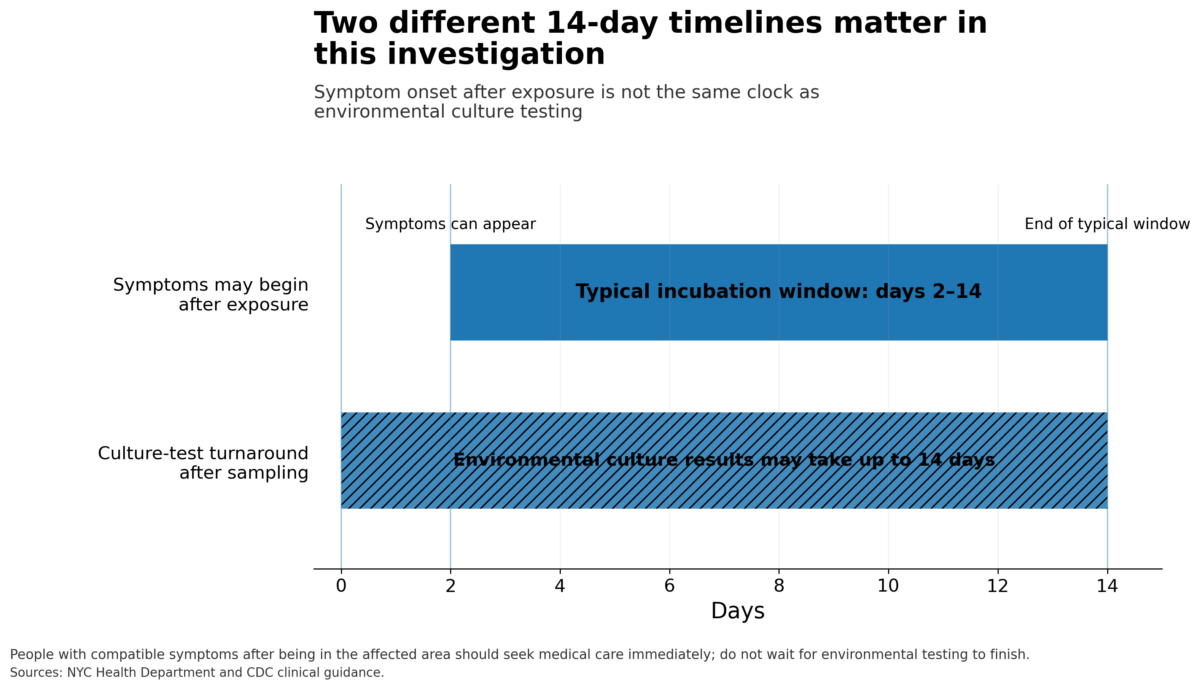
Why a clinical isolate can be so important
Public-health laboratories can use subtyping and whole-genome sequencing to compare bacteria from a patient with bacteria from a suspected water source. A close molecular match, combined with a compatible exposure history and epidemiologic pattern, can be powerful evidence of source attribution. New York’s 2026 clinician advisory emphasizes the importance of respiratory culture for this reason. Read the joint New York State and New York City clinician advisory.
Is it safe to drink tap water, shower, or use air conditioning?
For the current Upper East Side community cluster, NYC says residents may continue to drink tap water, bathe, shower, cook, use cooling centers, and operate home or window air conditioners. The city has stated that the investigation is not about an affected building’s internal plumbing.
A rooftop cooling tower is different from a window air conditioner. Cooling towers recirculate warm water and release mist outdoors. Window units and other systems that do not recirculate water and release mist are not cooling towers and do not create the same Legionella risk.
Public guidance can differ in a building-specific cluster. When two or more cases are associated with the same building and shared hot-water system, NYC may evaluate the building’s plumbing, and residents may receive tailored instructions. Always follow the latest health-department notice for your particular location.
Why are cooling towers the focus of the Upper East Side investigation?
Community clusters can occur when a contaminated cooling tower releases aerosolized water droplets into the outdoor air. Cooling towers are commonly part of large air-conditioning, refrigeration, or industrial systems. They remove heat through evaporation, leaving warm recirculating water that can support bacterial growth if control measures are ineffective.
Legionella can multiply when water is warm, flow is poor, disinfectant levels are inadequate, or biofilm, scale, corrosion, and sediment protect bacteria from treatment. Fans can then carry contaminated mist beyond the rooftop. People become ill when they inhale droplets containing enough bacteria to reach the lungs.
The fact that cooling towers are being tested does not mean every tower is unsafe or that every positive environmental result identifies the outbreak source. Learn more about where Legionnaires’ disease comes from and the different water systems that can create exposure.
What is New York City doing to investigate the source?
The city’s response has included epidemiologic interviews, clinician alerts, case surveillance, community outreach, cooling-tower sampling, rapid PCR screening, culture testing, inspection, remediation orders, and laboratory comparison of patient and environmental specimens. The Upper East Side has a high concentration of registered towers, which makes prioritization and laboratory capacity especially important. This response was more intensive and more public than prior city Legionnaires’ disease responses, including the unprecedented release of address-level preliminary PCR findings.
The city initially reported sampling 139 towers by July 6. It ultimately tested 183 cooling towers at 160 buildings. The current NYC outbreak page reports that 77 towers at 75 buildings tested PCR positive and that 59 towers at 58 buildings tested culture positive for live Legionella. In total, 124 towers tested culture negative. Those figures account for all 183 towers, so culture testing is complete.
The July 29 culture-results list marks five towers that tested PCR negative and culture positive. It also lists 23 culture-negative towers from the group that had a positive result in at least one testing method. The live NYC page, not the address PDF, provides the complete investigation-wide total of 124 culture-negative towers.
The Health Department conducted full inspections of every tower with a positive result and the unregistered tower found during the investigation. NBC New York reported that the city issued 110 violations and found compliance issues at 60% of towers that had a positive outbreak test. Fifteen buildings received at least one public health hazard violation, and 50 violations were classified as critical.
These enforcement findings do not identify the outbreak source or establish that a violation caused an illness. They are relevant to whether owners and operators followed testing, maintenance, reporting, and planning requirements designed to detect and control Legionella before people become sick.
Which Upper East Side cooling towers tested culture-positive for live Legionella?
As of July 28, the NYC Health Department’s confirmatory culture list identified 59 culture-positive cooling towers at 58 buildings. A culture-positive result confirms that live Legionella was present when the sample was collected, but the result alone does not identify the tower as the source of exposure in the outbreak. All culture-positive towers were cleaned and disinfected.
- 60 East End Avenue
- 100 East End Avenue
- 180 East End Avenue
- 1381 Lexington Avenue
- 1486 Lexington Avenue *
- 1150 Madison Avenue
- 1239 Madison Avenue
- 1275 Madison Avenue
- 920 Park Avenue
- 1020 Park Avenue
- 1249 Park Avenue
- 1507 York Avenue *
- 1750 York Avenue
- 1755 York Avenue
- 1875 Second Avenue
- 1660 Second Avenue
- 1438 Third Avenue
- 1551 Third Avenue
- 980 Fifth Avenue
- 1001 Fifth Avenue
- 1130 Fifth Avenue
- 1080 Fifth Avenue
- 1045 Fifth Avenue *
- 1071 Fifth Avenue
- 1513 First Avenue
- 200 E 78th Street
- 124 E 79th Street
- 135 E 79th Street
- 155 E 79th Street
- 201 E 79th Street
- 211 E 79th Street
- 300 E 79th Street
- 301 E 80th Street *
- 511 E 80th Street
- 238 E 81st Street
- 240 E 82nd Street
- 8 E 83rd Street
- 500 E 83rd Street
- 13 E 84th Street
- 145 E 84th Street
- 160 E 84th Street
- 7 E 86th Street
- 401 E 86th Street
- 444 E 86th Street
- 445 E 86th Street
- 401 E 88th Street
- 51 E 87th Street
- 120 E 87th Street
- 125 E 87th Street
- 501 E 87th Street
- 168 E 88th Street
- 9 E 90th Street
- 410 E 92nd Street
- 40 E 94th Street
- 200 E 95th Street
- 235 E 95th Street
- 115 E 97th Street*
* These five addresses had cooling towers that tested PCR-negative and culture-positive: 1486 Lexington Avenue, 1507 York Avenue, 1045 Fifth Avenue, 301 E 80th Street, and 115 E 97th Street. NYC says all culture-positive towers were remediated.
Which 76 Upper East Side addresses had preliminary PCR-positive cooling-tower results?
On July 14, 2026, the NYC Health Department identified 76 addresses in the Carnegie Hill and Yorkville investigation zone where cooling-tower systems returned preliminary PCR-positive results. The city listed 57 as cleaning complete and 19 as cleaning pending. The directory below preserves the city’s exact address format and separates remediation status from source attribution.
How names were verified. The city’s document supplies street addresses, not formal building names. Public-facing names are included only when they can be reliably connected to the official address. An “official address only” entry means the article is intentionally avoiding an uncertain or inconsistent building name. Cleaning status is copied from the July 14 city list and should be rechecked before publication.
Notable publicly identified properties on the July 14 list
- The Metropolitan Museum of Art – 1000 Fifth Avenue – cleaning complete
- Solomon R. Guggenheim Museum – 1071 Fifth Avenue – cleaning complete
- The Chapin School – 100 East End Avenue – cleaning complete
- The Dalton School – 108 East 89th Street – cleaning complete
- The Spence School – 22 East 91st Street – cleaning complete
- Ramaz Middle School – 114 East 85th Street – cleaning complete
- Trevor Day School Middle and Upper School – 312 East 95th Street – cleaning complete
- Asphalt Green Upper East Side campus – 1750 York Avenue – cleaning complete
- Whole Foods Market Upper East Side – 1551 Third Avenue – cleaning complete
A property’s presence on the list does not mean the property caused illness, contained viable bacteria at the time of testing, or violated a legal duty.
Current remediation update: NYC reports that all 59 culture-positive cooling towers at 58 buildings were cleaned and disinfected. The city previously reported that all 82 cooling towers at 80 buildings ordered to clean and disinfect during the investigation completed remediation.
Avenue-addressed properties: East End, York, First, Second, Third, Lexington, Madison, and Park
| Official NYC address | July 20 status | Public identification | Property details for identification |
| 60 East End Avenue | Cleaning complete | 60 East End Avenue | Residential cooperative: 123 units, 42 stories, built in 1973. The street address is the established public identification. |
| 80 East End Avenue | Cleaning complete | 80 East End Avenue | Residential cooperative: 152 units, 20 stories, built in 1958. The building is generally identified by its address. |
| 90 East End Avenue | Cleaning complete | 90 East End Avenue | Residential condominium: 43 units, 21 stories, completed in 2000 and designed by Costas Kondylis & Partners. |
| 100 East End Avenue | Cleaning complete | The Chapin School | Independent K-12 girls’ school campus at East 84th Street; public property records classify the building for school use. |
| 180 East End Avenue | Cleaning complete | Gracie Towers | Postwar residential cooperative overlooking Carl Schurz Park and the East River; public profiles identify about 150 apartments in a 21-story building. |
| 1520 York Avenue | Cleaning complete | 1520 York Avenue | Address-based identification retained. Reliable public sources did not establish a consistently used building name for this York Avenue property. |
| 1750 York Avenue | Cleaning complete | Asphalt Green Upper East Side campus | Nonprofit sports, aquatics, fitness, and recreation campus. Asphalt Green also uses 555 East 90th Street as a visitor address. |
| 1755 York Avenue | Cleaning complete | 1755 York Avenue | Address-based identification retained. Public property sources identify a York Avenue residential property, but no stable public-facing building name was verified. |
| 1513 First Avenue | Cleaning complete | 1513 First Avenue | Low-rise commercial property; public real-estate records describe a three-story building dating to the early 20th century. |
| 1660 Second Avenue | Cleaning complete | Yorkshire Towers | Address associated with the Yorkshire Towers residential complex near East 86th Street, a large postwar rental development. |
| 1875 Second Avenue | Cleaning complete | 1875 Second Avenue | Four-story commercial property completed in the 2010s. No consistently used public-facing building name was verified. |
| 1438 Third Avenue | Cleaning complete | Maison East | Residential condominium tower formerly marketed as Turnberry Tower. |
| 1511 Third Avenue | Cleaning complete | Yorkville Bank Building | Landmarked early-20th-century commercial building commonly identified by its historic Yorkville Bank name. |
| 1551 Third Avenue | Cleaning complete | Whole Foods Market – Upper East Side | Commercial retail property occupied by the Upper East Side Whole Foods Market. |
| 1157 Lexington Avenue | Cleaning complete | Unitarian Church of All Souls | The congregation’s Upper East Side sanctuary, built in 1932 and designed by Hobart Upjohn in a Colonial Revival/Neo-colonial style. |
| 1381 Lexington Avenue | Cleaning complete | 1381 Lexington Avenue | Address-based identification retained. Public sources did not establish a stable, widely used building name for this Lexington Avenue property. |
| 1025 Madison Avenue | Cleaning complete | 1025 Madison Avenue | Madison Avenue mixed-use/commercial property identified most consistently by its street address; no stable public-facing building name was verified. |
| 1150 Madison Avenue | Cleaning complete | Butterfield Market (street-level identification) | Mixed-use/commercial property publicly associated with Butterfield Market’s Madison Avenue location, which opened in 2020. |
| 1239 Madison Avenue | Cleaning complete | 1239 Madison Avenue | Madison Avenue mixed-use/commercial property identified most consistently by its street address. |
| 1275 Madison Avenue | Cleaning complete | 1275 Madison Avenue | Madison Avenue mixed-use/commercial property identified most consistently by its street address. |
| 920 Park Avenue | Cleaning complete | 920 Park Avenue | Prewar Park Avenue residential apartment/cooperative property; the street address is the most consistent public identifier. |
| 1020 Park Avenue | Cleaning complete | 1020 Park Avenue | Prewar Park Avenue residential apartment/cooperative property identified publicly by its address. |
| 1249 Park Avenue | Cleaning complete | 1249 Park Avenue | Residential apartment property near East 96th Street; no consistently used public-facing building name was verified. |
Fifth Avenue and East 78th through East 85th Streets
| Official NYC address | July 20 status | Public identification | Property details for identification |
| 980 Fifth Avenue | Cleaning complete | 980 Fifth Avenue | Fifth Avenue residential apartment/cooperative property facing Central Park; public sources identify it primarily by its address. |
| 1000 Fifth Avenue | Cleaning complete | The Metropolitan Museum of Art | The Met Fifth Avenue, the museum’s primary building on the eastern edge of Central Park. |
| 1001 Fifth Avenue | Cleaning complete | 1001 Fifth Avenue | Philip Johnson-designed postmodern residential cooperative opposite The Metropolitan Museum of Art. |
| 1071 Fifth Avenue | Cleaning complete | Solomon R. Guggenheim Museum | Frank Lloyd Wright-designed museum building that opened in 1959 and is a major New York cultural landmark. |
| 1080 Fifth Avenue | Cleaning complete | 1080 Fifth Avenue | Postwar residential cooperative facing Central Park, completed around 1960-1961. |
| 1110 Fifth Avenue | Cleaning complete | Address-based identification | NYC’s list uses this exact address. Public sources do not consistently identify a distinct formal building name, so the address is retained without speculation. |
| 1130 Fifth Avenue | Cleaning complete | Willard D. Straight House | Landmarked neo-Georgian mansion designed by Delano & Aldrich and completed in 1915. |
| 153 E 78th Street | Cleaning complete | 153 East 78th Street | Small residential rental property; public profiles describe a four-story building with approximately 15 apartments. |
| 188 E 78th Street | Cleaning complete | 188 East 78th Street | Residential apartment property between Lexington and Third Avenues; no consistently used public-facing building name was verified. |
| 200 E 78th Street | Cleaning complete | 200 East 78th Street | Residential apartment property near Third Avenue, identified most consistently by its street address. |
| 124 E 79th Street | Cleaning complete | 124 East 79th Street | Prewar residential apartment/cooperative property identified most consistently by its street address. |
| 135 E 79th Street | Cleaning complete | 135 East 79th Street | Boutique luxury condominium designed by William Sofield, with approximately 31 residences. |
| 155 E 79th Street | Cleaning complete | 155 East 79th Street | Low-rise residential/mixed-use property; no consistently used public-facing building name was verified. |
| 201 E 79th Street | Cleaning complete | 201 East 79th Street | Residential apartment property near Third Avenue; the street address is the established public identifier. |
| 211 E 79th Street | Cleaning complete | 211 East 79th Street | Residential apartment property near Third Avenue; no stable public-facing building name was verified. |
| 300 E 79th Street | Cleaning complete | 300 East Seventy-Nine | Residential condominium commonly marketed as 300 East Seventy-Nine. |
| 40 E 80th Street | Cleaning complete | 40 East 80th Street | Prewar residential apartment/cooperative property in the Upper East Side historic district; address-based identification retained. |
| 511 E 80th Street | Cleaning complete | 511 East 80th Street | Residential apartment property near the East River; no consistently used public-facing building name was verified. |
| 238 E 81st Street | Cleaning complete | Rockefeller University housing | Eleven-story, 21-apartment university housing property operated for the Rockefeller University community. |
| 240 E 82nd Street | Cleaning complete | 240 East 82nd Street | Postwar residential rental property; public profiles describe about 20 stories and 177 apartments. |
| 444 E 82nd Street | Cleaning complete | 444 East 82nd Street | Residential apartment property east of First Avenue; no consistently used public-facing building name was verified. |
| 8 E 83rd Street | Cleaning complete | 8 East 83rd Street | Full-service residential cooperative near Fifth Avenue. |
| 25 E 83rd Street | Cleaning complete | 25 East 83rd Street | Historic low-rise/townhouse-scale residential property; the street address is the most reliable public identifier. |
| 300 E 83rd Street | Cleaning complete | 300 East 83rd Street | Address-based property identification. NYC specifically marked the cooling tower at this address as unregistered in the July 14 list. |
| 500 E 83rd Street | Cleaning complete | 500 East 83rd Street | Residential apartment property near East End Avenue; no stable public-facing building name was verified. |
| 13 E 84th Street | Cleaning complete | 13 East 84th Street | Historic low-rise/townhouse-scale residential property; the street address is the most consistent public identifier. |
| 40 E 84th Street | Cleaning complete | 40 East 84th Street | Residential apartment/cooperative property near Madison Avenue; address-based identification retained. |
| 145 E 84th Street | Cleaning complete | 145 East 84th Street | Sixteen-story postwar residential cooperative dating to the early 1960s. |
| 160 E 84th Street | Cleaning complete | 160 East 84th Street | Twenty-one-story postwar residential rental building dating to the early 1960s. |
| 114 E 85th Street | Cleaning complete | Ramaz Middle School | Benjamin & Esther Gottesman Education Center, used by the Ramaz Middle School. |
| 117 E 85th Street | Cleaning complete | Address-based identification | Public databases conflict over the property associated with this number. The directory preserves NYC’s exact address and avoids assigning an uncertain formal name. |
East 86th through East 95th Streets
| Official NYC address | July 20 status | Public identification | Property details for identification |
| 7 E 86th Street | Cleaning complete | 7 East 86th Street | Residential apartment property near Fifth and Madison Avenues; the address is the most consistent public identifier. |
| 401 E 86th Street | Cleaning complete | 401 East 86th Street | Residential apartment property at or near First Avenue; no consistently used public-facing building name was verified. |
| 444 E 86th Street | Cleaning complete | 444 East 86th Street | Residential apartment/cooperative property near York Avenue; address-based identification retained. |
| 445 E 86th Street | Cleaning complete | 445 East 86th Street | Residential apartment property near York Avenue; public sources generally identify it by its street address. |
| 51 E 87th Street | Cleaning complete | 51 East 87th Street | Residential apartment/cooperative property in Carnegie Hill; no consistently used public-facing building name was verified. |
| 120 E 87th Street | Cleaning complete | Park Avenue Court | Residential condominium converted from the former Gimbels East department-store building. |
| 125 E 87th Street | Cleaning complete | The Sherry House | Postwar residential rental building commonly identified as The Sherry House. |
| 152 E 87th Street | Cleaning complete | The Alyn | Luxury residential rental building completed in the late 2010s. |
| 501 E 87th Street | Cleaning complete | Rivers Bend | Large residential rental property near the East River and Carl Schurz Park. |
| 160 E 88th Street | Cleaning complete | Lexington Towers | Postwar residential rental property commonly identified as Lexington Towers. |
| 168 E 88th Street | Cleaning complete | Address associated with 170 East 88th Street | NYC uses 168 East 88th Street. Public real-estate listings commonly identify the associated residential property as 170 East 88th Street. |
| 401 E 88th Street | Cleaning complete | 401 East 88th Street | Postwar residential rental property; public profiles describe approximately 16 floors and 205 apartments. |
| 108 E 89th Street | Cleaning complete | The Dalton School | Middle and High School campus of the independent K-12 school; Dalton has used this location since 1929. |
| 9 E 90th Street | Cleaning complete | 9 East 90th Street | Historic low-rise/townhouse-scale property in Carnegie Hill; address-based identification retained. |
| 22 E 91st Street | Cleaning complete | The Spence School | Middle and Upper School campus of the independent K-12 girls’ school. |
| 333 E 91st Street | Cleaning complete | Azure | Residential tower in a mixed-use development that also includes public-school space. |
| 354 E 91st Street | Cleaning complete | The Cole by Stonehenge | Residential rental tower formerly marketed as The Electra. |
| 410 E 92nd Street | Cleaning complete | 410 East 92nd Street | Residential apartment property near First Avenue; no consistently used public-facing building name was verified. |
| 40 E 94th Street | Cleaning complete | 40 East 94th Street | Residential property in Carnegie Hill; the street address is the most consistent public identifier. |
| 200 E 95th Street | Cleaning complete | The Kent | Thirty-story residential condominium completed in the late 2010s, with approximately 104 units. |
| 235 E 95th Street | Cleaning complete | Address associated with the Normandie Court complex | NYC lists 235 East 95th Street. Public marketing commonly identifies the related multi-building rental complex as Normandie Court at 225 East 95th Street. |
| 312 E 95th Street | Cleaning complete | Trevor Day School Middle and Upper School | Trevor Day School’s grades 6-12 campus. |
What this list can and cannot tell you. The addresses can help a patient reconstruct where they lived, worked, visited, attended school, exercised, shopped, or received services during the exposure window. They cannot, by themselves, identify the source of a person’s infection. Source attribution still requires viable environmental culture results, patient-specific exposure evidence, the timing and geography of cases, and—when available—comparison of clinical and environmental isolates.
Why the “unregistered cooling tower” notation matters
NYC labels the cooling tower at this address as unregistered in the July 20 version of its PCR-positive list.
The city identifies the cooling tower at 300 E 83rd Street as unregistered. The tower tested PCR negative and culture negative. The negative results do not erase the registration issue. Registration is a threshold legal requirement that allows the city to identify, inspect, and monitor cooling-tower systems.
What this list can and cannot tell you. The addresses can help a patient reconstruct where they lived, worked, visited, attended school, exercised, shopped, or received services during the exposure window. They cannot, by themselves, identify the source of a person’s infection. Source attribution still requires epidemiologic fit, viable culture results, strain or genome comparison when patient isolates are available, and an evaluation of tower operation, maintenance, weather, and potential aerosol dispersion.
The Health Department’s July 31 release gives the fullest account so far of the tower at 300 East 83rd Street, which it identifies as the tower carrying the most violations of any it inspected. According to the department, the tower had never been registered with the City and was therefore operating illegally. Inspectors found that the owners had failed to develop the required maintenance program and plan, failed to document water treatment, and had not conducted any Legionella sampling for more than a year. The department cited 11 violations and issued 11,000 dollars in fines to the building owners.
What the city found at the unregistered tower
How the city found it is worth understanding, because it says something about how many towers may be missing from the register. Investigators compared Department of Buildings construction permit records against cooling tower registration data and then inspected the addresses where the two did not match. The tower was not discovered through the registration system. It was discovered by looking for towers the registration system did not know about.
The department also reports that the tower with the second highest number of violations is at 1520 York Avenue, which drew nine violations and 9,000 dollars in fines for failing to develop a required maintenance program and plan, failing to document water treatment, and failing to conduct the newly required monthly Legionella sampling.
A positive PCR result is not the same as proving the outbreak source
PCR is useful because it can quickly screen many environmental samples and identify towers that need urgent attention. It detects Legionella DNA, however, and does not by itself show that the detected bacteria were alive, aerosolized in a way that reached patients, or genetically related to the bacteria that caused a particular person’s pneumonia.
Culture can show viable Legionella and produce an isolate for additional analysis. Whole-genome sequencing can compare a patient isolate with environmental isolates at high resolution. Even a molecular match is considered together with the exposure timeline, geography, weather, and other epidemiologic evidence. The CDC’s outbreak-testing guidance explains why PCR is generally used to screen and prioritize environmental samples for culture and why comparing clinical and environmental isolates matters.
This distinction protects both public health and accuracy. An investigation may find several towers with Legionella, but only one or two may match patient specimens. In other outbreaks, no source is conclusively identified because a clinical isolate was not obtained, environmental bacteria were removed before sampling, or the evidence remained inconclusive.
How investigators determine whether a case belongs to the outbreak
Health officials generally combine several lines of evidence:
- Clinical evidence: pneumonia plus a laboratory result confirming Legionella infection
- Time: symptom onset and specimen-collection dates consistent with the likely exposure period
- Place: residence, work, visits, medical care, travel routes, and time spent in the investigation area
- Epidemiology: whether cases cluster around common locations, dates, and potential sources
- Environmental testing: Legionella PCR and culture results from cooling towers or other water systems
- Molecular evidence: comparison of patient and environmental isolates by serogrouping, sequence-based typing, or whole-genome sequencing
- Alternative explanations: travel, health-care exposure, hot tubs, another building water system, or a separate sporadic source
A patient’s home address is only one part of the analysis. Investigators may identify a worker or visitor as part of a community cluster when the person’s location and timing fit the pattern. Conversely, a person who lives in the affected ZIP code may have acquired the infection elsewhere.
New York City cooling-tower rules and the new 2026 state law
New York City enacted cooling-tower requirements after the deadly 2015 South Bronx outbreak and strengthened them after the 2025 Central Harlem outbreak. Effective May 8, 2026, NYC requires Legionella sampling at least every 31 days while a tower is operating, replacing the prior 90-day sampling interval. A qualified person must conduct a compliance inspection at least every 90 days while the system is operating.
On August 5, 2026, Governor Hochul signed Chapter 206, adding new requirements to the New York City Administrative Code. Owners and operators will be required to file certifications twice a year, in January and July or on other dates set by the Department of Buildings. The city must send an electronic reminder at least 30 days before each certification deadline.
The new law also creates clearer response deadlines. When microbial test results indicate a maintenance deficiency, the owner must clean and disinfect as soon as possible and no later than 48 hours after learning, or reasonably being expected to know, of the result. When the result presents a serious health threat, the owner must notify the city and clean and disinfect as soon as possible and no later than 24 hours.
Required inspection and testing records will have to be kept for at least 10 years instead of three. Maximum civil penalties increase to $2,500 for a first violation, $7,000 for a second or later violation, and $12,500 when a violation is accompanied by or results in serious injury or death. The response deadlines take effect 30 days after the law was signed. Most other changes take effect after 90 days.
Twice-yearly certification is not the same as twice-yearly government inspection. It is an owner or operator filing stating that required work was completed. Existing owner monitoring, qualified-person inspections, Legionella testing, maintenance, treatment, cleaning, reporting, and city enforcement duties remain important.
The NYC Health Department cooling-tower page explains the city’s registration and maintenance program. Owners must register systems, implement a site-specific Maintenance Program and Plan, monitor water quality, use appropriate treatment, respond to abnormal conditions and test results, and preserve accurate records.
New York State requirements outside New York City
New York State’s Part 4 regulations establish requirements for cooling towers and covered health-care facilities. The rules address registration, maintenance programs, Legionella sampling, corrective action, notification, and recordkeeping. Within New York City, owners must comply with applicable state and city requirements. Outside the city, state rules and local health-department oversight remain central. Review 10 NYCRR Part 4 – Protection Against Legionella.
Compliance rose sharply only after the city published the list
One set of figures in the department’s July 31 release has not been reported elsewhere, and it is the clearest measure of how many building owners were meeting their obligations before this outbreak. On July 10 the Health Department published a preliminary list of buildings whose cooling towers had screened positive. On July 11, the day after that list appeared, 74 percent of the 82 towers it went on to inspect had submitted records showing compliance with the city’s new monthly Legionella testing requirement. By July 24, that figure had reached 97 percent.
The same pattern holds across the wider area. Among all 183 cooling towers sampled in the affected ZIP codes, compliance with the monthly testing requirement rose from 73 percent to 92 percent over the same two weeks. Citywide, it moved from 77 percent to 80 percent. The department notes that some towers that have not reported may not be subject to the requirement, because they were not operating during the reporting period.
Read plainly, roughly a quarter of the towers in the affected area were not meeting the monthly testing requirement while people were being infected, and most of that gap closed within two weeks of the city making the positive list public. For a family asking whether anyone could have prevented this, that is a more useful number than any single building’s violation count, because it describes the condition of the whole neighborhood’s equipment at the time of the exposure rather than one owner’s record afterward.
The one date still ahead: DNA fingerprinting results expected by the end of August
The department’s Public Health Laboratory is comparing bacterial samples taken from patients against samples recovered from the cooling towers that grew live Legionella. The department says it expects results from that sequencing analysis by the end of August. That comparison is the method by which a specific tower can be tied to specific illnesses, and it is the reason the source of this outbreak may still be named after the exposure period has closed.
If you were diagnosed with Legionnaires’ disease after spending time on the Upper East Side this summer, the end of the exposure period does not end your right to bring a claim, and it does not shorten the time you have to do it. Evidence in these cases comes from maintenance records, inspection histories and laboratory results, all of which continue to exist after the news coverage stops.
What cooling-tower records can reveal
A well-run cooling tower generates a detailed operational history. In a public-health or legal investigation, relevant material may include:
- The registered owner, operator, and responsible building personnel
- The Maintenance Program and Plan and revisions in effect during the exposure period
- Daily or routine measurements, including temperature, pH, conductivity, disinfectant levels, and make-up water data
- Biocide type, dosage, feed records, and interruptions
- Legionella sampling dates, laboratory methods, species or serogroup results, and colony counts
- Microbiological indicator results and responses to elevated levels
- Alarms, control-system data, service tickets, and equipment failures
- Start-up, shutdown, idle-period, heat-wave, and seasonal operating procedures
- Cleaning, disinfection, emergency remediation, and validation records
- Compliance inspection reports, violations, notices, and corrective actions
- Contracts and communications among owners, managers, water-treatment vendors, laboratories, engineers, and maintenance companies
Testing is a snapshot. A negative result in one month does not prove that conditions remained controlled every day, and a later positive result does not automatically reveal when growth began. Trends, deviations, and the response to warning signs often matter more than a single data point.
Conditions that can allow Legionella to grow or spread
The following are examples of issues investigators may evaluate. Their inclusion does not mean any one occurred in the current Upper East Side outbreak:
- Warm, stagnant, or slowly moving water
- Inadequate disinfectant residual or unreliable chemical feed
- Biofilm, scale, sediment, corrosion, or organic material
- Poorly managed start-up after shutdown or low-use periods
- Dead legs, bypasses, leaks, or equipment that prevents uniform treatment
- Failure to monitor at required frequencies or act on abnormal readings
- Delayed response to positive test results, alarms, complaints, or illness reports
- Inadequate cleaning, disinfection, verification, or follow-up sampling
- Poor drift control or mechanical conditions that increase mist release
- Incomplete records or unclear division of responsibility among contractors and owners
Can a person affected by the Upper East Side outbreak bring a lawsuit?
A person diagnosed with Legionnaires’ disease may have a claim if the evidence shows that a negligently managed cooling tower or other water system caused the infection. Being present in the affected ZIP codes and receiving a diagnosis are important facts, but they do not automatically establish legal causation or fault.
A case evaluation typically asks:
- Was the person’s Legionnaires’ disease confirmed by an appropriate laboratory test?
- Does the symptom-onset period fit time spent near the suspected source?
- What other possible exposure sources existed during the incubation period?
- Did public-health findings, environmental cultures, or molecular testing identify a likely source?
- Who owned, operated, maintained, treated, inspected, or controlled that source?
- Were regulations, maintenance plans, industry practices, contracts, or warning signs disregarded?
- What medical, economic, and personal losses resulted from the illness?
A source does not always need to be proved by a perfect DNA match, but strong cases usually rely on multiple consistent forms of evidence. Our page on the five steps we take to prove a Legionnaires’ disease case explains how medical, epidemiologic, environmental, and operational evidence fit together.
Contact Eric Hageman and his Legionnaires’ Disease legal team today and find out how you can get compensation and justice
1-888-377-8900 (Toll-Free) | [email protected]

Who could be legally responsible?
Depending on the evidence, potentially responsible parties may include:
- A building or property owner
- A property manager or facility operator
- A tenant or business that controlled the cooling-tower system
- A cooling-tower service or maintenance company
- A water-treatment contractor
- An engineering, commissioning, or consulting firm
- A laboratory or inspection provider, when its conduct contributed to a missed danger
- A construction contractor or entity responsible for a temporary tower
- A public entity, if it owned or operated the source and applicable law permits a claim
Responsibility may be divided among several companies. Contracts can assign day-to-day tasks, but they do not always eliminate an owner’s or operator’s legal duties. Claims involving a government entity may have separate notice and procedural requirements, making prompt legal advice especially important. Learn more about determining liability in a Legionnaires’ disease outbreak.
What compensation may be available?
Compensation depends on the facts, applicable law, and the severity and duration of the illness. Recoverable losses may include:
- Emergency care, hospitalization, intensive care, medication, rehabilitation, and follow-up medical expenses
- Future medical care and monitoring related to lasting complications
- Lost wages and reduced earning capacity
- Pain, breathing difficulty, physical limitations, and loss of normal activities
- Emotional distress and the effects of a frightening hospitalization
- Travel, caregiving, household services, and other out-of-pocket costs
- Losses experienced by a spouse or family, where allowed by law
- Wrongful-death damages when an infection causes a death
Learn more about Legionnaires’ disease lawsuits and compensation, review our Legionnaires’ disease settlement information, and see our page on Legionnaires’ disease wrongful-death claims.
Evidence patients and families should preserve
You should not attempt to collect water samples from a suspected cooling tower or building system yourself. Environmental sampling must be planned, documented, and performed safely. Patients and families can preserve other evidence that may be difficult to reconstruct later:
- A day-by-day timeline for the 14 days before symptoms began
- Home, work, medical, hotel, restaurant, shopping, recreation, and transit locations
- Phone-location data, maps, calendars, photos, receipts, credit-card records, and transit or rideshare history
- Work schedules, timecards, building-access records, delivery routes, or appointment confirmations
- All medical records, test results, imaging, medication lists, and discharge instructions
- The name of the laboratory and the type of Legionella test performed
- Information about whether a lower respiratory specimen or isolate was retained
- Health-department questionnaires, case numbers, and communications
- Building notices, emails, text messages, press releases, and screenshots of changing public updates
- Medical bills, insurance explanations of benefits, wage-loss proof, and caregiving expenses
- Names and contact information for coworkers, family members, or others who can confirm locations and symptoms
How Pritzker Hageman investigates Legionnaires’ disease cases
Legionnaires’ disease cases require a coordinated investigation across medicine, epidemiology, microbiology, building systems, water treatment, regulation, and law. Pritzker Hageman’s national Legionnaires’ disease team has represented patients and families in cases involving cooling towers, hotels, hospitals, long-term-care facilities, apartment buildings, workplaces, and other complex water systems.
Our work may include:
- Reviewing diagnostic tests, hospitalization records, and the clinical course
- Building a precise exposure and symptom-onset timeline
- Coordinating with public-health information and independent experts
- Identifying the owner, operator, contractors, and others who controlled the suspected source
- Seeking maintenance plans, treatment logs, testing data, contracts, inspections, and communications
- Evaluating whether the illness fits the known outbreak or another source
- Preserving evidence and pursuing additional testing when appropriate and lawful
- Calculating medical, financial, occupational, and family losses
- Handling communications with insurers and defendants so the client can focus on recovery
We understand that a source investigation may still be open when a patient first calls. Early contact allows us to begin preserving information without overstating what public-health officials have not yet concluded. Visit our Legionnaires’ disease legal practice page or contact Pritzker Hageman for a free case review.
Selected past Legionnaires’ disease outbreaks in New York
New York’s outbreak history includes community cooling-tower clusters, building hot-water clusters, and health-care or senior-living outbreaks. The examples below are selected, not exhaustive. Counts can change after an investigation closes, and different agencies may use different reporting cutoffs.
| Outbreak | Reported impact | Source or investigation finding |
| 2025 Central Harlem | 114 cases; 90 hospitalized; 7 deaths | Community outbreak. Patient isolates matched cooling towers at Harlem Hospital and 40 West 137th Street. |
| 2025 Parkchester North | At least 4 cases | Building cluster. The building hot-water system was identified as the source. |
| 2025 Westchester County | At least 37 cases; 2 deaths | Countywide increase. Public reporting did not identify one common source for all cases. |
| 2024 Albany senior living | 20 hospitalized; 4 deaths | Long-term-care outbreak at Peregrine Senior Living. |
| 2022 Highbridge, Bronx | 30 cases; 28 hospitalized; 2 deaths | Patient isolates matched a cooling tower at 1325 Jerome Avenue. |
| 2021 Central Harlem | 18 cases; all hospitalized; 0 deaths | A patient isolate matched a cooling tower at NYC Health + Hospitals/Harlem. |
| 2018 Lower Washington Heights | More than 50 sick; 2 deaths | Linked to a building cooling-tower system; NYC found that not all system components were properly maintained. |
| 2015 South Bronx | 138 cases; 128 hospitalized; 16 deaths | Patient and environmental isolates linked the outbreak to the Opera House Hotel cooling tower. |
2025 Central Harlem community outbreak: 114 cases, 90 hospitalizations, 7 deaths
The 2025 Central Harlem cluster became one of New York City’s largest recent outbreaks. When the Health Department closed the investigation on August 29, 2025, it reported 114 cases associated with the cluster, 90 people hospitalized and seven deaths. During the investigation, multiple towers tested culture-positive for live Legionella. The city ultimately reported a molecular match between patient isolates and Legionella from cooling towers at Harlem Hospital, 506 Lenox Avenue, and a construction site at 40 West 137th Street; seven patient specimens were available for comparison.
The outbreak led to increased staffing and stronger city rules, including Legionella sampling at least every 31 days while towers operate. Read our Central Harlem outbreak coverage and the NYC Health Department’s investigation closure.
2025 Parkchester North building cluster: a hot-water-system source
At least four Parkchester North Condominium residents were reported with Legionnaires’ disease. Unlike a community cooling-tower cluster, NYC identified the building’s hot-water system as the source, according to the public-health information summarized in our Parkchester North outbreak report. This distinction matters: a building-plumbing cluster generally creates risk for people using that building’s water, not the surrounding neighborhood.
2025 Westchester County increase: 37 cases and 2 deaths reported
Westchester County reported an increase that included at least 37 cases and two deaths. Public reporting did not identify one confirmed common source for all cases. A countywide rise can involve sporadic cases, separate buildings, health-care exposures, travel, or more than one environmental source. Read our Westchester Legionnaires’ disease update.
2024 Peregrine Senior Living in Albany: 20 hospitalizations and 4 deaths
An outbreak at Peregrine Senior Living in Albany hospitalized 20 people and caused four deaths, according to state-official information reported at the time. Long-term-care settings require particular attention because residents may have age, lung disease, immune suppression, or other conditions that increase the risk of severe illness. Read our Peregrine Senior Living outbreak coverage.
2022 Highbridge, Bronx: 30 cases, 28 hospitalizations, 2 deaths
NYC closed the Highbridge investigation with 30 cases, 28 hospitalizations, and two deaths. The Health Department matched Legionella from a cooling tower at 1325 Jerome Avenue with isolates from two patients. The owner was ordered to disinfect and perform additional remediation. See the NYC Highbridge investigation findings.
2021 Central Harlem: 18 cases, all hospitalized, no deaths
The 2021 Central Harlem community cluster involved 18 cases; all 18 people were hospitalized and no deaths were reported. NYC matched bacteria from a patient specimen to a cooling tower at NYC Health + Hospitals/Harlem. The cluster shows how obtaining even one suitable clinical isolate can materially strengthen a source investigation. See the NYC 2021 Central Harlem closure report.
2018 Lower Washington Heights: more than 50 illnesses and 2 deaths
NYC reported that more than 50 people became ill and two died in a 2018 outbreak linked to a building cooling-tower system in Lower Washington Heights. The investigation found that not all parts of the system had been properly maintained. The city highlighted dead legs, biofilm, sediment, and the need to clean and treat every wet component of a cooling-tower system – not only the visible tower – in its cooling-tower lessons bulletin.
2015 South Bronx: 138 cases, 128 hospitalizations, 16 deaths
The 2015 South Bronx outbreak was one of the largest and deadliest Legionnaires’ disease outbreaks in U.S. history. Investigators linked 138 cases and 16 deaths to a hotel cooling tower; 128 patients were hospitalized. Environmental and clinical isolates were analyzed with molecular methods, including whole-genome sequencing. The outbreak drove New York City’s first comprehensive cooling-tower law. Read the CDC Emerging Infectious Diseases investigation.
What New York’s past outbreaks teach
1. A preliminary positive tower is a lead, not a final source conclusion
Large investigations often find Legionella in more than one tower. Patient-location patterns, viable cultures, bacterial type, and molecular comparisons help distinguish the tower that merely contained Legionella from the source most likely to have caused illness.
2. Clinical respiratory specimens can determine whether a source can be confirmed
In 2025 Central Harlem, the city received seven clinical specimens and matched the outbreak strain to two locations. In 2021 Central Harlem, one patient specimen matched a tower. When patients are diagnosed only by urine antigen, the diagnosis may be valid, but investigators do not receive an isolate for source comparison.
3. Community and building clusters require different public guidance
Community cooling-tower outbreaks can affect people who live, work, or visit an outdoor area. Building hot-water clusters usually affect residents, patients, guests, or staff who use that building’s plumbing. Clear communication prevents unnecessary fear while protecting the people at actual risk.
4. Compliance on paper is not the end of the inquiry
A tower can have a maintenance plan and still experience an operational failure, an unexpected treatment interruption, or conditions that allow bacterial growth. Investigators examine what was actually done, measured, observed, and documented during the relevant period.
5. Fast public-health action and careful source proof serve different purposes
Officials may order immediate disinfection based on a preliminary screen to reduce risk. A later scientific and legal analysis requires more: viable culture, isolate comparison, exposure timing, source operation, maintenance history, and alternative-source analysis.
Legionnaires’ disease burden in New York
A June 2026 joint New York State and New York City clinician advisory reported that statewide legionellosis incidence rose sharply in 2025 to 6.1 cases per 100,000 people after remaining relatively stable from 2022 through 2024. The highest burden was among residents of New York City and counties in Western New York. In 2025, state and city agencies investigated 33 community-acquired and 107 health-care-facility-associated clusters or outbreaks.
New York City’s 2019-2022 surveillance report notes that the city has recorded roughly 200 to 700 diagnosed cases per year. It also documented unequal burden: non-Latino Black New Yorkers had the highest rate among racial and ethnic groups, and most diagnosed people in 2019-2022 lived in the Bronx. The report discusses building conditions, neighborhood infrastructure, testing differences, poverty, and structural racism as factors relevant to understanding disparities. Read the NYC Legionnaires’ disease surveillance report.
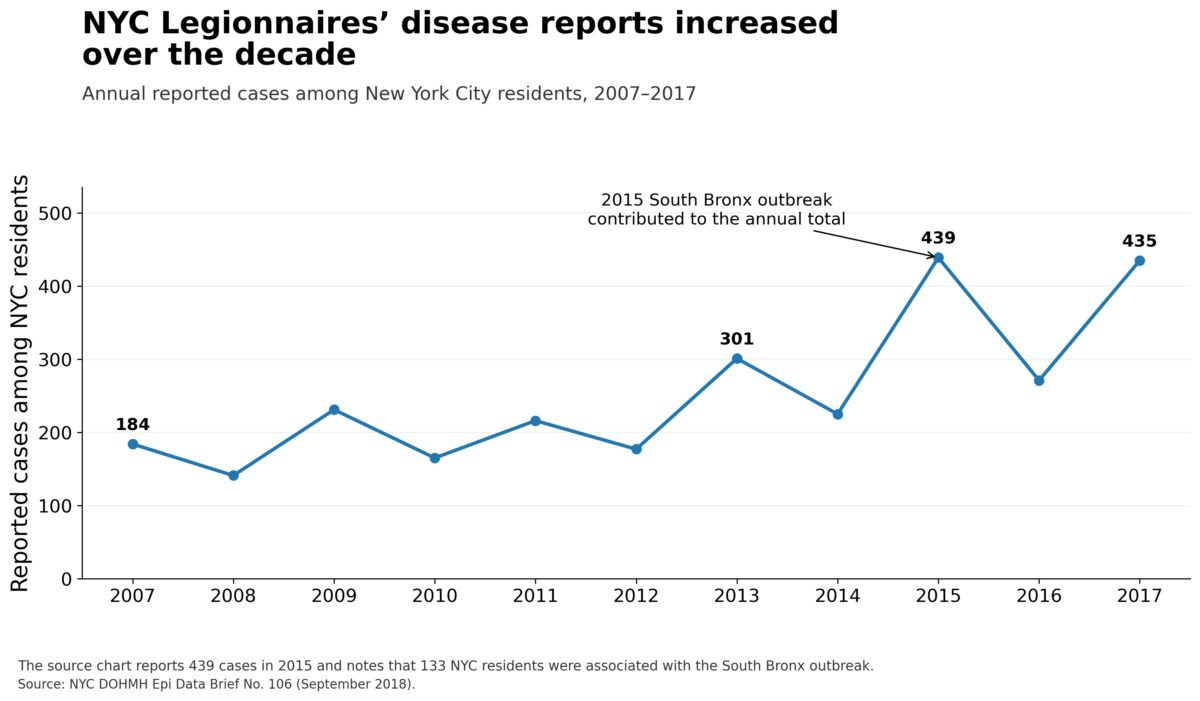
These data underscore that prevention is not limited to emergency remediation. Routine water management, transparent oversight, clinician testing, clinical-specimen collection, and timely public communication all affect whether cases are prevented, recognized, and linked to a source.
Frequently asked questions about the New York outbreak
On July 31, 2026 the NYC Health Department declared the outbreak officially over. Its July 30 update reported 92 cases and seven deaths. The toll has since risen: on August 14, 2026 the Health Commissioner announced two more deaths among people diagnosed weeks earlier, and on August 28, 2026 he announced two more, bringing the cluster to 94 cases and 11 deaths with no one still hospitalized NYC says no cases were diagnosed after July 21 and that it is confident the exposure source has been eliminated. The exact source has not been publicly identified.
Yes. Eleven people have died in connection with the Upper East Side cluster. New York City reported seven deaths as of July 30, 2026, Health Commissioner Dr. Alister Martin announced two further deaths on August 14, 2026, and he announced two more on August 28, 2026. The patients in each of those announcements had been diagnosed weeks earlier.
The investigation area includes Carnegie Hill and Yorkville in ZIP codes 10028, 10128, and 10075. The July 5 city statement also advised people who had visited the east side of Central Park from East 76th to East 97th Street to monitor for symptoms.
No. The city’s guidance includes people who lived, worked, or visited the area since late June. A worker, patient, tourist, delivery driver, caregiver, or other visitor can have a relevant exposure history.
Cough, fever, shortness of breath, chills, headache, muscle aches, fatigue, confusion, diarrhea, or nausea can occur. Symptoms usually begin 2 to 14 days after exposure. Seek medical care promptly and explain your Upper East Side exposure.
In general, no. Legionnaires’ disease is not spread through ordinary person-to-person contact. People usually become ill after inhaling mist containing Legionella bacteria.
NYC says the current community outbreak is not a building-plumbing issue. Residents may continue to drink tap water, bathe, shower, and cook. Follow any separate notice issued for your specific building.
Yes. NYC says home air conditioning, window units, cooling centers, and city facilities are safe. A window air conditioner does not operate like a water-recirculating rooftop cooling tower.
NYC reported 77 PCR-positive towers at 75 buildings and 59 culture-positive towers at 58 buildings. In total, 82 towers at 80 buildings had a positive result in either testing method and completed remediation.
NYC says there is no additional risk from being inside the listed buildings. The investigation concerns outdoor mist from rooftop cooling-tower systems, not the buildings’ internal plumbing. The city also says tap water, showering, cooking, and home or window air conditioning remain safe. Follow any newer property-specific or public-health notice if one is issued.
NYC says it is confident the exposure source has been eliminated, but it has not publicly identified a specific building, cooling tower, or other system as the outbreak source. A culture-positive result confirms live Legionella was present when sampled. Source attribution requires compatible patient exposure histories, epidemiology, bacterial typing, and other laboratory evidence.
No. PCR is a rapid screening tool that detects bacterial genetic material. It helps identify towers for immediate action and culture testing, but it does not by itself prove that viable bacteria from that tower reached or infected patients.
Yes, many did. New York reported that the Health Department found compliance issues at 60% of the cooling towers that had a positive outbreak test and issued 110 violations. A violation does not identify a tower as the outbreak source, but testing, maintenance, reporting, and planning violations can be important when investigators evaluate notice, control, and whether required prevention measures were followed.
CDC recommends a Legionella urinary antigen test paired with testing of a lower respiratory specimen by culture or a molecular method. The urine test is fast but usually detects only L. pneumophila serogroup 1. Culture can provide an isolate for comparison with environmental bacteria.
Contact your treating clinician promptly, explain when and where you were in the investigation area, and ask whether Legionella testing is still appropriate. Test sensitivity and usefulness can change after antibiotics, but treatment should never be delayed.
A Legionnaires’ disease lawyer can begin evaluating and preserving evidence while the public-health investigation remains open. Whether a viable claim exists ultimately depends on diagnosis, exposure timing, source evidence, responsibility, and damages.
Potential rights do not depend on having a home address in the affected ZIP codes. A worker or visitor may have a claim if the evidence connects the infection to a negligently managed source and the person suffered compensable harm.
A representative of the estate or eligible surviving family members may be able to pursue a wrongful-death or survival claim, depending on the law and facts. Preserve medical and funeral records and obtain prompt legal advice about applicable deadlines.
Deadlines depend on the responsible parties, the legal theory, the date of injury or death, and whether a public entity is involved. Some claims can have short notice requirements. Do not assume the ordinary personal-injury deadline applies to every situation.
Use the NYC Health Department’s Legionnaires’ disease page for the current count and public guidance. Clinicians and patients can also consult the joint New York State and New York City advisory and CDC Legionella resources linked below.
The law requires cooling-tower owners and operators in New York City to file certifications twice each year, respond within specified deadlines to microbial test results that indicate maintenance deficiencies or serious health threats, keep inspection and testing records for 10 years, and face higher civil penalties. The 24-hour and 48-hour response provisions take effect 30 days after the law was signed. Most other changes take effect after 90 days. The law does not mean that a city inspector must visit every tower twice a year.
Contact Pritzker Hageman about a New York Legionnaires’ disease case
If you or a loved one was diagnosed with Legionnaires’ disease after living, working, receiving care, or visiting the Upper East Side investigation area – or after another New York exposure – Pritzker Hageman can review what happened. Our team understands the medical testing, cooling-tower and plumbing evidence, public-health process, and preservation work these cases require.
Call 1-888-377-8900, text 612-261-0856, or contact our Legionnaires’ disease legal team online for a free, confidential consultation. We are not paid unless we win for you.
Official sources and further reading
- NYC Health Department: Current Upper East Side case count, testing totals, and public guidance
- Pritzker Hageman: Why NYC cooling-tower findings and violations raise accountability questions
- Pritzker Hageman: Legionnaires’ disease lawyers and national case review
- New York Governor: August 5, 2026 cooling-tower legislation signing announcement
- New York State Assembly: A.9058-A full bill text, memorandum, and legislative history
- NYC Health Department: Cooling Tower Confirmatory Culture Results, updated July 29
- NBC New York: 110 violations, 60% compliance finding, and 1520 York Avenue enforcement details
- NYC Health Department: Cooling Tower Confirmatory Culture Results, updated July 28
- NYC Health Department: July 21 update on the fifth death, 82 cases, culture results, inspections, and remediation
- NYC Health Department: Cooling Tower Confirmatory Culture Results, updated July 21
- NYC Health Department: July 20 preliminary PCR-positive cooling-tower address list
- New York City Council: July 21 announcement of a September oversight hearing and possible legislative changes
- NYC Health Department: July 2 Upper East Side cluster announcement
- NYC Health Commissioner: July 5 Upper East Side investigation statement
- NYC Mayor’s Office: accelerated Upper East Side response
- NYC Health Department: July 14 list of PCR-positive cooling-tower systems
- Associated Press: all 183 towers inspected; new diagnoses slowing; source still unidentified
- NYC Health Department: cooling-tower registration, maintenance, and 2026 requirements
- NYC Health Department: 2026 strengthened cooling-tower testing and inspection rules
- NYC Health Department: cooling-tower inspection results
- New York State and New York City: 2026 legionellosis advisory for clinicians
- New York Codes, Rules and Regulations: Part 4 – Protection Against Legionella
- NYC Health Department: New 31-day cooling-tower Legionella testing rule effective May 8, 2026
- CDC: About Legionnaires’ disease
- CDC: Laboratory testing for Legionella
- CDC: Methods for Legionella testing and specimen collection during investigations
- NYC: 2019-2022 Legionnaires’ disease surveillance report
- NYC: 2025 Central Harlem investigation closure
- NYC: 2022 Highbridge investigation closure
- NYC: 2018 Lower Washington Heights cooling-tower lessons bulletin
- CDC Emerging Infectious Diseases: 2015 South Bronx outbreak investigation
Additional Pritzker Hageman Legionnaires’ disease resources
- Legionnaires’ disease lawyers and lawsuits
- Legionnaires’ disease symptoms and diagnosis
- Where Legionnaires’ disease comes from
- What to do if you contract Legionnaires’ disease
- How we prove a Legionnaires’ disease case
- Determining liability for an outbreak
- Lawsuits and compensation
- Wrongful-death lawsuits
- Frequently asked questions
- Recent Legionnaires’ disease news and outbreak posts
We have obtained 100+ separate verdicts and settlements greater than $1 million:
We obtained this result on behalf of three people sickened in a Legionnaires’ disease outbreak at a resort hotel.
We obtained this settlement on behalf of six people impacted by a Legionnaires’ disease outbreak linked to a hotel hot tub.
Our client contracted Legionnaires’ disease at a hotel and was hospitalized for eight weeks.
We obtained this settlement on behalf of the family of a woman who died after contracting Legionnaires’ Disease.
We obtained this result on behalf of clients who contracted Legionnaires’ disease from a hotel HVAC cooling tower.
On behalf of a client sicked from contaminated water at a senior care facility.
Our client contracted Legionnaires’ disease at a hotel and was hospitalized for over a month.
On behalf of a women hospitalized for over two months from a contaminated hotel hot tub in Myrtle Beach.
We obtained this settlement for a woman sickened with Legionnaires’ disease after being exposed in a hotel hot tub.
We obtained this settlement for the family of a 52-year old man who died of Legionnaires’ disease linked to a hotel.
We collected this on behalf of a client who contracted Legionnaires’ disease from contaminated water at a hotel.
We recovered this settlement for the family of a 50-year old man who died of Legionnaires’ disease after being exposed to legionella bacteria at a hotel.
Collected on behalf of the family of a man who died as a result of Legionnaires’ Disease contracted while staying at a Wisconsin resort.
We obtained this on behalf of a man hospitalized after Legionella bacteria exposure at a hotel.
See more settlements & verdicts.
The Pritzker Hageman law firm and our attorneys have been recognized in:
U.S. News & World Report

Pritzker Hageman has been recognized as one of the best law firms for personal injury litigation by U.S. News & World Report every year the award has been given since 2012.
Super Lawyers®, Thomson Reuters

Attorneys at Pritzker Hageman have been awarded the peer selected Super Lawyers distinction every year since 2004.
America’s Top 100 Attorneys®

Lifetime Achievement selection to America’s Top 100 Attorneys®.
Three Time Attorneys of the Year

Pritzker Hageman lawyers have been named Attorneys Of The Year by Minnesota Lawyer three times.