
A 39-year-old man died on Friday, July 17, 2026, after an apparent electrical incident while swimming in Lake Vermilion in Beatty Township, Minnesota. According to reporting based on the St. Louis County Sheriff’s Office statement, the emergency call came in at approximately 4:47 p.m. Witnesses said the man was swimming when he grabbed a docked boat, appeared to receive an electric shock, and became unconscious.
Emergency personnel attempted life-saving measures, but he died at the scene. The sheriff’s office said the boat’s electrical system appeared to be plugged into a nearby boathouse at the time. Local reporting stated that the medical examiner’s investigation was pending, and the man’s name had not yet been publicly released.
These facts are preliminary. No public agency has announced a final medical cause of death or found any person, property owner, contractor, manufacturer, or company legally responsible. A careful investigation will be needed to determine whether electricity escaped from the boat, the shore-power connection, the boathouse or dock wiring, another electrical device, or a combination of conditions.
Pritzker Hageman extends its condolences to the man’s family and everyone who witnessed or responded to this tragedy. Our Minnesota boating accident and wrongful death lawyers investigate catastrophic cases involving boats, drownings, electrical systems, property safety, and evidence that can be altered or lost soon after an incident.
Contact our Minnesota Boat Wrongful Death Legal Team
What Authorities Have Reported About the Lake Vermilion Death
The publicly reported facts currently include:
- The incident occurred during the afternoon of July 17, 2026, on Lake Vermilion in Beatty Township.
- The swimmer was a 39-year-old man.
- Witnesses reportedly saw him grab a docked boat, appear to receive an electrical shock, and lose consciousness.
- The boat’s electrical system appeared to be connected to a nearby boathouse.
- The Cook Fire Department, Cook Ambulance, LifeLink, Lake Country Power, and the St. Louis County Sheriff’s Office were reported to have assisted.
- The medical examiner and law-enforcement investigation had not issued final public findings when this article was prepared.
Lake Vermilion is a large freshwater lake in northeastern Minnesota, with extensive shoreline, islands, private docks, resorts, marinas, and boathouses. The Minnesota Department of Natural Resources describes the lake and its northwoods setting. The combination of freshwater swimming and electrical equipment near docks makes careful installation, maintenance, inspection, and emergency planning especially important.
Why the Boat-to-Boathouse Electrical Connection Matters
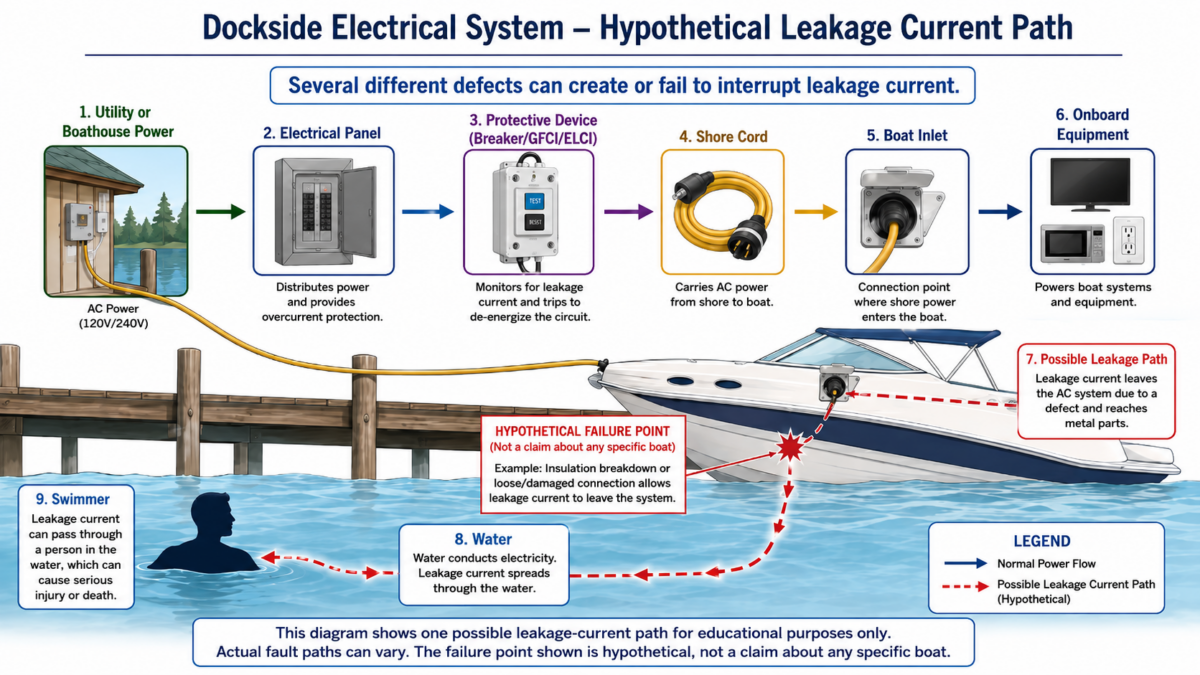
A boat connected to shore power becomes part of an electrical system that may include the boathouse service, breakers, receptacles, cords, plugs, adapters, the boat’s shore-power inlet, onboard wiring, chargers, appliances, grounding conductors, bonding conductors, and protective devices. A defect or improper connection at any point can create a path for electrical current to reach metal parts or the surrounding water.
The reported connection does not prove where the electrical problem began. It does, however, make the entire path from the shore-side source through the boat a central part of the investigation. The boat, shore cord, adapters, receptacles, breakers, protective devices, boathouse wiring, and connected equipment should be preserved and examined together before repairs, alterations, disposal, or destructive testing.
What Is Electric Shock Drowning?
Electric shock drowning generally describes a situation in which alternating electrical current enters the water and passes through a swimmer. The current can cause pain, tingling, loss of muscle control, respiratory impairment, paralysis, abnormal heart rhythm, or direct electrocution. A swimmer who cannot control the arms and legs may be unable to keep the airway above water or reach safety.
The National Fire Protection Association explains that leaking current from electrical systems at marinas, private docks, or vessels can paralyze a swimmer and lead to drowning. Electric shock drowning can be difficult to recognize because the victim may have no visible burn, the event may resemble an ordinary drowning, and the electrical source may stop operating or be disconnected before testing occurs.
Not every death involving electricity and water is technically the same. Electricity may cause immediate fatal electrocution, trigger a dangerous heart rhythm, cause a person to lose consciousness, or produce muscle paralysis followed by drowning. The final classification requires medical findings, witness accounts, electrical testing, and a reconstruction of the sequence of events.
Why Fresh Water Can Be Especially Dangerous
The risk depends on voltage, current, distance from the source, the path through the body, water conductivity, body position, exposure time, and the condition of protective devices. In many freshwater conditions, the human body can provide a lower-resistance path than the surrounding water. A swimmer who enters an electrical field may therefore carry enough current through the body to lose muscle control even when there is no visible spark or dramatic sign at the surface.
This is one reason a person in the water may feel tingling, cramping, weakness, or an inability to move before anyone on shore realizes electricity is present. It is also why rescuers should not enter the water until the electrical source has been shut off and the scene is safe.
Possible Sources of Current Leakage Near a Boat or Dock
Investigators commonly consider multiple possible failure points. The list below describes general possibilities and is not a statement about what caused the Lake Vermilion incident.
- A damaged, waterlogged, corroded, or improperly repaired shore-power cord, plug, adapter, or boat inlet.
- A missing, damaged, or disconnected equipment-grounding conductor.
- Improper neutral-to-ground connections, reversed polarity, or other wiring errors on the boat or shore side.
- Faulty onboard equipment such as a battery charger, inverter, water heater, air conditioner, refrigerator, pump, or other appliance.
- Damaged wiring insulation caused by age, vibration, heat, chafing, pests, water intrusion, or prior repairs.
- Corrosion or loose connections in the boathouse, dock, pedestal, receptacle, panel, boat lift, lighting system, pump, or other equipment.
- Ground-fault protection that was absent, incorrectly selected, improperly installed, bypassed, defective, or not tested.
- Use of extension cords, household adapters, temporary wiring, or equipment not suitable for wet marine environments.
- Electrical modifications performed without required permits, inspection, qualified personnel, or manufacturer instructions.
- More than one defect that allowed current leakage and also prevented a breaker or protective device from disconnecting power promptly.
Minnesota Electrical-Code and Inspection Questions
Minnesota’s electrical code incorporates the National Electrical Code. The Minnesota Department of Labor and Industry identifies the code editions that apply to electrical work and provides electrical-code resources. The Minnesota Electrical Code is published in Minnesota Rules, chapter 1315.
Code compliance in a case like this cannot be determined by looking for one device. Investigators need to identify when the boathouse, dock, service, receptacles, and boat systems were installed or modified; which code edition and permit requirements applied; whether inspections occurred; whether listed equipment was used; and whether later repairs or deterioration changed the system. A system may also be unsafe even when a responsible party argues that it was once approved or grandfathered.
The NFPA recommends close inspection of grounding and bonding connections, protective devices, and corrosion-prone marina equipment. Movement, moisture, weather, corrosion, and repeated connecting and disconnecting can create conditions that did not exist when the system was first installed.
Evidence That Should Be Preserved Immediately
Electrical evidence can change quickly. A cord may be unplugged, a breaker may be reset, a damaged component may be replaced, corrosion may dry, a boat may be moved, or an owner may make a well-intentioned repair. The safest legal and technical approach is usually to preserve the scene and arrange a documented, coordinated inspection by qualified experts.
Important evidence may include:
- The boat in its post-incident condition, including the shore-power inlet, onboard panel, appliances, chargers, inverters, wiring, grounding and bonding systems, and underwater metal components.
- The complete shore-power cord, every adapter and splitter, plugs, connectors, receptacles, panels, breakers, ground-fault devices, and any equipment-leakage protection.
- The boathouse and dock wiring, boat lift, lights, pumps, outlets, extension cords, junction boxes, disconnects, grounding electrodes, bonding connections, and utility service equipment.
- Photographs and video showing exactly what was connected, where the boat was positioned, the swimmer’s location, water level, weather, and the condition of equipment before anything was moved.
- Electrical permits, inspection records, plans, invoices, manuals, installation records, repair records, maintenance logs, and prior recommendations.
- Records of prior breaker trips, tingling complaints, shocks, flickering lights, corrosion, damaged cords, water intrusion, or other warning signs.
- 911 audio, dispatch records, body-camera footage, first-responder reports, utility records, medical records, autopsy findings, toxicology, and photographs taken by investigators.
- Witness names, phone numbers, written statements, text messages, photographs, social-media posts, and surveillance or doorbell-camera recordings.
- Ownership, rental, service, and insurance records for the property, boathouse, dock, boat, and electrical equipment.
- Non-destructive and controlled testing data, including voltage, current, leakage, continuity, polarity, insulation resistance, grounding, bonding, trip thresholds, water conductivity, and distance measurements.
Testing should be planned so that it does not destroy or alter the evidence before all appropriate parties have an opportunity to document it. Depending on the circumstances, the family’s attorney may need to send immediate preservation notices and request that no one repair, energize, dismantle, sell, discard, or move critical components without notice.
Who Could Be Legally Responsible?
Responsibility depends on what the evidence shows. The fact that a person owned a boat, dock, or property does not by itself establish negligence. A complete investigation may consider the conduct and legal duties of several people or companies, including:
- The boat owner, operator, or person responsible for maintaining or modifying the boat’s electrical system.
- The property, dock, or boathouse owner and anyone responsible for shore-side electrical maintenance and safety.
- A marina, resort, rental company, property-management company, or other commercial operator, if one was involved.
- An electrician, electrical contractor, boat dealer, marine technician, installer, inspector, or repair company whose work contributed to the hazardous condition.
- The manufacturer or seller of a defective boat, cord, inlet, adapter, breaker, protective device, appliance, lift, or other component.
- An entity that received prior warnings or complaints but failed to investigate, disconnect power, restrict swimming, warn users, or correct a known hazard.
- Other parties identified through ownership records, contracts, permits, service records, expert testing, or discovery.
A legal investigation should ask not only where current leaked, but also why protective systems did not prevent exposure, whether the hazard was foreseeable, who had the ability and duty to correct it, and whether prior incidents or warning signs were ignored.
Minnesota Wrongful Death Rights and Deadlines
When a death is caused by a wrongful act or omission, Minnesota law permits a court-appointed trustee to pursue a claim for the benefit of the surviving spouse and next of kin. The Minnesota wrongful death statute allows recovery for losses caused by the death and, under current law, damages suffered by the deceased person from the injury before death. Funeral expenses and other recoverable losses may also be addressed.
Minnesota’s general wrongful death deadline is often three years from the date of death, subject to a six-year limit measured from the act or omission. Other rules can create shorter notice periods or different deadlines depending on the parties, the type of claim, government involvement, product issues, insurance provisions, or where a case must be filed. Families should not use the general deadline as a reason to wait. The practical evidence deadline may be measured in hours or days.
Our wrongful death attorneys can evaluate who has the right to act for the family, which claims may apply, what evidence must be preserved, and where the case should be brought.
What the Family Can Do Now
- Ask that the boat, boathouse, dock, shore-power equipment, cords, adapters, breakers, and electrical components be preserved without repair or destructive testing.
- Save every photograph, video, text, email, social-media post, receipt, maintenance record, and communication concerning the boat, property, electrical work, and incident.
- Write down the names and contact information of witnesses and responders while memories are fresh.
- Request the incident report, 911 and dispatch records, medical examiner information, and other public records when available.
- Do not sign a release, transfer ownership of evidence, or give a recorded statement to an insurer before receiving legal advice.
- Speak with a lawyer who understands electrical evidence, boating systems, wrongful death law, and the need for coordinated expert inspections.
How to Respond Safely to a Suspected Electrical Shock in Water
A rescuer can become a second victim. The U.S. Consumer Product Safety Commission advises people to turn off all power immediately and call 911 when electrical shock in water is suspected. Do not enter the water or make direct contact with the victim until the electrical source is disconnected and the scene is safe.
- Turn off power at the appropriate disconnect or breaker if it can be done safely.
- Call 911 and clearly report a possible electrical hazard in the water.
- Warn others to stay out of the water and away from metal docks, ladders, rails, boats, lifts, and electrical equipment.
- Use a nonconductive rescue device from a safe position if trained and if the power has been disconnected.
- After safe removal, begin CPR if the person is unresponsive and not breathing normally, and use an AED as soon as it is available.
- Anyone who felt tingling, cramping, weakness, pain, or shock should receive medical evaluation, even if symptoms improve.
Preventing Electric Shock Drowning Around Docks and Boats
- Do not swim near boats that are connected to shore power or near docks and boathouses with energized electrical equipment.
- Have boat and shore-side electrical systems inspected by qualified professionals familiar with wet-location and marine requirements.
- Use properly listed shore-power equipment and do not improvise with household extension cords or adapters.
- Inspect cords, plugs, inlets, receptacles, panels, grounding and bonding connections, and protective devices for damage, corrosion, heat, looseness, and water intrusion.
- Test ground-fault protective devices at the recommended intervals and investigate every unexplained trip instead of repeatedly resetting a breaker.
- Disconnect power and stop swimming immediately if anyone reports tingling, cramping, unusual weakness, or a shock sensation.
- Post no-swimming and emergency-shutoff information where electrical equipment is present near the water.
- Keep rescue equipment and an AED accessible, and make sure family members, employees, and guests know how to shut off power and call for help.
Frequently Asked Questions
Not yet, based on the information publicly available when this article was prepared. Witnesses reportedly saw the swimmer appear to receive an electric shock after grabbing the boat, and the boat appeared connected to a boathouse. The final cause and mechanism should be based on the medical examiner’s findings, electrical testing, and the completed investigation.
Yes. A dangerous condition does not require a dramatic high-voltage event. Common boat and building electrical systems can cause severe injury or death when current leaks into water and passes through a person. The amount and path of current through the body, exposure time, water conditions, and operation of protective devices all matter.
No protective device should be assumed to eliminate all risk. Investigators must determine whether the correct devices were required and installed, whether they were functioning, whether wiring allowed them to detect the fault, whether trip settings were appropriate, and whether someone bypassed, reset, altered, or failed to maintain them.
The source of current may be identified only by examining the system in its post-incident condition. Moving the boat, unplugging or replacing a cord, drying wet components, resetting breakers, repairing wiring, or discarding an adapter can erase evidence needed to determine what happened.
A family may have a claim if evidence shows that a person or company breached a legal duty and caused or contributed to the death. The answer depends on the electrical findings, ownership and control, prior notice, applicable codes and standards, contracts, product condition, and Minnesota law.
That conclusion should not be accepted or rejected without an independent investigation. Electrical current does not enter the water without a source and path. Experts can evaluate whether the system was properly designed, installed, maintained, protected, and operated, and whether the hazard should have been detected or prevented.
Contact the Pritzker Hageman wrongful death legal team and find out how you can get compensation and justice for your family
1-888-377-8900 (Toll-Free) | [email protected]

Pritzker Hageman Investigates Electrical Drowning and Boating Death Cases
Pritzker Hageman is a Minnesota law firm that represents families in complex wrongful death cases. Our work includes boating accidents, drownings, electrical injuries, defective products, unsafe property conditions, and cases requiring engineers and other technical experts.
Managing partner Eric Hageman has handled catastrophic injury and wrongful death cases across the country. His reported results include a $3 million recovery in a school drowning wrongful death case and a recovery exceeding $5 million for a boat passenger who suffered a severe propeller injury. Past results do not guarantee a future outcome, but they demonstrate the firm’s experience with high-stakes investigations and significant losses.
If your family has information about the Lake Vermilion incident or needs confidential legal advice after an electric shock drowning, electrocution, or boating death, contact Pritzker Hageman. Call 1-888-377-8900, text 612-261-0856, or email [email protected]. The consultation is free, and you pay nothing unless we recover compensation for you.