
The New York City Department of Health and Mental Hygiene is investigating two confirmed Legionnaires’ disease cases among residents of North Shore Towers in the Glen Oaks neighborhood of Queens. CBS New York’s report on the North Shore Towers Legionnaires’ disease investigation says health officials are examining the apartment complex’s hot water system. As of October 5, officials had not confirmed Legionella bacteria in the building’s plumbing.
Gothamist’s reporting on the North Shore Towers resident notices says NYC Health began distributing letters to residents on Friday evening, October 2. The notices advised residents who smoke, have chronic respiratory conditions, or are over age 50 to avoid taking showers in their apartments temporarily to reduce exposure to water mist. Health officials also said the building’s tap water is safe to drink.
If you or a family member has been diagnosed with Legionnaires’ disease after living at, working at, or visiting North Shore Towers, Pritzker Hageman can review the diagnosis, exposure timeline, water-system evidence, and public-health investigation. Call 1-888-377-8900, text 612-261-0856, or contact Pritzker Hageman’s national Legionnaires’ disease legal team for a free, confidential consultation.
Diagnosed with Legionnaires’ Disease?
North Shore Towers Legionnaires’ Disease Investigation: Quick Facts
Location: North Shore Towers, a residential complex on Grand Central Parkway in Glen Oaks, Queens, New York.
Cases: Two North Shore Towers residents have been diagnosed with Legionnaires’ disease.
Current investigation: NYC Health is examining the building’s hot water system.
Legionella testing status: As of the latest public reporting reviewed October 6, Legionella has not been confirmed in the complex’s plumbing.
Resident guidance: The building’s tap water is considered safe to drink. Local reporting says residents over 50, smokers, and people with chronic respiratory conditions were advised to avoid showers temporarily while the investigation continues.
Why Is NYC Health Investigating the Hot Water System?
NYC Health is investigating the North Shore Towers hot water system because multiple residents have been diagnosed with Legionnaires’ disease, and building plumbing can be a source of Legionella exposure. The NYC Health Department guidance on building-related Legionnaires’ disease and hot water systems explains that when multiple people with Legionnaires’ disease live in the same building, investigators often evaluate the building’s plumbing, particularly the hot water system. If Legionella is present, residents can be exposed by breathing contaminated water mist from showers and other fixtures.
The focus on the building’s plumbing also helps distinguish this investigation from the community clusters New York City investigates when cooling towers are suspected. Cooling towers can release contaminated water droplets into outdoor air and expose people across a wider area. At North Shore Towers, NYC Health has said it is examining the residential hot water system rather than investigating cooling towers as a possible neighborhood-wide source.
NYC Health says it can begin a building evaluation when two or more confirmed Legionnaires’ disease cases occur within 12 months in a residential building with a shared hot water system. Under the city’s Legionnaires’ disease building-evaluation process for residential plumbing systems, the building owner must hire a qualified water-system management team to assess the plumbing system, identify conditions that could allow Legionella to grow, and collect water samples for testing. If Legionella is detected, corrective action and follow-up testing are required.
Can Legionella Spread Through Apartment Building Showers?
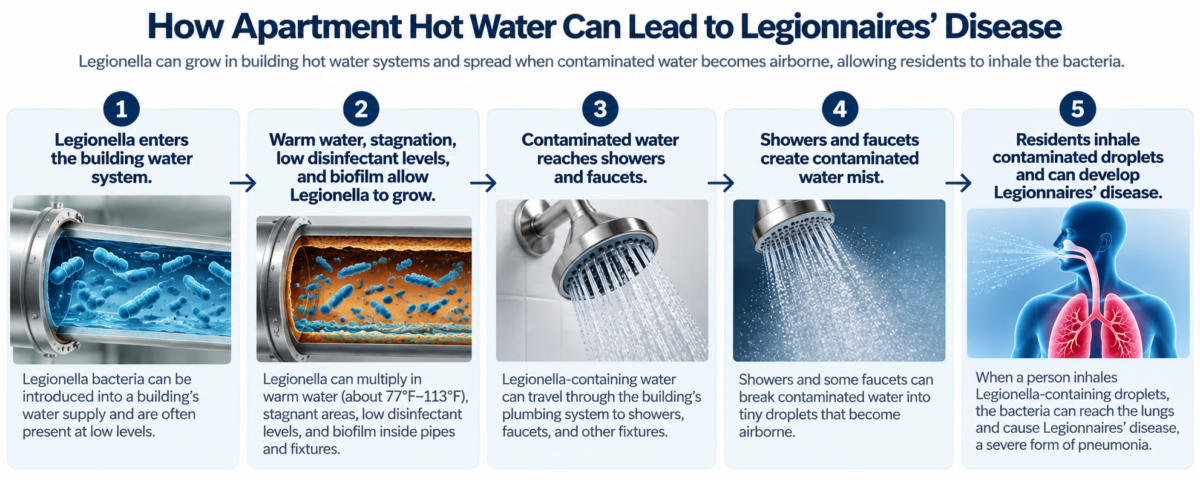
Yes. Apartment building showers can expose residents to Legionella when the bacteria are present in the building’s water system. Legionella can multiply in large plumbing systems and reach showerheads and other fixtures. When a shower turns contaminated water into fine droplets, a person can develop Legionnaires’ disease by breathing in the mist.
The CDC’s guidance on how Legionella spreads through building water systems, showers, faucets, hot tubs, and cooling towers identifies large plumbing systems and showerheads as potential sources of Legionella exposure.
In apartment buildings, hot water systems can create conditions that allow Legionella to grow and circulate through the plumbing. Investigators may examine water temperatures, disinfectant levels, circulation, areas of stagnation, water-sampling results, maintenance records, and water-management practices when evaluating Legionella exposure from an apartment building hot water system.
A well-designed water management program addresses those same conditions before they lead to exposure. For large apartment buildings with centralized hot water, Legionella water management programs for apartment building hot water systems should identify where Legionella can grow, establish measurable control limits, monitor whether those limits are being maintained, and define corrective action when conditions fall outside the program’s limits. Records showing whether those steps were actually followed can also help explain how Legionella was able to grow or spread through a building’s plumbing.
At North Shore Towers, NYC Health is investigating the hot water system as a potential source of the residents’ illnesses. Legionella has not yet been publicly confirmed in the building’s plumbing, so the source of exposure remains under investigation.
What Should North Shore Towers Residents Do Now?
North Shore Towers residents should follow NYC Health’s current water-use guidance and seek medical care promptly if they develop symptoms of Legionnaires’ disease.
Local reporting says residents who are over 50, smoke, or have chronic respiratory conditions were advised to avoid showers temporarily while NYC Health investigates the building’s hot water system.
Residents should also:
- Seek medical care promptly for fever, cough, shortness of breath, muscle aches, chills, confusion, diarrhea, or other symptoms of pneumonia. Legionnaires’ disease symptoms, pneumonia warning signs, and diagnostic testing can help residents recognize symptoms and understand how the infection is diagnosed.
- Tell your healthcare provider that you live at, work at, or recently visited North Shore Towers and that NYC Health is investigating Legionnaires’ disease cases at the complex.
- Save building notices, emails, letters, medical records, laboratory results, discharge instructions, and other documents related to the investigation or diagnosis.
- Write down where you spent time during the two weeks before symptoms began. Knowing what to do after a Legionnaires’ disease diagnosis and possible building water exposure can help preserve exposure information that public-health and legal investigators may later need.
Residents should continue to follow the most recent instructions from NYC Health because shower precautions and other guidance may change as environmental testing proceeds.
What Evidence Can Show Whether the North Shore Towers Hot Water System Was the Source?
Determining whether the North Shore Towers hot water system caused the residents’ Legionnaires’ disease can involve environmental testing, information about how the plumbing system was operating, the residents’ exposure histories, and their medical and laboratory results. Together, those findings can help investigators determine whether Legionella was circulating through the hot water system and whether residents were exposed through showers or other fixtures.
Evidence may include:
- Environmental samples collected from the hot water system, including showers, faucets, storage tanks, recirculation lines, and other parts of the plumbing.
- The locations where samples were collected and the amount, species, or serogroup of Legionella detected.
- Hot water storage, distribution, and recirculation temperatures.
- Disinfectant levels, water age, and areas where low flow or stagnation could allow Legionella to grow.
- Records for boilers, storage tanks, pumps, mixing valves, recirculation loops, plumbing, and fixtures.
- Water outages, construction, repairs, pressure changes, or other events that may have changed conditions within the hot water system.
- Previous Legionella testing, water-management plans, corrective actions, resident complaints, and communications involving management, contractors, laboratories, and public-health officials.
- The diagnosed residents’ Legionella test results, symptom-onset dates, apartment locations, water exposures, and other possible exposures during the relevant period.
- Comparisons between clinical and environmental Legionella isolates when suitable samples are available.
Medical, epidemiologic, environmental, and laboratory evidence used to identify a Legionnaires’ disease exposure source can help investigators determine whether the bacteria came from the hot water system and how residents may have been exposed.
At North Shore Towers, water sampling and the evaluation of the building’s hot water system may clarify whether Legionella was present, where it was growing within the plumbing, and whether that system was connected to the residents’ illnesses.
How Is the North Shore Towers Investigation Different From a New York City Cooling Tower Outbreak?
The North Shore Towers investigation is focused on a residential hot water system, while a cooling tower outbreak can expose people across a wider neighborhood.
Cooling towers use water as part of a building’s cooling system and can release small droplets into outdoor air. If Legionella grows inside a cooling tower, people who live, work, or spend time nearby can breathe in contaminated mist even if they never enter the building where the tower is located. That broader exposure pattern has been documented in New York City Legionnaires’ disease outbreaks involving cooling towers and community exposure.
When investigators suspect a residential building’s plumbing as a possible source, they may examine the water used inside the property, including the hot water system, showers, faucets, storage tanks, and recirculation lines. New York City has investigated several residential Legionnaires’ disease outbreaks involving building plumbing. In 2026, Legionella found in the Haven Plaza apartment water system during an East Village Legionnaires’ disease outbreak shifted the investigation toward the building’s water system. In 2025, NYC identified the hot water system as the source of the Parkchester North Condominiums Legionnaires’ disease outbreak in the Bronx.
Queens has also had previous residential Legionnaires’ disease investigations, including a possible outbreak at Rochdale Village. Those and other New York apartment building Legionnaires’ disease investigations and lawsuits provide additional examples of investigations involving shared building water systems.
NYC Health is now investigating whether the complex’s hot water system contained Legionella and whether exposure to water from that system was connected to the residents’ illnesses.
Can You Sue an Apartment Building for Legionnaires’ Disease?
Yes. A person who develops Legionnaires’ disease after exposure to Legionella in an apartment building may be able to bring a claim against the property owner, property manager, water-management company, contractor, or another party responsible for the water system.
A Legionnaires’ disease lawsuit involving an apartment building usually investigates whether Legionella was present in the building’s water system, how the bacteria were able to grow or spread, and who was responsible for maintaining or managing the conditions that contributed to the exposure.
Evidence may include water-testing results, maintenance records, water-management plans, plumbing records, temperature and disinfectant data, resident complaints, and communications involving building management and contractors.
Who Can Be Liable for Legionnaires’ Disease in an Apartment Building?
Responsibility may extend beyond the building owner. Determining who may be legally responsible for Legionnaires’ disease caused by an apartment building water system can involve examining the roles of property managers, water-treatment companies, water-management consultants, plumbers, mechanical contractors, and other companies involved in maintaining or monitoring the system.
What Compensation Is Available in an Apartment Building Legionnaires’ Disease Lawsuit?
A person who became seriously ill may be able to recover damages for medical expenses, lost income, pain and suffering, disability, future medical care, and other losses. The compensation available in an apartment building Legionnaires’ disease lawsuit will depend on the severity and long-term effects of the illness and the evidence establishing responsibility.
Do You Have to Wait for the Health Department Investigation to End?
No. A public-health investigation does not necessarily have to be complete before a potential legal claim can be evaluated. Medical records, exposure histories, building notices, environmental testing, water-system records, and other evidence can help determine whether an apartment building’s water system was the source and who may be responsible.
Contact Eric today and find out how you can get compensation and justice
1-888-377-8900 (Toll-Free) | [email protected]

Contact Pritzker Hageman About a North Shore Towers Legionnaires’ Disease Case
Pritzker Hageman’s national Legionnaires’ disease legal team handles complex cases involving apartment buildings, hotels, hospitals, senior housing, cooling towers, hot tubs, and other water systems. Our legal team’s investigations bring together medical records, exposure timelines, public-health findings, water-system records, laboratory evidence, and engineering analysis to determine where an exposure occurred and who controlled the conditions that allowed it to happen.
If you or a family member developed Legionnaires’ disease after living at, working at, or visiting North Shore Towers, call 1-888-377-8900, text 612-261-0856, or contact our Legionnaires’ disease team for a free, confidential consultation.
Frequently Asked Questions About North Shore Towers Legionnaires’ Disease
NYC Health is investigating two confirmed Legionnaires’ disease cases among North Shore Towers residents. Legionella has not yet been publicly confirmed in the complex’s water system, so the hot water system has not been identified as the official source of the illnesses.
As of October 6, 2026, NYC Health had not publicly confirmed Legionella in the North Shore Towers water system. Officials are inspecting and testing the complex’s internal hot water system to determine whether it was the source of the residents’ exposure.
Yes. NYC Health has said North Shore Towers residents can continue to drink the building’s tap water. Legionnaires’ disease is usually contracted by breathing in contaminated water droplets rather than by drinking water.
NYC Health has advised residents who are over 50, smoke, or have chronic respiratory conditions to avoid showers temporarily while the hot water system is being evaluated. Showers can create fine water droplets that can be inhaled if Legionella is present in the water. Residents should follow the most recent guidance from NYC Health and building management as testing continues.
Yes. If Legionella is growing in an apartment building’s water system, showers can aerosolize contaminated water and create droplets that residents breathe. Temperature, water circulation, disinfectant levels, stagnation, and other plumbing conditions can affect whether Legionella grows in a building’s hot water system.
Legionnaires’ disease is a severe form of pneumonia that can cause fever, cough, shortness of breath, muscle aches, headaches, chills, confusion, and gastrointestinal symptoms. Anyone who develops pneumonia symptoms after a possible North Shore Towers water exposure should seek medical care and tell their healthcare provider about the ongoing investigation.
Yes. A person who contracts Legionnaires’ disease from an apartment building’s water system may have a claim against a property owner, property manager, water-management company, contractor, or another party responsible for conditions that allowed Legionella to grow or spread.
No. A person diagnosed with Legionnaires’ disease does not need to wait for NYC Health to complete its investigation before having a potential claim evaluated. Medical records, exposure information, building notices, environmental testing, and water-system records may help determine whether the hot water system was the source and who was responsible for managing it.
Additional Information About Legionnaires’ Disease
- Legionnaires’ Disease Frequently Asked Questions (FAQs)
- Where Does Legionnaires’ Disease Come From?
- Legionnaires’ Disease: Symptoms and Diagnosis
- What to do if You Contract Legionnaires’ Disease
- Legionnaires’ Disease: Determining Liability
- Legionnaires’ Disease: Lawsuits and Compensation
- Legionnaires’ Disease: Wrongful Death Cases
- Finding a Legionnaires’ Disease Lawyer
- Filing a Legionnaires’ Disease Lawsuit
- The Importance of Water Management Plans
We have obtained 100+ separate verdicts and settlements greater than $1 million:
We obtained this result on behalf of three people sickened in a Legionnaires’ disease outbreak at a resort hotel.
We obtained this settlement on behalf of six people impacted by a Legionnaires’ disease outbreak linked to a hotel hot tub.
Our client contracted Legionnaires’ disease at a hotel and was hospitalized for eight weeks.
We obtained this settlement on behalf of the family of a woman who died after contracting Legionnaires’ Disease.
We obtained this result on behalf of clients who contracted Legionnaires’ disease from a hotel HVAC cooling tower.
On behalf of a client sicked from contaminated water at a senior care facility.
Our client contracted Legionnaires’ disease at a hotel and was hospitalized for over a month.
On behalf of a women hospitalized for over two months from a contaminated hotel hot tub in Myrtle Beach.
We obtained this settlement for a woman sickened with Legionnaires’ disease after being exposed in a hotel hot tub.
We obtained this settlement for the family of a 52-year old man who died of Legionnaires’ disease linked to a hotel.
We collected this on behalf of a client who contracted Legionnaires’ disease from contaminated water at a hotel.
We recovered this settlement for the family of a 50-year old man who died of Legionnaires’ disease after being exposed to legionella bacteria at a hotel.
Collected on behalf of the family of a man who died as a result of Legionnaires’ Disease contracted while staying at a Wisconsin resort.
We obtained this on behalf of a man hospitalized after Legionella bacteria exposure at a hotel.
See more settlements & verdicts.
The Pritzker Hageman law firm and our attorneys have been recognized in:
U.S. News & World Report

Pritzker Hageman has been recognized as one of the best law firms for personal injury litigation by U.S. News & World Report every year the award has been given since 2012.
Super Lawyers®, Thomson Reuters

Attorneys at Pritzker Hageman have been awarded the peer selected Super Lawyers distinction every year since 2004.
America’s Top 100 Attorneys®

Lifetime Achievement selection to America’s Top 100 Attorneys®.
Three Time Attorneys of the Year

Pritzker Hageman lawyers have been named Attorneys Of The Year by Minnesota Lawyer three times.