
Three passengers who sailed aboard Norwegian Prima in May and July 2026 have been diagnosed with Legionnaires’ disease, and Norwegian Cruise Line told Fox News that the cruise line is working with the CDC to investigate the cases.
Norwegian Prima’s public hot tubs and private balcony heated whirlpools have been closed while the investigation continues. Hot tubs and other cruise-ship water systems can create aerosolized water mist, which is how people are typically exposed to Legionella.
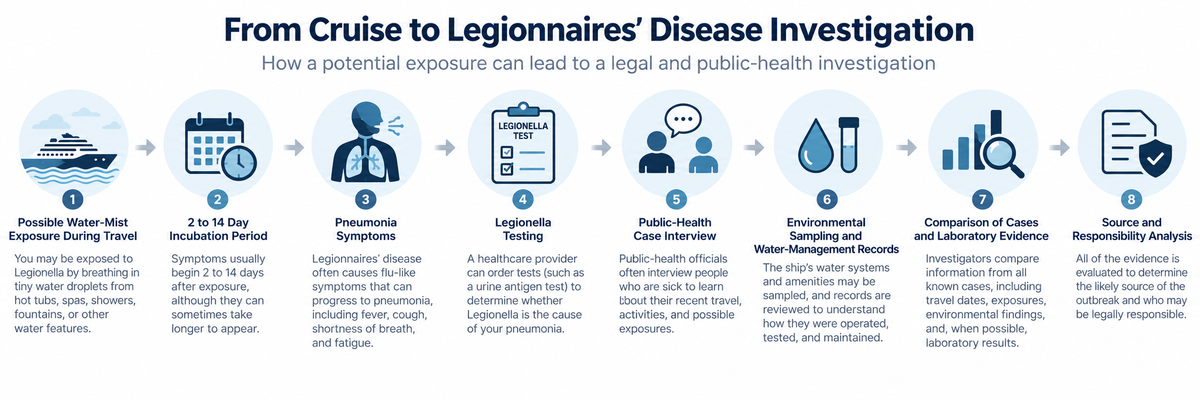
Investigators will need to evaluate the passengers’ illness timelines, shared voyage exposures, water-management practices, maintenance and disinfection records, prior sampling, and evidence from other cases to determine where exposure occurred.
Pritzker Hageman is investigating the Norwegian Prima cases. If you sailed on Norwegian Prima in May or July 2026 and were diagnosed with Legionnaires’ disease, or if you were hospitalized with serious pneumonia shortly after your cruise, our national Legionnaires’ disease legal team can review your travel timeline, medical records, and potential exposures.
Were you diagnosed after sailing on Norwegian Prima?
What Happened on Norwegian Prima?
Three former Norwegian Prima passengers have been diagnosed with Legionnaires’ disease, and Norwegian Cruise Line says it is working with the CDC to investigate where the exposures occurred.
- The diagnosed passengers sailed in May and July 2026.
- Public reporting has not identified the exact sailing dates or said whether all three passengers were on the same voyage.
- No onboard exposure source has been confirmed.
- Norwegian Cruise Line says water-fixture testing received so far has been negative for Legionella.
- Public hot tubs and private balcony heated whirlpools are closed as a precaution while additional sampling and any necessary remediation are completed.
- The investigation remains ongoing as of September 15, 2026.
Why Are Norwegian Prima Hot Tubs and Private Balcony Whirlpools Closed?
Norwegian Prima’s public hot tubs and private balcony heated whirlpools are closed while the Legionnaires’ disease investigation continues because hot tubs can be a source of Legionella exposure.
Legionella bacteria can grow in warm water, especially when hot tubs are not properly disinfected and maintained. Hot tub jets can then send contaminated water droplets into the air. People can develop Legionnaires’ disease after breathing in that mist, even if they never get into the hot tub.
CDC guidance for public hot tub operators says that when Legionnaires’ disease cases may be associated with a hot tub, the hot tub should be shut down, tested, and disinfected as part of the investigation.
Has Norwegian Prima Been Investigated for Legionnaires’ Disease Before?
Yes. This is not the first time passengers who sailed on Norwegian Prima have later been diagnosed with Legionnaires’ disease.
In February 2023, Cruise Hive reported that Norwegian Cruise Line (CLN) notified guests after two passengers from the November 19, 2022 Norwegian Prima voyage were diagnosed with Legionnaires’ disease. NCL said it was working with the CDC and testing water-related fixtures and equipment, including hot tubs, showers, and faucets.
The source of those illnesses was not publicly established. However, those earlier cases are important now that additional Norwegian Prima passengers have been diagnosed with Legionnaires’ disease.
A legal investigation can look beyond what has been publicly reported. That may include reviewing prior Legionella testing, water-management practices, maintenance records, remediation work, and whether the earlier and current cases involved similar water systems or onboard amenities.
What Has the CDC Found in Other Cruise Ship Legionnaires’ Disease Outbreaks?
The CDC has found that cruise ship hot tubs, including private balcony hot tubs, can be a source of Legionella exposure.
In a 2024 CDC investigation of two unnamed cruise ships, 12 passengers developed Legionnaires’ disease. Investigators ultimately identified private balcony hot tubs as the likely exposure source.
Legionella was found in six of 10 private balcony hot tubs tested on one ship and in all eight private balcony hot tubs tested on the other. The CDC found that the hot tubs had features that could allow Legionella to grow and spread through water mist.
This investigation shows why cruise ship Legionnaires’ disease cases may require more than routine water testing. Investigators may need to look closely at individual water features, how they were maintained, where sick passengers spent time, and whether other passengers had similar exposures.
Can You Be Exposed to Legionella Without Using a Hot Tub?
Yes. You do not have to get into a hot tub to be exposed to Legionella.
Legionella bacteria can spread through tiny droplets of contaminated water that people breathe into their lungs. The CDC says Legionella commonly spreads through water systems and devices that create mist, including hot tubs, showers, and faucets.
A person standing or sitting near a contaminated hot tub may also breathe in mist from the water. In its cruise ship investigation, the CDC noted that mist from private balcony hot tubs could potentially reach nearby common areas.
That is why investigators look at a passenger’s entire cruise and travel history, not just whether the person used a hot tub.
What Evidence Can Connect a Legionnaires’ Disease Case to a Cruise Ship?
Evidence that may connect a Legionnaires’ disease case to a cruise ship includes the passenger’s cruise dates, when symptoms began, medical testing, other passengers who became sick, possible water exposures, and records showing how the ship’s water systems were maintained.
Investigators may look at:
- Cruise and travel dates
- When symptoms began
- Legionella test results
- Cabin and deck location
- Hot tub, spa, or whirlpool use
- Time spent near hot tubs or other sources of water mist
- Showers, faucets, and other onboard water sources
- Other passengers diagnosed after the same or nearby voyages
- Water testing and maintenance records
- Cleaning, disinfection, and remediation records
- Hotel stays and other possible exposures before or after the cruise
When several passengers connected to the same ship or voyage develop Legionnaires’ disease, that information can help investigators identify possible shared exposures.
Pritzker Hageman can begin gathering and preserving evidence before a public-health investigation is complete. Passengers do not need to know exactly where the Legionella came from before contacting our lawyers.
What Symptoms Should Recent Norwegian Prima Passengers Watch For?
Legionnaires’ disease symptoms usually begin 2 to 14 days after exposure, although they can sometimes appear later. Common symptoms include:
- Cough
- Fever or chills
- Shortness of breath
- Headache
- Muscle aches
- Fatigue or weakness
- Confusion
- Diarrhea or nausea
Seek medical care if you develop symptoms of pneumonia after a cruise. Tell your healthcare provider that you recently sailed on Norwegian Prima and provide your travel dates.
Who Is at Higher Risk for Legionnaires’ Disease?
Anyone can develop Legionnaires’ disease, but some people have a higher risk of becoming sick after exposure to Legionella.
People at increased risk include:
- Adults age 50 and older
- Current or former smokers
- People with chronic lung disease such as COPD or emphysema
- People with weakened immune systems
- People with certain underlying health conditions
If you are at higher risk and develop fever, cough, shortness of breath, or other pneumonia symptoms after a cruise, seek medical care promptly.
Can I Sue a Cruise Line if I Got Legionnaires’ Disease After a Cruise?
You may be able to bring a claim against a cruise line or another responsible party if evidence shows that you were exposed to Legionella during your trip and that negligence contributed to your illness.
You do not need to know exactly where or how you were exposed before contacting a lawyer. Determining the likely source of exposure and who may be responsible is part of the investigation.
A Legionnaires’ disease lawyer can investigate:
- Whether other passengers from your cruise became sick
- Where you may have been exposed to Legionella
- How the ship’s water systems, hot tubs, spas, showers, and other amenities were maintained
- What testing, disinfection, and maintenance were performed before and after your cruise
- Whether the ship had previous Legionnaires’ disease cases or Legionella concerns
- Whether the cruise line, a contractor, or another company was responsible for the water system or amenity involved
In a Legionnaires’ disease lawsuit, evidence about the source of exposure, water-system maintenance, prior problems, and who controlled the system can all help establish legal responsibility.
Cruise ship illness claims can involve shorter filing deadlines than other personal injury cases. The specific deadline can depend on the cruise line, passenger contract, and circumstances of the claim. Because those deadlines can affect your right to recover compensation, it is important to have a potential cruise ship Legionnaires’ disease claim reviewed as soon as possible
What Compensation May Be Available?
If negligence caused a passenger to develop Legionnaires’ disease, compensation may be available for the harm caused by the illness. Depending on the case, that may include medical bills, lost income, pain and suffering, long-term health problems, and other financial losses.
If Legionnaires’ disease results in death, surviving family members may also be able to bring a wrongful death claim.
The compensation available in a Legionnaires’ disease lawsuit depends on the severity of the illness, the financial impact on the person and family, and the evidence showing who was responsible.
Contact Eric today and find out how you can get compensation and justice
1-888-377-8900 (Toll-Free) | [email protected]

Contact Pritzker Hageman About a Norwegian Prima Legionnaires’ Disease Case
If you or a family member developed Legionnaires’ disease after sailing on Norwegian Prima, you may have a legal claim. You do not need to wait for the public-health investigation to identify the exact source before speaking with a lawyer.
Pritzker Hageman is investigating the current Norwegian Prima Legionnaires’ disease cases. Call 1-888-377-8900, text 612-261-0856, or contact our Legionnaires’ disease team online for a free, confidential consultation.
Norwegian Prima Legionnaires’ Disease FAQ
Three passengers who sailed on Norwegian Prima in May and July 2026 have been reported as diagnosed with Legionnaires’ disease. Norwegian Cruise Line says it is working with the CDC to investigate.
Public reporting identifies May and July 2026, but the exact voyage dates have not been publicly released. It is also not publicly known whether all three diagnosed passengers were on one sailing or separate voyages.
Yes. In February 2023, Norwegian Cruise Line notified passengers that two guests who sailed on the November 19, 2022 Norwegian Prima voyage had later been diagnosed with Legionnaires’ disease. The source of those illnesses was not publicly established.
Important evidence can include your cruise dates, when symptoms began, a confirmed Legionella diagnosis, other diagnosed passengers from the same voyage, shared onboard water exposures, cabin and amenity locations, environmental findings, and Norwegian Prima’s water-management and maintenance records. A lawyer can help obtain and evaluate evidence that passengers generally cannot access on their own.
That has not been publicly reported. Public hot tubs and private balcony heated whirlpools were closed as a precaution while the investigation continues.
Yes. Legionella can spread through mist from several water sources, including showers, faucets, and hot tubs. Aerosolized water from a hot tub can also expose people nearby, so investigators consider more than direct hot-tub use.
In general, no. Legionnaires’ disease is usually acquired by breathing in water mist containing Legionella bacteria, not through ordinary person-to-person contact.
Symptoms usually begin 2 to 14 days after exposure, although they can sometimes take longer to appear. Tell your healthcare provider about recent cruise and hotel travel if you develop pneumonia.
Ask for your hospital and laboratory records to see whether a Legionella test was performed. A healthcare provider can advise whether any additional testing is medically appropriate. Preserve your records and travel timeline because an unconfirmed diagnosis can make source investigation more difficult.
Yes. In fact, early investigation can be important. A lawyer can preserve evidence, document your travel and illness timeline, compare your case with other passengers, evaluate the prior Norwegian Prima history, and seek relevant records while the public-health investigation continues.
Additional Information About Legionnaires’ Disease
- Legionnaires’ Disease Frequently Asked Questions (FAQs)
- Where Does Legionnaires’ Disease Come From?
- Legionnaires’ Disease: Symptoms and Diagnosis
- What to do if You Contract Legionnaires’ Disease
- Legionnaires’ Disease: Determining Liability
- Legionnaires’ Disease: Lawsuits and Compensation
- Legionnaires’ Disease: Wrongful Death Cases
- Finding a Legionnaires’ Disease Lawyer
- Filing a Legionnaires’ Disease Lawsuit
- The Importance of Water Management Plans
We have obtained 100+ separate verdicts and settlements greater than $1 million:
We obtained this result on behalf of three people sickened in a Legionnaires’ disease outbreak at a resort hotel.
We obtained this settlement on behalf of six people impacted by a Legionnaires’ disease outbreak linked to a hotel hot tub.
Our client contracted Legionnaires’ disease at a hotel and was hospitalized for eight weeks.
We obtained this settlement on behalf of the family of a woman who died after contracting Legionnaires’ Disease.
We obtained this result on behalf of clients who contracted Legionnaires’ disease from a hotel HVAC cooling tower.
On behalf of a client sicked from contaminated water at a senior care facility.
Our client contracted Legionnaires’ disease at a hotel and was hospitalized for over a month.
On behalf of a women hospitalized for over two months from a contaminated hotel hot tub in Myrtle Beach.
We obtained this settlement for a woman sickened with Legionnaires’ disease after being exposed in a hotel hot tub.
We obtained this settlement for the family of a 52-year old man who died of Legionnaires’ disease linked to a hotel.
We collected this on behalf of a client who contracted Legionnaires’ disease from contaminated water at a hotel.
We recovered this settlement for the family of a 50-year old man who died of Legionnaires’ disease after being exposed to legionella bacteria at a hotel.
Collected on behalf of the family of a man who died as a result of Legionnaires’ Disease contracted while staying at a Wisconsin resort.
We obtained this on behalf of a man hospitalized after Legionella bacteria exposure at a hotel.
See more settlements & verdicts.
We have obtained 100+ separate verdicts and settlements greater than $1 million:
Our client suffered substantial injuries after ingesting a defective product.
We obtained this settlement on behalf of a family whose children were sickened with E. coli.
We obtained a $12.15 million settlement on behalf of an 8-year old girl who was sickened in an E. coli outbreak.
We represented seven children who suffered intestinal injuries as a result of a defective food product.
We obtained this settlement on behalf of a 13-year old girl who was sickened with E. coli.
We won this verdict for a child with kidney damage from E. coli in contaminated food.
Our attorneys won this landmark verdict in a case against Foster Poultry Farms. Our client was a 5-year-old child who contracted Salmonella Heidelberg and, as a result, suffered brain damage.
We obtained a settlement from a company that sold contaminated food to our clients, causing the death of unborn children.
Our client suffered severe neurologic injuries as a result of Listeria monocytogenes, a food-borne pathogen.
On behalf of a client who was seriously sicked by food contaminated with Listeria monocytogenes.
See more settlements & verdicts.