
Two residents of Castleton Park Apartments on Staten Island were diagnosed with Legionnaires’ disease within the past 12 months, prompting the New York City Health Department to evaluate the complex’s internal hot water system. Gothamist reported that Legionella was detected in the complex’s water system and that residents of 185 Saint Marks Place received a Health Department notice on September 28. CBS New York reported that remediation is underway and that officials do not consider this a community cluster or a risk to the surrounding neighborhood.
Pritzker Hageman’s national Legionnaires’ disease legal team is reviewing the Castleton Park investigation. If you or a family member was diagnosed after living at, working at, visiting, or providing services at the complex, call 1-888-377-8900, text 612-261-0856, or contact the firm for a free and confidential case review. You pay no legal fee unless the firm recovers compensation for you.
Diagnosed With Legionnaires’ Disease?
Castleton Park Investigation: Quick Facts
- Location: Castleton Park Apartments, 165-185 Saint Marks Place, Staten Island, New York 10301.
- Cases: Two residents were diagnosed with Legionnaires’ disease within a 12-month period, according to NYC Health statements reported by CBS New York.
- Water finding: Gothamist reported that Legionella was detected in the complex’s water system. The public reports do not describe a molecular comparison between patient and environmental samples.
- Investigation: NYC Health is evaluating the internal hot water system. Officials said the investigation is not focused on a cooling tower.
- Current response: The city told CBS New York that remediation is underway and that residents will continue to receive updates and guidance.
- Resident notice: Residents of 185 Saint Marks Place reportedly received notice on September 28 and were told to reduce exposure to water mist.
- Tap water: NYC Health said residents may drink the tap water, while continuing to follow the building-specific safe-water guidance.
What Castleton Park Residents Should Do Now
Castleton Park residents should follow the most recent instructions from NYC Health and building management, reduce exposure to water mist, and seek medical care promptly if they develop symptoms of Legionnaires’ disease. Guidance may change as remediation and follow-up testing continue.
- Avoid showers if instructed: Gothamist reported that the September 28 notice advised residents to avoid showers temporarily and use a tub or bucket for bathing because showers create water mist that can be inhaled. Residents should follow any newer instructions from NYC Health or building management.
- Watch for Legionnaires’ disease symptoms: Legionnaires’ disease symptoms after Legionella exposure can include cough, fever, muscle aches, shortness of breath, headache, nausea, diarrhea, or confusion. Symptoms often begin within 2 to 14 days after exposure, although they can sometimes appear later.
- Seek medical care for pneumonia symptoms: Anyone who develops symptoms after a possible Castleton Park exposure should tell their healthcare provider about the building’s Legionella investigation. Adults 50 and older, people who smoke or vape, people with chronic lung disease, and people with weakened immune systems are at higher risk of severe illness.
- Save building notices and communications: Keep the September 28 notice, emails, texts, photographs, maintenance requests, and later instructions about water use, testing, or remediation.
- Document possible water exposures: Write down when and where you used showers, faucets, or other water sources at the complex, when symptoms began, when you sought medical care, and any other places where Legionella exposure may have occurred during the two weeks before symptoms started.
Why Is NYC Health Investigating the Castleton Park Hot Water System?
NYC Health is evaluating the Castleton Park Apartments hot water system after two residents were diagnosed with Legionnaires’ disease and Legionella was detected in the complex’s water system.
Legionnaires’ disease is a severe form of pneumonia caused by Legionella bacteria. People can become infected by breathing small droplets of contaminated water. In large buildings, Legionella can grow in plumbing systems and spread through showers, faucets, hot water tanks, and other fixtures that create water mist. Legionella exposure from apartment building hot water systems can occur when conditions within the plumbing allow the bacteria to multiply and reach places where water becomes aerosolized.
The Castleton Park investigation is different from a neighborhood cooling tower investigation. A contaminated cooling tower can release water mist outdoors and expose people across a wider area. At Castleton Park, NYC Health is evaluating the apartment complex’s internal hot water system and has said the investigation does not indicate a risk to the surrounding community.
Investigators may review the building’s hot water equipment, water temperatures, disinfectant levels, circulation, recent repairs or water interruptions, sampling results, treatment records, resident complaints, and building communications. Together, those records can help show whether conditions in the plumbing allowed Legionella to grow and how contaminated water reached residents.
How Does NYC Investigate Legionnaires’ Disease in an Apartment Building?
NYC Health can begin a building evaluation when two or more confirmed Legionnaires’ disease cases occur within 12 months among people associated with a residential building that shares a hot water system.
Under NYC Legionnaires’ disease building-evaluation guidance, the building owner must hire a qualified water-system management team to examine the plumbing and mechanical systems, identify conditions that could allow Legionella to grow, and collect water samples from the building.
Residents and staff must also be notified during the evaluation so people at higher risk can take steps to reduce exposure to water mist. If Legionella is detected, the owner must take corrective action to control the bacteria. Depending on the building and the test results, that may include disinfecting the water system or using another treatment recommended by the water-management team.
NYC Health can close the evaluation after testing and corrective work show that the water system is under control. Ongoing water management is then used to keep Legionella from returning by monitoring conditions such as water temperature, disinfectant levels, circulation, and areas where water may sit for long periods. Legionella water management plans for apartment buildings are designed to identify those risks, establish controls, and spell out what should happen when conditions fall outside safe limits.
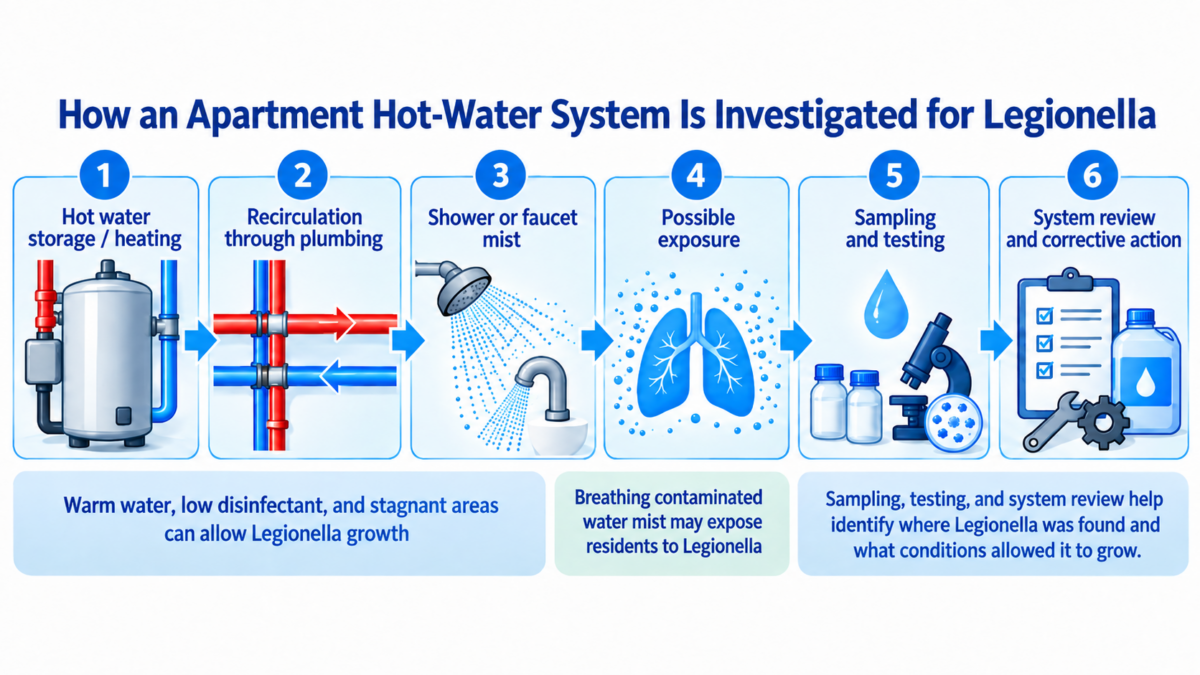
New York Apartment Building Legionnaires’ Disease Investigations Involving Hot Water Systems
New York City has investigated several Legionnaires’ disease clusters involving residents of the same apartment building or complex, including cases where the building’s hot water or plumbing system was identified or investigated as a possible source.
Parkchester North Condominiums, Bronx
In 2025, at least four residents of Parkchester North Condominiums developed Legionnaires’ disease. NYC Health identified the building’s hot water system as the source of the Parkchester North Legionnaires’ disease outbreak.
Haven Plaza, East Village
In 2026, Legionella was detected in the water system at Haven Plaza after residents developed Legionnaires’ disease. The Haven Plaza apartment water system investigation focused on the building’s plumbing, and residents were advised to avoid showers while testing and remediation were underway.
North Shore Towers, Queens
NYC Health is also investigating Legionnaires’ disease cases among residents of North Shore Towers in Queens. The North Shore Towers hot water system investigation began after two residents were diagnosed. Unlike Castleton Park, Legionella has not yet been publicly confirmed in the North Shore Towers water system.
Can You Sue an Apartment Building for Legionnaires’ Disease?
Yes. A person who develops Legionnaires’ disease after exposure to Legionella in an apartment building may have a claim against the property owner, property manager, water-management company, contractor, or another party responsible for the building’s water system.
A legal investigation may examine how Legionella was able to grow or spread through the plumbing, how residents may have been exposed, who controlled the parts of the water system involved, and whether reasonable steps were taken to prevent or correct conditions that allowed the bacteria to grow.
Responsibility can extend beyond the building owner. Liability for apartment building Legionnaires’ disease may involve the property manager, water-management or water-treatment companies, plumbing and mechanical contractors, laboratories, or other companies that maintained, monitored, tested, or treated the water system.
Water testing results, maintenance records, water-management plans, contracts, resident complaints, and other evidence can help show what was happening in the building’s water system and who was responsible for managing those conditions.
What Evidence May Be Used in an Apartment Building Legionnaires’ Disease Case?
Evidence in an apartment building Legionnaires’ disease case can help show where the exposure occurred, how Legionella was able to grow or spread through the water system, who controlled those conditions, and how the illness affected the person who became sick.
- Medical evidence: Legionella test results, imaging, hospital records, physician notes, treatment records, complications, rehabilitation, and long-term health effects.
- Exposure evidence: Apartment or work location, dates at the property, shower and faucet use, symptom-onset dates, visitor or employment records, travel, and other possible water exposures.
- Public health evidence: Case interviews, resident notices, environmental sampling, remediation reports, and laboratory comparisons between clinical and environmental Legionella isolates when available.
- Building and water-system evidence: Water-management plans, temperature and disinfectant logs, maintenance and repair records, plumbing diagrams, testing results, complaints, contracts, invoices, and communications about the water system.
- Evidence of losses: Medical bills, wage records, out-of-pocket expenses, disability documentation, photographs, and records showing how the illness affected work and daily life.
The evidence used to prove a Legionnaires’ disease case can include medical, exposure, environmental, laboratory, and building system information. The evidence available in each case is different and can help show where the exposure came from, how it happened, who may be responsible, and what losses the illness caused.
What Compensation May Be Available in a Legionnaires’ Disease Lawsuit?
A person who develops Legionnaires’ disease may be able to recover compensation for medical expenses, lost income, reduced earning capacity, pain and suffering, disability, rehabilitation, future care, and other losses caused by the illness.
The compensation available in a Legionnaires’ disease lawsuit can reflect the medical care a person needed, time away from work, ongoing health effects, and the ways the illness changed daily life.
When Legionnaires’ disease leads to a death, surviving family members may also have a wrongful death claim for the financial and personal losses they have experienced.

How Can Our Lawyers Help You?
1-888-377-8900 (Toll-Free) | [email protected]
Pritzker Hageman’s Legionnaires’ Disease Experience
Pritzker Hageman represents people and families affected by Legionnaires’ disease nationwide. Our attorneys have handled cases involving hotels, apartment buildings, hospitals, senior living facilities, cooling towers, hot tubs, and other water systems where Legionella exposure caused serious illness or death.
Our Legionnaires’ disease lawsuit results and settlements reflect experience investigating how an exposure occurred, reviewing public-health and water-system evidence, and identifying the people and companies responsible for maintaining the systems involved.
If you or a family member was diagnosed with Legionnaires’ disease after living at, working at, visiting, or providing services at Castleton Park Apartments, call 1-888-377-8900, text 612-261-0856, or contact Pritzker Hageman about a Castleton Park Legionnaires’ disease case for a free, confidential consultation.
Frequently Asked Questions About Castleton Park Legionnaires’ Disease
Yes. Legionella was detected in the Castleton Park Apartments water system after two residents were diagnosed with Legionnaires’ disease within a 12-month period. NYC Health is evaluating the complex’s internal hot water system, and remediation is underway.
Yes. NYC Health has said Castleton Park residents may continue to drink the tap water while following the building’s current water-use guidance. Legionnaires’ disease is usually caused by breathing contaminated water mist rather than by drinking water.
Residents should follow the most recent instructions from NYC Health and building management. The September 28 notice reportedly advised residents to avoid showers temporarily and use a tub or bucket for bathing to reduce exposure to water mist while the hot water system is being evaluated and treated.
Legionella can grow when conditions in a building’s plumbing allow the bacteria to multiply. Contaminated water can then reach showers, faucets, and other fixtures that create small droplets people can breathe.
Legionnaires’ disease symptoms after Legionella exposure can include fever, cough, shortness of breath, muscle aches, headache, nausea, diarrhea, or confusion. Anyone who develops pneumonia symptoms after a possible Castleton Park exposure should seek medical care and tell their healthcare provider about the building’s Legionella investigation.
Yes. A person who develops Legionnaires’ disease after exposure to Legionella in an apartment building may have a claim if the evidence connects the illness to the building’s water system and shows that a person or company responsible for the system failed to use reasonable care.
Evidence may include medical records and Legionella test results, exposure timelines, environmental sampling, resident notices, water-management plans, maintenance and repair records, temperature and disinfectant logs, plumbing records, and communications involving the building’s water system.
A person who develops Legionnaires’ disease may be able to recover compensation for medical care, lost income, future treatment, pain and suffering, disability, and other ways the illness affected work and daily life.
No. A person diagnosed with Legionnaires’ disease does not need to wait for the public-health investigation to end before having a potential claim reviewed. Medical records, resident notices, exposure information, water-testing results, and building records can be evaluated while NYC Health’s investigation and remediation continue.
Additional Information About Legionnaires’ Disease
- Legionnaires’ Disease Frequently Asked Questions (FAQs)
- Where Does Legionnaires’ Disease Come From?
- Legionnaires’ Disease: Symptoms and Diagnosis
- What to do if You Contract Legionnaires’ Disease
- Legionnaires’ Disease: Determining Liability
- Legionnaires’ Disease: Lawsuits and Compensation
- Legionnaires’ Disease: Wrongful Death Cases
- Finding a Legionnaires’ Disease Lawyer
- Filing a Legionnaires’ Disease Lawsuit
- The Importance of Water Management Plans
We have obtained 100+ separate verdicts and settlements greater than $1 million:
We obtained this result on behalf of three people sickened in a Legionnaires’ disease outbreak at a resort hotel.
We obtained this settlement on behalf of six people impacted by a Legionnaires’ disease outbreak linked to a hotel hot tub.
Our client contracted Legionnaires’ disease at a hotel and was hospitalized for eight weeks.
We obtained this settlement on behalf of the family of a woman who died after contracting Legionnaires’ Disease.
We obtained this result on behalf of clients who contracted Legionnaires’ disease from a hotel HVAC cooling tower.
On behalf of a client sicked from contaminated water at a senior care facility.
Our client contracted Legionnaires’ disease at a hotel and was hospitalized for over a month.
On behalf of a women hospitalized for over two months from a contaminated hotel hot tub in Myrtle Beach.
We obtained this settlement for a woman sickened with Legionnaires’ disease after being exposed in a hotel hot tub.
We obtained this settlement for the family of a 52-year old man who died of Legionnaires’ disease linked to a hotel.
We collected this on behalf of a client who contracted Legionnaires’ disease from contaminated water at a hotel.
We recovered this settlement for the family of a 50-year old man who died of Legionnaires’ disease after being exposed to legionella bacteria at a hotel.
Collected on behalf of the family of a man who died as a result of Legionnaires’ Disease contracted while staying at a Wisconsin resort.
We obtained this on behalf of a man hospitalized after Legionella bacteria exposure at a hotel.
See more settlements & verdicts.
The Pritzker Hageman law firm and our attorneys have been recognized in:
U.S. News & World Report

Pritzker Hageman has been recognized as one of the best law firms for personal injury litigation by U.S. News & World Report every year the award has been given since 2012.
Super Lawyers®, Thomson Reuters

Attorneys at Pritzker Hageman have been awarded the peer selected Super Lawyers distinction every year since 2004.
America’s Top 100 Attorneys®

Lifetime Achievement selection to America’s Top 100 Attorneys®.
Three Time Attorneys of the Year

Pritzker Hageman lawyers have been named Attorneys Of The Year by Minnesota Lawyer three times.