
Yes. A person can contract Legionnaires’ disease after exposure to contaminated water at a Korean-style spa, Korean bathhouse, or jjimjilbang in the United States. The greatest concern is not the Korean origin of the spa tradition. The risk comes from the same conditions that can make any public spa dangerous: warm water, complex plumbing and recirculation systems, jets that create mist, heavy bather loads, biofilm, inadequate disinfectant, poor filtration, and failures in cleaning or water-management practices.
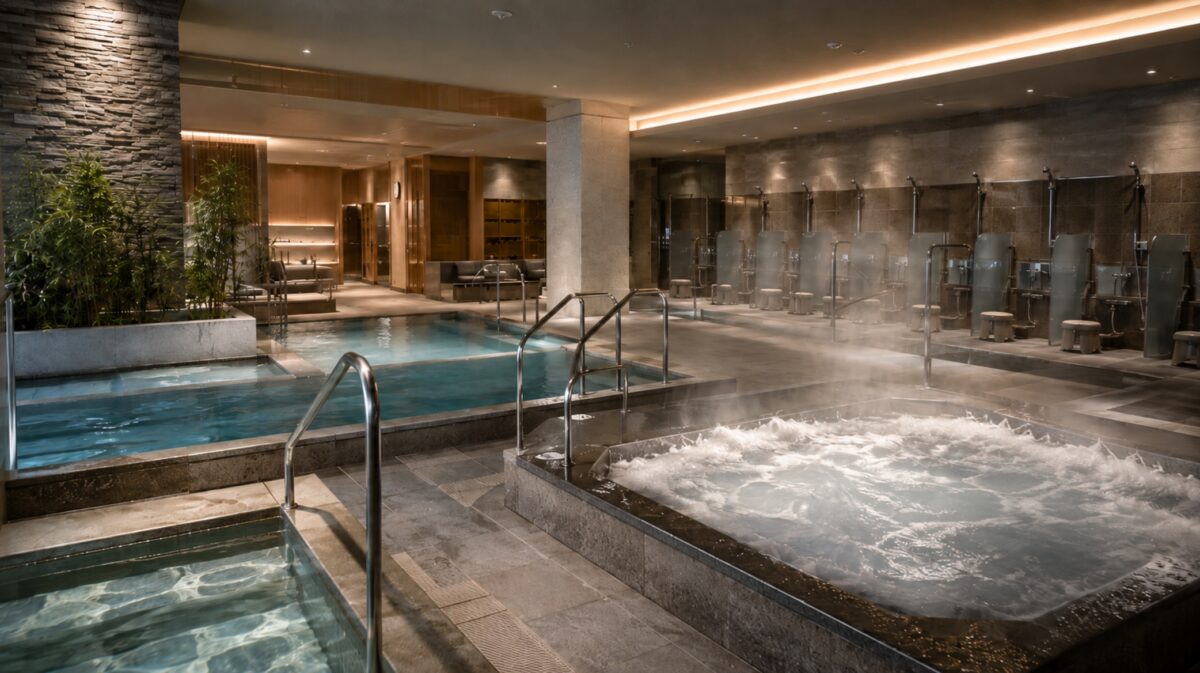
Korean spas often place many water and heat amenities under one roof. Depending on the facility, these may include hot soaking pools, whirlpool or hydrotherapy jets, cold plunges, showers, steam rooms, saunas, body-scrub stations, water features, and extensive hot-water plumbing. A well-designed and properly maintained facility can control the risk. A facility that fails to manage its water systems can create favorable conditions for Legionella bacteria to multiply and become airborne in tiny water droplets.
Legionnaires’ disease is a severe form of pneumonia. It can require intensive-care treatment, cause lasting lung or organ damage, and be fatal. Anyone who develops pneumonia symptoms after visiting a Korean spa should promptly seek medical care and tell the healthcare provider about the spa visit. The Centers for Disease Control and Prevention (CDC) specifically advises people who develop cough, shortness of breath, fever, or muscle aches within two weeks of hot-tub use to seek care and mention that exposure.
If you or a family member was diagnosed with Legionnaires’ disease after visiting a Korean spa, jjimjilbang, sauna complex, or public bathhouse, our national Legionnaires’ disease lawyers can investigate the possible source and explain your legal options. Call 1-888-377-8900, text 612-261-0856, or request a free consultation.
Key Points About Korean Spas and Legionnaires’ Disease
- Korean-style spas are not inherently unsafe. Legionella risk is created by water-system conditions and maintenance failures, not by anything specific to Korean design or the jjimjilbang concept.
- Hot tubs, whirlpools, jetted soaking pools, and hydrotherapy spas generally present the highest potential risk because they keep water warm and create aerosolized mist.
- Showers, handheld sprayers, warm soaking pools, decorative water features, complex plumbing, filters, storage tanks, and other water systems can also become sources.
- Dry sauna heat is not itself a typical Legionella source. The surrounding showers, pools, plumbing, misting devices, or humidification systems may still create exposure.
- Legionnaires’ disease symptoms usually begin 2 to 14 days after exposure, although longer incubation periods have occasionally been reported.
- A routine pneumonia diagnosis does not identify Legionella. Specific laboratory testing is required.
- A spa-related case can be difficult to detect because visitors disperse after leaving and may become ill in different cities or states.
- Even a single diagnosed case may justify public-health follow-up, especially when the patient used a hot tub or other aerosol-producing water feature.
Diagnosed with Legionnaires’ Disease?
What Is a Korean-Style Spa or Jjimjilbang?
A Korean-style spa in the United States is often modeled on the Korean jjimjilbang: a communal bath and wellness facility where guests may spend several hours or, at some facilities, much of a day. The exact layout varies. Many U.S. Korean spas have gender-separated wet areas with showers and pools, plus shared areas containing dry heated rooms, saunas, relaxation spaces, food service, and treatment areas.
Water-related features may include:
- Hot soaking pools at several temperatures
- Jetted whirlpools or hydrotherapy pools
- Cold plunges
- Warm mineral, herbal, salt, or specialty baths
- Seated and handheld showers
- Body-scrub or washing stations
- Steam rooms
- Waterfalls, fountains, or decorative water features
- Hot-water storage, mixing valves, recirculation loops, filters, pumps, and balance tanks
Not every Korean spa has every feature. The important point is that a large bathhouse can contain multiple interconnected or separate water systems, each with its own risks and maintenance requirements. The more complex the system, the more carefully it must be designed, operated, monitored, cleaned, and documented.
Why Korean Spa Water Systems Can Support Legionella Growth
Legionella bacteria occur naturally in freshwater at low levels. They become dangerous when they enter a man-made water system, multiply, and spread in droplets small enough to be inhaled or aspirated into the lungs. The EPA explains that Legionella can become a health concern when it grows and spreads within building plumbing and water-using devices.
Several common spa conditions can work together to increase risk.
Warm water is within Legionella’s preferred growth range
Legionella grows especially well in water between approximately 77°F and 113°F, or 25°C to 45°C. That range overlaps with the temperatures used in many soaking pools, hot tubs, warm-water pipes, and spa treatment systems. CDC guidance notes that hot tubs maintain water within the range most favorable to Legionella growth and that heat also speeds the loss of disinfectant.
Jets, bubbles, showers, and sprays create inhalable droplets
People usually contract Legionnaires’ disease by breathing in mist containing Legionella. Whirlpool jets, air blowers, showerheads, spray hoses, waterfalls, and splashing can generate small droplets. A person does not have to drink the water or fully enter a pool to be exposed. Staff members and people standing near a contaminated aerosol-producing feature may also inhale mist.
High bather loads consume disinfectant
Public spas can have a large number of guests using a relatively small volume of water. Sweat, skin cells, lotions, cosmetics, and other organic material place a heavy demand on chlorine or bromine. If the disinfectant feed and monitoring system cannot keep up, the residual disinfectant may drop below safe operating levels.
The CDC describes the combination of low water volume, high temperature, and heavy bather load as a particular challenge for public hot-tub operation. These conditions can permit Legionella and other organisms to survive and grow when disinfectant levels fall.
Biofilm protects bacteria
Biofilm is the slimy microbial layer that can form on pipes, pool surfaces, jets, fittings, filters, tanks, and other wet components. Legionella can live and multiply within biofilm and within amoebae that inhabit it. Biofilm can also make bacteria harder to eliminate with routine disinfection.
Scale, sediment, corrosion, and accumulated debris provide additional habitat and nutrients. A water-management program must address more than the appearance of the visible pool; it must also control conditions inside the system.
Filters and recirculation systems can become reservoirs
Filters are essential, but they can harbor microorganisms when they are not properly selected, operated, backwashed, cleaned, and replaced. A 2023 open-access engineering study of Legionella in South Korean bath-facility water systems found the highest Legionella detection rate in hot bathtub water and identified sand-filter circulation systems as susceptible to Legionella growth.
That research examined facilities in South Korea, not every U.S. jjimjilbang. It is nevertheless highly relevant to the types of warm baths and recirculation equipment that may be used in Korean-style spas.
Stagnation and “dead legs” allow disinfectant to disappear
Water that sits unused can lose its disinfectant residual and move into a temperature range favorable to bacterial growth. Stagnation may occur in infrequently used showers, treatment rooms, spare pools, seasonal features, long pipe runs, capped branches, bypass lines, or other low-flow sections of plumbing. Overnight shutdowns, maintenance closures, renovations, and periods of low attendance can create additional risk if reopening procedures are inadequate.
Complex plumbing can create uneven temperatures and disinfectant levels
Large spas may have central water heaters, storage tanks, tempering valves, recirculation loops, multiple floors, distant fixtures, and systems added during renovations. Water may be hot enough in one area but lukewarm in another. Disinfectant may reach some fixtures while becoming depleted elsewhere. Improperly balanced recirculation can create localized areas where Legionella grows even though other readings appear acceptable.
Indoor aerosol movement can expose people outside the water
Indoor hot tubs and jetted pools can release mist into the surrounding room. Air-handling design, airflow, dehumidification, and the location of air returns can influence where those droplets travel. CDC’s current hot-tub guidance recommends considering isolated air handlers and dehumidifiers for indoor hot-tub rooms and positioning air outlets and returns to reduce aerosol transmission.
Which Parts of a Korean Spa Present the Greatest Legionella Risk?
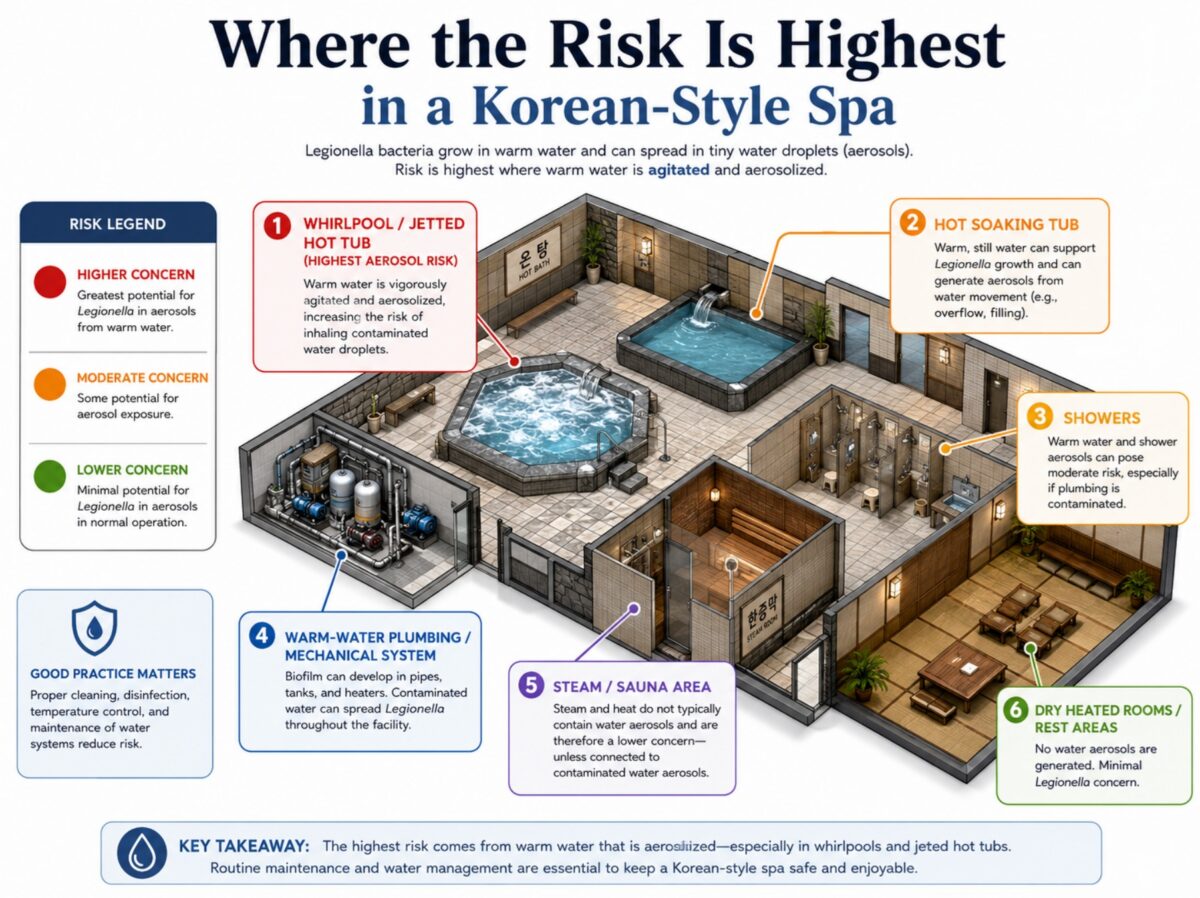
The risk depends on the design and condition of each facility, but some features deserve particular attention.
1. Hot tubs, whirlpools, and jetted hydrotherapy pools
These are generally the highest-concern features because they combine warm water, turbulence, aeration, a relatively small water volume, and heavy use. Their jets and bubbles efficiently create mist. The CDC states that hot tubs have been associated with Legionnaires’ disease outbreaks and should use automatic feed and control systems for disinfectant and pH.
CDC’s 2024 Model Aquatic Health Code recommends that spas maintain at least 3 parts per million free chlorine or 4 parts per million bromine, with pH between 7.0 and 7.8. State and local legal requirements vary, and the Model Aquatic Health Code is guidance rather than a federal regulation.
2. Warm soaking pools without obvious jets
A quiet soaking pool may appear safer because it produces less visible spray. It can still support Legionella growth if the water is warm, the disinfectant is inadequate, or biofilm develops in pipes, drains, filters, inlets, or recirculation equipment. Movement by bathers, filling, draining, waterfalls, and nearby showers can still create droplets.
3. Showers and handheld washing sprayers
Showers are a recognized Legionella exposure route. The showerhead and hose can contain biofilm, and the spray creates respirable droplets close to the user’s face. Infrequently used shower stations can be especially concerning because stagnant water may sit in the branch line.
4. Body-scrub stations and treatment areas
Korean body-scrub services often involve warm water, buckets, handheld sprays, or nearby showers. The risk depends on the source water, plumbing, equipment, cleaning, and how water is dispersed. Single-use bowls or continuously refreshed water do not eliminate risk if the incoming plumbing is contaminated.
5. Steam rooms, humidifiers, and misting systems
Properly generated steam is produced at temperatures that should kill Legionella, so steam itself is not usually considered the principal source. The surrounding water system can still matter. Showers, spray nozzles, improperly maintained humidifiers, misting devices, floor-washing hoses, or decorative water features can aerosolize contaminated water. A “steam room exposure” may therefore actually involve another water source in or near the room.
6. Cold plunges
Cold water is less favorable for rapid Legionella multiplication than warm water, but a cold plunge should not automatically be treated as risk-free. Its plumbing, filter, balance tank, or recirculation system may contain warmer or stagnant zones. It may also share equipment or source water with other features. Agitation, filling, and overflow can create droplets.
7. Dry saunas and heated rooms
A traditional dry sauna or heated salt, clay, charcoal, jade, or infrared room does not by itself provide the warm aerosolized water Legionella needs for transmission. The relevant exposure may instead come from a shower, pool, whirlpool, misting device, drinking-water fixture, or plumbing system used before or after the sauna. When reconstructing an exposure timeline, it is important to identify every water feature used, not merely the room where a guest spent the most time.
8. Building plumbing, water heaters, and storage tanks
A spa can have well-maintained pools yet still have Legionella in its hot-water plumbing. Water heaters set too low, poorly circulating hot-water loops, oversized storage, faulty mixing valves, low-use fixtures, and sediment can contribute to growth. Showers and faucets can then become points of exposure.
9. Decorative fountains and other water features
Decorative fountains, waterfalls, and similar features can aerosolize water. They need their own maintenance and control measures. A feature intended mainly for appearance may receive less attention than a pool while still creating inhalable droplets.
10. Cooling towers serving the building
Some large spa buildings or shopping centers use cooling towers as part of their HVAC systems. Cooling towers are separate from the pools but can release contaminated mist outdoors or through nearby air intakes. An exposure investigation should consider the entire property, not only the wet spa area.

U.S. Legionnaires’ Disease Cases Have Been Reported in Connection With Korean Spas in the Past
In 2017, NBC 5 Dallas-Fort Worth reported that two people filed a lawsuit alleging that they contracted Legionnaires’ disease after separate visits to King Spa & Sauna in Dallas, described in the report as a 24-hour Korean spa. According to the news report, the visitors did not know one another and attended on different dates.
Publicly announced Korean-spa outbreaks may appear uncommon for several reasons. Cases can be missed or recorded simply as pneumonia. Visitors may become sick after returning to different communities. A single facility may draw customers from a wide metropolitan region or from out of state. Unless doctors test for Legionella and health departments obtain detailed exposure histories, the shared spa visit may never be recognized.
Broader U.S. Outbreak Data Shows That Public Spas Are a Real Risk
The strongest evidence comes from the broader category of hot tubs, spa pools, and treated recreational water.
A CDC review of U.S. outbreaks associated with treated recreational water found that, from 2015 through 2019, Legionella caused 65 reported outbreaks and 13 deaths. The category included pools, hot tubs, and water playgrounds. Those figures do not represent Korean spas alone, but they demonstrate that Legionella is a major and sometimes fatal public-spa hazard.
More recent CDC investigations continue to identify hot tubs as sources. In a 2026 report, whole-genome sequencing linked two Legionnaires’ disease cases to a hot tub at a short-term rental property. In another CDC report, epidemiologic, environmental, and laboratory evidence identified private balcony hot tubs as the likely source of two cruise-ship outbreaks.
The lesson for Korean-style spas is straightforward: whenever a facility combines warm recirculated water with aerosol-generating jets, it must treat Legionella control as a core life-safety responsibility.
Why a Korean Spa Outbreak Can Be Difficult to Recognize
Symptoms do not begin immediately
Legionnaires’ disease outbreaks are often harder to detect than foodborne outbreaks involving a single meal or event. The incubation period is usually 2 to 14 days, with symptoms most commonly developing around 5 or 6 days after exposure. By then, visitors have left the spa and resumed normal activities. They may not connect pneumonia with a bathhouse visit from the previous week.
Most exposed people do not become ill
Legionella does not sicken everyone who breathes it. A contaminated feature may expose many guests while only a small number develop diagnosed Legionnaires’ disease. This low attack rate can conceal a serious maintenance problem.
Guests may live in different health jurisdictions
A destination spa may serve customers from many suburbs, counties, states, or countries. Each patient may be reported to a different health department. Linking cases requires complete interviews and communication among jurisdictions.
Pneumonia is not always tested for Legionella
Legionnaires’ disease cannot be reliably distinguished from other pneumonias based only on symptoms, examination, or a chest X-ray. If specific testing is not ordered, the illness may be treated without ever being identified as Legionella.
Urine testing alone can limit source confirmation
The urinary antigen test is fast and useful, but it usually detects only Legionella pneumophila serogroup 1. A lower-respiratory specimen tested by culture or a molecular method can detect additional species and serogroups. Culture is especially valuable because a clinical isolate can be compared with Legionella recovered from the spa environment.
Facilities may clean or alter the system before sampling
Once illness is reported, water chemistry may change quickly. A facility may drain a pool, shock it with disinfectant, replace filters, or alter operating conditions. Prompt coordination with public-health authorities and preservation of records can be critical.
Symptoms After Visiting a Korean Spa
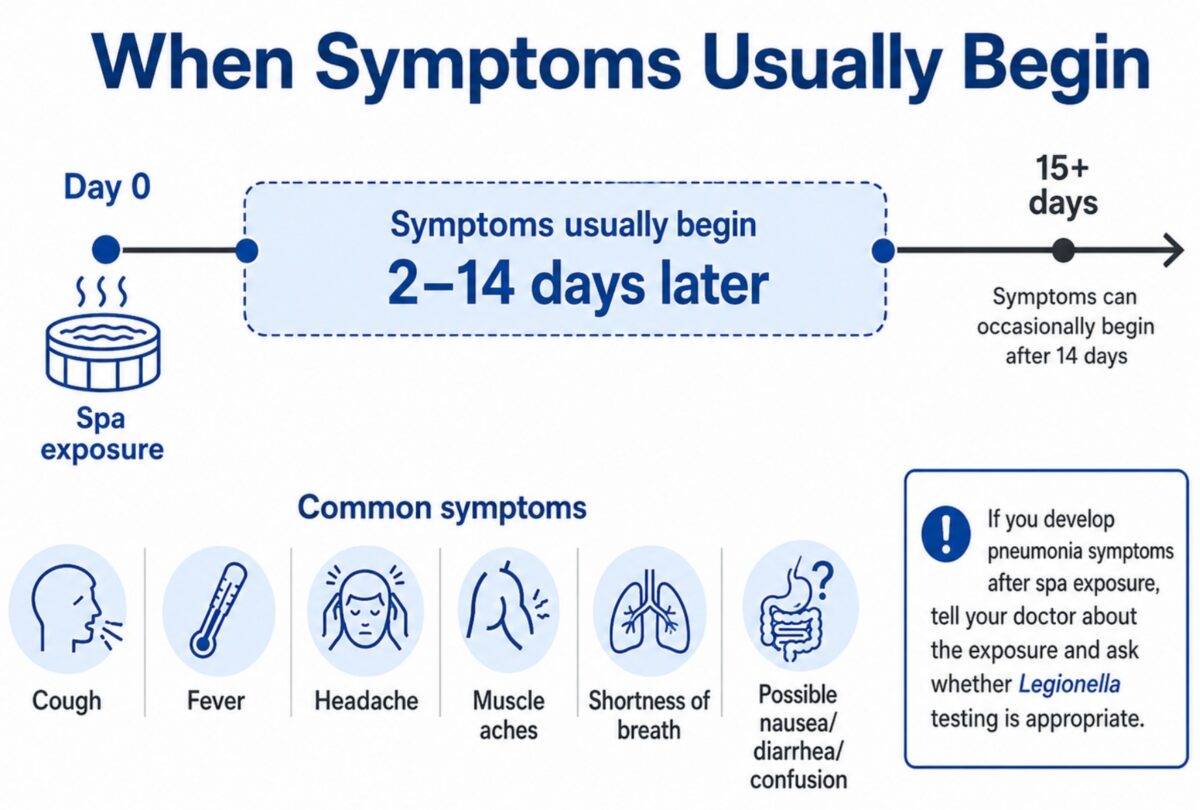
Legionnaires’ disease symptoms usually begin 2 to 14 days after exposure, although CDC notes that it can sometimes take longer. Symptoms often resemble other forms of pneumonia and may include:
- Cough
- Shortness of breath or difficulty breathing
- Fever or chills
- Headache
- Muscle aches
- Unusual fatigue or weakness
- Chest discomfort
- Confusion, especially in older adults
- Nausea, vomiting, or diarrhea
Symptoms can worsen rapidly. Seek urgent medical care for difficulty breathing, blue or gray lips, confusion, severe weakness, chest pain, low oxygen levels, or other signs of serious illness.
Legionella can also cause Pontiac fever, a milder flu-like illness without pneumonia. Pontiac fever often resolves without antibiotic treatment, but a cluster of these illnesses can be an important warning that a water system is contaminated.
Who Is at Highest Risk of Severe Illness?
Most healthy people exposed to Legionella do not develop Legionnaires’ disease. Risk is higher for:
- People age 50 or older
- Current or former smokers
- People with chronic lung disease, including COPD or emphysema
- People with weakened immune systems
- People receiving immune-suppressing medication
- People with cancer
- People with diabetes
- People with kidney or liver failure
- Organ or stem-cell transplant recipients
A person without a recognized risk factor can still become seriously ill. High-risk guests should be especially cautious about using public hot tubs or jetted pools when they cannot verify that the facility is being properly maintained.
What to Tell a Doctor After a Korean Spa Visit
A patient with pneumonia symptoms should provide a specific exposure history. Do not simply say, “I went to a spa.” Tell the provider:
- The spa’s exact name and city
- The date and approximate time of the visit
- Whether you used a hot tub, whirlpool, jetted pool, warm soaking bath, cold plunge, shower, steam room, body-scrub station, or other water feature
- Whether you noticed cloudy water, visible residue, closed features, maintenance activity, or unusual conditions
- Whether anyone else in your group became ill
- Whether the health department or spa contacted you about a possible exposure
The CDC says Legionnaires’ disease cannot be distinguished clinically or radiographically from pneumonia caused by other pathogens. Its clinical guidance recommends paired testing with a urinary antigen test and culture or molecular testing of lower-respiratory secretions.
A useful question is: “Because I used public spa pools and showers within the last two weeks, should I be tested for Legionella with both a urine antigen test and a respiratory test?” Medical decisions belong to the treating provider, but a detailed exposure history may prevent the connection from being overlooked.
What to Do If You Were Diagnosed After Visiting a Korean Spa
Your health comes first. Once urgent care is underway, several steps can help public-health investigators identify the source and preserve your legal rights.
1. Follow treatment instructions and keep all follow-up appointments
Legionnaires’ disease is treated with antibiotics, and severe cases may require hospitalization, oxygen, ventilation, dialysis, or rehabilitation. Complete the prescribed treatment and promptly report worsening symptoms.
2. Write down a 14-day exposure timeline
List every place visited during the 14 days before symptoms began. Include the spa, hotels, hospitals, gyms, workplaces, fountains, and other possible water exposures. For the spa visit, record every feature used and the approximate sequence and duration.
Our page on what to do after contracting Legionnaires’ disease provides a more detailed evidence-preservation checklist.
3. Preserve proof of the spa visit
Save:
- Credit-card or bank records
- Admission receipts
- Online reservations or confirmation emails
- Membership records
- Text messages arranging the visit
- Location-history data
- Photographs and videos
- Rideshare, parking, toll, or transit records
- Names and contact information for companions
Do not edit original photos, videos, or electronic records. Keep copies in a secure location.
4. Report the possible exposure to public health
Legionnaires’ disease is nationally notifiable, and the diagnosing provider or laboratory will generally report a confirmed case. A patient may also contact the state or local health department where the suspected exposure occurred. The CDC notes that even one case can require some level of public-health response.
Tell investigators the exact spa features used. A generic reference to “the sauna” may lead investigators away from the relevant whirlpool, shower, or plumbing system.
5. Ask whether a respiratory specimen was collected
The urine antigen test often remains positive after antibiotics begin, but a respiratory culture can be more time-sensitive and can produce an isolate for comparison with environmental samples. Ask the treating team whether sputum, bronchoalveolar lavage, or another lower-respiratory specimen was collected or can still be collected.
6. Keep records of the illness and its consequences
Preserve medical bills, discharge summaries, test results, medication lists, work-loss records, travel expenses, and notes about physical limitations. Legionnaires’ disease can have long-term effects involving the lungs, kidneys, heart, nervous system, stamina, memory, and ability to work.
7. Speak with an experienced Legionnaires’ disease lawyer promptly
These cases depend on evidence that can change or disappear, including water chemistry, filters, logs, surveillance footage, maintenance records, employee recollections, and environmental samples. An attorney can seek preservation of evidence, identify the correct entities, work with experts, and coordinate with health authorities without interfering with their investigation.
Contact Eric Hageman and his Legionnaires’ Disease legal team today and find out how you can get compensation and justice
1-888-377-8900 (Toll-Free) | [email protected]

What Should a Korean Spa Do to Prevent Legionnaires’ Disease?
A Korean spa should use a written, facility-specific water-management program that covers both the building plumbing and every device capable of supporting or aerosolizing Legionella. A generic pool-maintenance checklist is not enough for a complex facility.
The CDC’s water-management framework calls for a team to map the water systems, identify hazardous conditions, establish and monitor control measures, define corrective actions, verify that the program is operating as designed, validate effectiveness, and document all work.
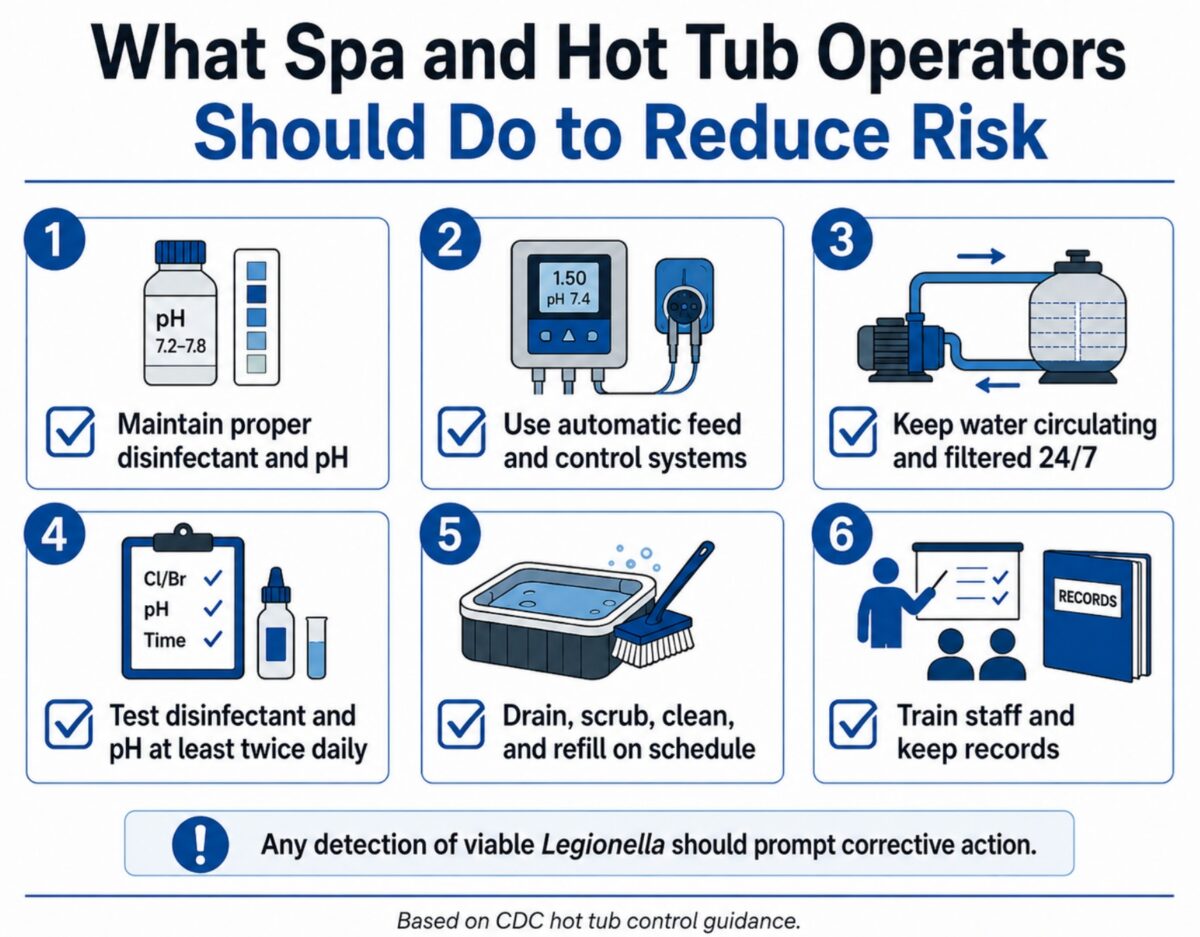
For hot tubs and whirlpool spas, CDC guidance includes the following practices.
Automatic disinfectant and pH control
Public hot tubs should use automatic feed and control systems. Manual dosing alone can leave dangerous gaps, particularly during periods of heavy use.
Frequent testing
CDC advises testing disinfectant residual and pH at least twice per day and as often as hourly during heavy use. Readings should be taken at representative locations, documented, reviewed for trends, and followed by corrective action when limits are missed.
Continuous circulation and filtration
CDC recommends steady flow across the filter 24 hours per day. Pumps, inlets, outlets, and recirculation equipment must provide uniform treatment rather than leaving low-flow zones.
Filter maintenance
Sand and diatomaceous-earth filters require appropriate backwashing. Cartridge filters require regular replacement. Maintenance should follow manufacturer instructions and account for actual bather load, not merely a calendar date.
Cleaning, draining, and removal of biofilm
Spa basins, jets, fittings, accessible piping, and other components need regular physical cleaning. Disinfectant alone may not penetrate established biofilm. CDC guidance calls for routine draining, scrubbing, cleaning, and refilling, as well as daily removal from service for elevated disinfection.
Control of bather load
The maximum occupancy should be clearly posted and enforced. Overloading can rapidly consume disinfectant and reduce water quality.
Trained operators and complete logs
Employees responsible for water quality should receive appropriate operator and chemical-safety training. The facility should retain complete records of test results, corrective actions, filter service, draining, cleaning, equipment alarms, closures, and complaints.
Management of every pool and plumbing system
Each bath, plunge, shower group, steam-related water device, water feature, and plumbing loop must be included. Specialty or “natural” additives do not replace adequate disinfection and maintenance.
Proper ventilation and aerosol control
Indoor hot-tub areas should be designed to control humidity and limit the movement of aerosolized water into adjacent spaces. Ventilation does not make contaminated water safe, but poor airflow can expand exposure.
Immediate action after a suspected illness
If cases are linked to a hot tub, CDC advises turning it off immediately, collecting appropriate samples, and disinfecting the system. Sampling should occur before remediation when possible so the evidence is not destroyed.
Warning Signs Guests Can Look For
A customer cannot determine from appearance alone whether a spa is free of Legionella. Clear water can be contaminated, and a strong chemical smell does not prove that the disinfectant level is correct. Still, certain observations should prompt caution:
- Cloudy water or poor visibility
- Slime, residue, scale, or visibly dirty surfaces
- Broken jets, pumps, gauges, or chemical-feed equipment
- No posted maximum occupancy
- Overcrowded hot tubs or pools
- Staff who cannot explain when disinfectant and pH were last checked
- Missing or incomplete inspection information
- A feature repeatedly closed and reopened without explanation
- Water that appears poorly circulated
- Complaints of multiple guests becoming ill
The CDC suggests asking the operator for the most recent health-inspection score and whether disinfectant and pH are checked at least twice daily and more often during heavy use. Consumers may also use appropriate test strips to check hot-tub free chlorine, bromine, and pH, although a strip cannot detect Legionella and does not replace professional oversight.
People at elevated risk may decide to avoid public hot tubs and jetted pools when they cannot verify safe operation.
Are U.S. Korean Spas Regulated?
Public pools and spas are generally regulated through state or local health codes, building codes, and licensing or inspection programs. Requirements vary significantly by jurisdiction. Some codes closely follow CDC’s Model Aquatic Health Code; others do not. Different parts of the same facility may also fall under different regulatory programs.
The CDC’s Model Aquatic Health Code is voluntary guidance for public aquatic venues, not a single nationwide law. A spa’s compliance with minimum local code does not necessarily answer whether it used reasonable Legionella-prevention practices for its actual design and clientele.
A legal investigation may therefore examine:
- State and local pool and spa codes
- Building and plumbing codes
- Licensing and inspection records
- CDC guidance
- ASHRAE standards and guidelines
- Manufacturer requirements
- Industry practices
- The facility’s own policies and representations
- Prior complaints, positive tests, or illness reports
Who May Be Responsible for a Spa-Related Legionnaires’ Disease Case?
Responsibility depends on the facts. Potentially liable parties may include:
- The spa owner or operating company
- A parent company, franchise entity, or management company
- The property owner or shopping-center landlord
- A pool or spa maintenance contractor
- A water-treatment company
- A plumbing, HVAC, or mechanical contractor
- A designer, engineer, or consultant
- An equipment manufacturer or supplier when a defect contributed to the hazard
The central questions are who controlled the relevant water system, who was responsible for maintaining it, what each party knew or should have known, whether accepted prevention practices were followed, and whether the failure caused the illness.
Our page on determining liability for a Legionnaires’ disease outbreak explains this process in more detail.
How Is a Korean Spa Identified as the Source?
No single type of evidence is required in every case. Investigators may use a combination of epidemiology, environmental evidence, laboratory testing, and maintenance records.
Exposure timing
The patient visited the spa during the incubation window and used a feature capable of transmitting Legionella.
Multiple linked illnesses
Two or more people with compatible illnesses and a shared spa exposure can strongly support an investigation. The visitors do not need to know one another.
Environmental sampling
Qualified investigators may sample pool water, filters, jets, balance tanks, showers, water heaters, storage tanks, hot-water returns, decorative features, cooling towers, and other locations. Sampling must be carefully planned because a negative sample after remediation does not prove the system was safe at the time of exposure.
Clinical and environmental matching
Culture or molecular testing can sometimes show that a patient’s Legionella isolate is closely related to bacteria recovered from the facility. CDC guidance emphasizes the value of collecting both a urine specimen and a lower-respiratory specimen because culture enables comparison with environmental isolates.
Operational records
Disinfectant and pH logs, alarm histories, filter records, invoices, employee schedules, inspection reports, training records, and communications may reveal missed testing, repeated low disinfectant, equipment failure, overcrowding, or inadequate corrective action.
Evidence of prior notice
Past illness reports, positive Legionella samples, guest complaints, failed inspections, recurring water-quality problems, or warnings from contractors can show that the responsible parties knew or should have known of the hazard.
A person does not always need to be part of a publicly announced outbreak to have a viable claim. A single case may be supported by a strong exposure history, environmental evidence, operational failures, and the exclusion of other plausible sources.
Can You Sue a Korean Spa for Legionnaires’ Disease?
A person may have a claim when evidence shows that negligent design, operation, maintenance, monitoring, or remediation allowed Legionella to grow and caused the illness. Potential compensation can include:
- Past and future medical expenses
- Lost wages and reduced earning capacity
- Rehabilitation and home-care costs
- Pain, suffering, and emotional distress
- Permanent impairment or disability
- Other out-of-pocket losses
When Legionnaires’ disease is fatal, eligible family members or the estate may be able to pursue a wrongful-death claim.
Legionnaires’ disease cases are scientifically demanding. They often require rapid evidence preservation, analysis of complex water systems, medical review, epidemiology, microbiology, and knowledge of public-health investigations. Learn more about Legionnaires’ disease lawsuits and compensation.
How Pritzker Hageman Investigates Korean Spa Legionnaires’ Disease Cases
For more than 40 years, Pritzker Hageman has represented people harmed by Legionnaires’ disease and other preventable outbreaks. Our team handles cases nationwide and works with qualified experts when needed.
An investigation may include:
- Building a detailed 14-day exposure timeline
- Obtaining medical and laboratory records
- Confirming what clinical specimens were collected
- Identifying other possible cases
- Communicating with public-health agencies
- Preserving water-system and surveillance evidence
- Obtaining inspection, maintenance, and chemical records
- Mapping pools, filters, plumbing, water heaters, and aerosol sources
- Reviewing water-management plans and compliance
- Evaluating alternative exposures
- Working with epidemiologists, microbiologists, engineers, and infectious-disease physicians
- Identifying every potentially responsible company
Our firm has obtained significant recoveries in Legionnaires’ disease cases, including a $6 million settlement for six people affected by an outbreak linked to a resort hot tub. Past results do not guarantee a similar outcome, and each case depends on its own facts.
Contact a National Legionnaires’ Disease Lawyer
If you or a loved one developed Legionnaires’ disease after visiting a Korean spa, Korean sauna complex, jjimjilbang, bathhouse, hot tub, or public spa anywhere in the United States, contact Pritzker Hageman for a free, confidential case review.
Call 1-888-377-8900, text 612-261-0856, or contact our Legionnaires’ disease legal team online. We handle cases nationwide and charge no attorney fee unless we recover compensation for you.
Frequently Asked Questions
Can a Korean spa cause Legionnaires’ disease?
Yes. A Korean spa can become a source when Legionella grows in a hot tub, jetted pool, warm bath, shower, plumbing system, water feature, or other device and contaminated droplets are inhaled. The cultural style of the spa is not the cause; unsafe water conditions are.
Is a jjimjilbang the same as a sauna?
Not exactly. A jjimjilbang may include dry heated rooms and saunas, but many facilities also have extensive wet bathing areas, showers, hot pools, whirlpools, and cold plunges. Those water systems are the primary Legionella concern.
Can a dry sauna transmit Legionella?
A dry sauna alone is not a typical Legionella source because it does not normally aerosolize warm water. Exposure may occur in nearby showers, pools, misting systems, humidifiers, or plumbing used before or after the sauna.
Can a steam room transmit Legionella?
Properly generated steam is unlikely to be the direct source because of the high temperature used to generate it. However, showers, sprayers, humidifiers, water features, or contaminated plumbing in or near the steam room can create exposure.
Can a cold plunge contain Legionella?
It is possible. Cold water is less favorable for growth, but the filter, pipes, tank, or shared system may contain stagnant or warmer zones. A cold plunge may also receive contaminated source water.
How soon after a Korean spa visit do symptoms start?
Symptoms usually begin 2 to 14 days after exposure and most commonly around 5 or 6 days. Rarely, longer incubation periods have been reported.
Is Legionnaires’ disease contagious?
In general, no. People usually get it by inhaling contaminated water droplets, not through ordinary contact with another person.
What test should be requested?
CDC recommends a Legionella urinary antigen test paired with culture or molecular testing of a lower-respiratory specimen. The treating clinician decides which tests are appropriate.
What if the hospital performed only a urine test?
A positive urine antigen test can confirm Legionnaires’ disease, but it generally detects only Legionella pneumophila serogroup 1. Ask whether a sputum or other lower-respiratory specimen can be collected for culture or molecular testing, especially if a public-health investigation may occur.
Can one person’s illness trigger an investigation?
Yes. CDC says even a single case can require some level of public-health response. The response depends on the exposure history, setting, patient risk, and other evidence.
Should I test the spa water myself?
Do not attempt to collect Legionella samples without guidance. Poor sampling can produce misleading results, expose the collector, or interfere with an official investigation. Environmental sampling should be planned by public-health officials or qualified Legionella professionals.
Does clear water mean the spa is safe?
No. Legionella cannot be seen by looking at the water. A clear pool may still have contaminated pipes, filters, jets, or tanks.
Does a strong chlorine smell mean the spa is disinfected?
No. Odor is not a reliable measure of free chlorine or bromine. Chemical levels and pH must be measured with appropriate testing equipment.
Can I have a legal case if no outbreak has been announced?
Possibly. Public announcements are not required for every claim. A case may be supported by the exposure timeline, clinical diagnosis, maintenance failures, environmental evidence, other unpublicized illnesses, and expert analysis.
How long do I have to file a lawsuit?
Deadlines vary by state and can be especially short when a government entity is involved. Evidence can disappear much sooner than the formal filing deadline. Prompt legal advice is important.
Who should I contact if I became ill after a Korean spa visit?
Seek medical care first. Tell the healthcare provider about the spa exposure, contact the relevant state or local health department, preserve proof of the visit, and speak with an experienced Legionnaires’ disease attorney.
Additional Information About Legionnaires’ Disease
- Legionnaires’ Disease Frequently Asked Questions (FAQs)
- Where Does Legionnaires’ Disease Come From?
- Legionnaires’ Disease: Symptoms and Diagnosis
- What to do if You Contract Legionnaires’ Disease
- Legionnaires’ Disease: Determining Liability
- Legionnaires’ Disease: Lawsuits and Compensation
- Legionnaires’ Disease: Wrongful Death Cases
- Finding a Legionnaires’ Disease Lawyer
- Filing a Legionnaires’ Disease Lawsuit
- The Importance of Water Management Plans
Authoritative Resources
- CDC: Protecting Yourself from Legionella in Hot Tubs
- CDC: Controlling Legionella in Hot Tubs
- CDC: Clinical Guidance for Legionella Infections
- CDC: Water Management Programs
- CDC: Model Aquatic Health Code
- EPA: Legionella in the Indoor Environment
- Research: Legionella in South Korean Bath-Facility Water Systems
We have obtained 100+ separate verdicts and settlements greater than $1 million:
We obtained this result on behalf of three people sickened in a Legionnaires’ disease outbreak at a resort hotel.
We obtained this settlement on behalf of six people impacted by a Legionnaires’ disease outbreak linked to a hotel hot tub.
Our client contracted Legionnaires’ disease at a hotel and was hospitalized for eight weeks.
We obtained this settlement on behalf of the family of a woman who died after contracting Legionnaires’ Disease.
We obtained this result on behalf of clients who contracted Legionnaires’ disease from a hotel HVAC cooling tower.
On behalf of a client sicked from contaminated water at a senior care facility.
Our client contracted Legionnaires’ disease at a hotel and was hospitalized for over a month.
On behalf of a women hospitalized for over two months from a contaminated hotel hot tub in Myrtle Beach.
We obtained this settlement for a woman sickened with Legionnaires’ disease after being exposed in a hotel hot tub.
We obtained this settlement for the family of a 52-year old man who died of Legionnaires’ disease linked to a hotel.
We collected this on behalf of a client who contracted Legionnaires’ disease from contaminated water at a hotel.
We recovered this settlement for the family of a 50-year old man who died of Legionnaires’ disease after being exposed to legionella bacteria at a hotel.
Collected on behalf of the family of a man who died as a result of Legionnaires’ Disease contracted while staying at a Wisconsin resort.
We obtained this on behalf of a man hospitalized after Legionella bacteria exposure at a hotel.
See more settlements & verdicts.
The Pritzker Hageman law firm and our attorneys have been recognized in:
U.S. News & World Report

Pritzker Hageman has been recognized as one of the best law firms for personal injury litigation by U.S. News & World Report every year the award has been given since 2012.
Super Lawyers®, Thomson Reuters

Attorneys at Pritzker Hageman have been awarded the peer selected Super Lawyers distinction every year since 2004.
America’s Top 100 Attorneys®

Lifetime Achievement selection to America’s Top 100 Attorneys®.
Three Time Attorneys of the Year

Pritzker Hageman lawyers have been named Attorneys Of The Year by Minnesota Lawyer three times.
How Can Our Lawyers Help You?
Phone: 1-888-377-8900 | Text: 612-261-0856 | [email protected]