
Evanston health officials have announced two cases of Legionnaires’ disease associated with the Hilton Garden Inn Chicago North Shore/Evanston at 1818 Maple Avenue. The City’s Health and Human Services Department is investigating with the Illinois Department of Public Health.
Local reporting says the hotel notified guests and that the pool and hot tub area has been closed while environmental testing is conducted. Public-health officials have not announced a source of the illnesses.
People who recently stayed at or visited the hotel and then developed pneumonia symptoms should tell their healthcare provider about the possible exposure. Legionnaires’ disease is a serious form of pneumonia caused by Legionella bacteria, and travel history can be important to diagnosis and public-health investigation.
Pritzker Hageman’s Legionnaires’ disease lawyers represent people sickened in hotel, resort, healthcare, apartment, and other Legionella outbreaks nationwide. If you or a family member was diagnosed with Legionnaires’ disease after staying at or visiting the Evanston Hilton Garden Inn, our legal team can investigate the exposure and explain your legal options.
Diagnosed with Legionnaires’ disease?
What We Know About the Evanston Hilton Garden Inn Legionnaires’ Disease Cases
- Cases: Two people associated with the hotel have been diagnosed with Legionnaires’ disease.
- Hotel: Hilton Garden Inn Chicago North Shore/Evanston, 1818 Maple Avenue, Evanston, Illinois.
- Public-health response: Evanston Health and Human Services is investigating with the Illinois Department of Public Health.
- Guest notification: Local reporting says the hotel notified guests about the cases.
- Pool and hot tub: The pool and hot tub area has been closed during testing.
- Source: No source has been publicly confirmed as of September 14, 2026.
What Did Evanston Health Officials Announce?
The City of Evanston’s Health and Human Services Department announced that two people linked to the Hilton Garden Inn North Shore/Evanston had been diagnosed with Legionnaires’ disease. According to local reporting, the hotel notified guests, and the pool and hot tub were closed during testing.
The city’s Communicable Disease Unit conducts disease surveillance and outbreak response and lists Legionella among infections that can spread from the environment to people. Illinois requires suspected or confirmed cases of certain reportable diseases to be reported to public-health officials, allowing investigators to look for shared exposures and take steps to reduce additional risk.
How Do Investigators Find the Source of a Hotel Legionnaires’ Disease Outbreak?
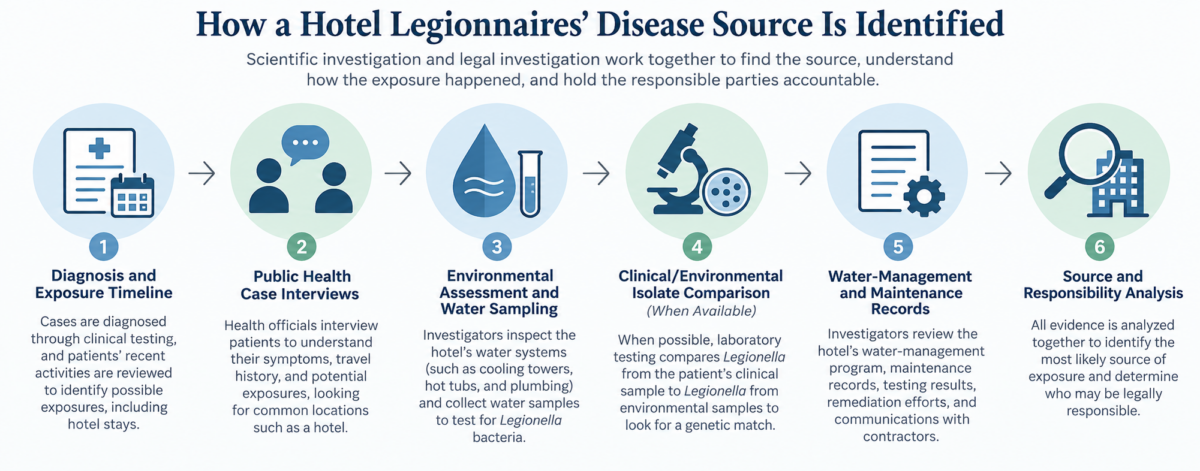
Investigators find the source of a hotel Legionnaires’ disease outbreak by comparing where sick guests spent time with medical test results, water samples, and information about the hotel’s water systems. If Legionella is found in a hotel water source, investigators look at that result together with the guests’ exposure histories and other evidence to determine whether it is connected to the illnesses.
The investigation often starts with an exposure timeline. Health officials look at when each person became sick and where they stayed, showered, used a hot tub or pool, or may have been exposed to mist from another water source during the days before symptoms began.
Investigators then inspect and test parts of the hotel’s water system that could allow Legionella bacteria to grow or spread. According to the CDC’s environmental sampling guidance, sampling locations are selected using information about the illnesses, the building’s water system, and the property’s water-management program. Testing may include:
- Guest-room showers and faucets
- Water heaters and hot-water storage tanks
- Hot-water recirculation lines
- Hot tubs and spas
- Swimming pools when appropriate
- Cooling towers
- Decorative water features
- Other equipment that stores, circulates, or creates mist from water
When possible, laboratories can also compare Legionella found in a patient’s respiratory sample with Legionella found in the hotel’s water system. A close laboratory match can provide important evidence when investigators are trying to determine whether a particular water source is connected to the illnesses.
Investigators may also review how the hotel managed its water system before the illnesses occurred. The CDC recommends water-management programs for hotels and resorts to identify places where Legionella could grow, monitor water conditions, and take corrective action when conditions become unsafe.
Pritzker Hageman uses the same evidence-based approach when evaluating a potential claim. A Legionnaires’ disease case investigation may include medical records, laboratory testing, exposure history, environmental evidence, public-health findings, and water-management records to determine how the illness occurred and who may be legally responsible.
Is the Pool or Hot Tub the Source of the Evanston Legionnaires’ Disease Cases?
The hotel has closed the pool and hot tub while environmental testing is underway, but public health officials have not publicly identified the source of exposure.
Investigators may look closely at the hot tub because hot tubs are a known source of Legionella exposure. Warm water can allow Legionella bacteria to grow, and jets can create a fine mist that people breathe. Legionnaires’ disease from hot tubs can occur when that mist contains Legionella bacteria.
The swimming pool and other parts of the hotel’s water system may also be tested. Health officials consider where the people who became sick spent time, which water sources they may have encountered, and how the hotel’s plumbing and water systems operate.
Other possible sources can include guest room showers and faucets, hot-water systems, storage tanks, recirculation systems, cooling towers, decorative water features, and other equipment that can create water mist.
Testing these areas can help investigators narrow down where Legionella may have been present and determine which water source, if any, is connected to the illnesses.
What Symptoms Should Recent Hilton Garden Inn Evanston Guests Watch For?
If you recently stayed at or visited the Hilton Garden Inn Evanston and are now experiencing cough, fever, shortness of breath, or other symptoms of pneumonia, seek medical care and tell your healthcare provider about your hotel stay. Legionnaires’ disease is a serious form of pneumonia caused by Legionella bacteria.
Symptoms usually begin 2 to 14 days after exposure, although they can sometimes appear later. Common symptoms include:
- Cough
- Fever
- Shortness of breath
- Headache
- Muscle aches
- Fatigue or weakness
- Confusion
- Diarrhea or nausea
If you are experiencing symptoms, tell your healthcare provider that you recently stayed at or visited the Hilton Garden Inn Evanston, provide the dates of your visit, and mention the reported Legionnaires’ disease cases. Ask specifically to be tested for Legionella.
Who Is at Higher Risk for Legionnaires’ Disease?
The CDC identifies several groups at higher risk of developing Legionnaires’ disease or serious illness after exposure:
- Adults age 50 and older
- Current or former smokers
- People with chronic lung disease such as COPD or emphysema
- People with weakened immune systems or who take medicines that suppress immunity
- People with cancer
- People with underlying illnesses such as diabetes, kidney failure or liver failure
People in higher-risk groups should be especially prompt about seeking medical attention if pneumonia symptoms develop after a possible exposure.
What Should You Do If You Were Diagnosed After Staying at the Hilton Garden Inn Evanston?
If you were diagnosed with Legionnaires’ disease after staying at or visiting the Hilton Garden Inn Evanston, document your illness and your time at the hotel as thoroughly as possible. Knowing what to do after a Legionnaires’ disease diagnosis can help preserve information that may be important to the public health investigation and any potential legal claim.
Keep records related to your stay, including hotel reservations, receipts, confirmation emails, and any notice you received from the property. Write down the dates you were at the hotel and the areas you used or spent time near, such as your guest room, pool, hot tub, fitness area, restaurant, lobby, or other shared spaces.
You should also keep copies of Legionella test results, hospital discharge paperwork, medical records, and medical bills. Save any photos, videos, emails, or text messages connected to your stay, and make note of when your symptoms began, when you first sought medical care, and when you received a diagnosis.
This information can help establish a clear timeline of your illness and possible exposure. It may also help public health investigators determine whether people who became sick shared common locations or water exposures at the hotel.
Can I Sue a Hotel for Legionnaires’ Disease?
Yes. You may be able to sue a hotel for Legionnaires’ disease if scientific evidence connects your illness to Legionella contamination in the hotel’s water system.
Determining whether an illness is connected to a hotel requires an investigation. In a hotel Legionnaires’ disease lawsuit, important evidence can include:
- When you stayed at the hotel and when your symptoms began
- Medical testing confirming Legionnaires’ disease
- Other Legionnaires’ disease cases associated with the hotel
- Legionella testing from the hotel’s water system
- Water-management and maintenance records
- Information about possible exposure sources, such as showers, hot tubs, pools, or cooling towers
Hotel Legionnaires’ disease cases may involve failures to properly maintain or manage a building water system, allowing Legionella bacteria to grow and spread. Pritzker Hageman has represented people sickened by Legionella exposure from hotel water systems, hot tubs, and cooling towers.
Contact Eric today and find out how you can get compensation and justice
1-888-377-8900 (Toll-Free) | [email protected]

Talk to a Legionnaires’ Disease Lawyer
If you or a loved one was diagnosed with Legionnaires’ disease after a hotel stay or another possible Legionella exposure, Pritzker Hageman can help you understand what may have caused the illness and what options may be available.
Our Legionnaires’ disease lawyers represent people nationwide in cases involving hotels, resorts, hot tubs, plumbing systems, cooling towers, and other sources of Legionella exposure.
A consultation is free and confidential. Call 1-888-377-8900, text 612-261-0856, or contact us online to speak with our legal team. There is no attorney fee unless we recover compensation for you.
Frequently Asked Questions About the Evanston Hilton Garden Inn Legionnaires’ Disease Investigation
Evanston health officials are investigating two diagnosed cases associated with the Hilton Garden Inn Chicago North Shore/Evanston. Local reporting has described the cases as linked to the hotel. Officials have not publicly identified the specific hotel water source responsible for the illnesses.
Public health officials have not yet announced the results of environmental testing from the hotel’s pool, hot tub, or other water systems. Local reporting says the pool and hot tub were closed while testing was underway.
No. You do not have to get into a hot tub to be exposed to Legionella. If a hot tub contains Legionella, the jets can create a fine mist or small water droplets that people nearby may breathe in. Hot tubs are only one possible source. Legionella can grow and spread from multiple types of building water systems and devices, including showers, faucets, hot-water systems, cooling towers, and decorative water features. Exposure can occur when contaminated water becomes airborne and is inhaled.
Symptoms usually begin 2 to 14 days after exposure, although longer incubation periods can occur. Evanston officials advised people who had visited the hotel within the prior two weeks and were experiencing pneumonia symptoms to consult a medical provider.
Keep your reservation confirmation, hotel folio or receipt, guest notices, dates of stay, photos or videos, and copies of medical and Legionella test records you receive. These materials can help document when and where you were present and can support both public health and legal investigation.
If you have a confirmed Legionnaires’ disease diagnosis and stayed at or visited a location under investigation, an early legal consultation can help preserve records and evaluate the exposure. Pritzker Hageman offers free consultations and represents Legionnaires’ disease clients nationwide.
Additional Information About Legionnaires’ Disease
- Legionnaires’ Disease Frequently Asked Questions (FAQs)
- Where Does Legionnaires’ Disease Come From?
- Legionnaires’ Disease: Symptoms and Diagnosis
- What to do if You Contract Legionnaires’ Disease
- Legionnaires’ Disease: Determining Liability
- Legionnaires’ Disease: Lawsuits and Compensation
- Legionnaires’ Disease: Wrongful Death Cases
- Finding a Legionnaires’ Disease Lawyer
- Filing a Legionnaires’ Disease Lawsuit
- The Importance of Water Management Plans
We have obtained 100+ separate verdicts and settlements greater than $1 million:
We obtained this result on behalf of three people sickened in a Legionnaires’ disease outbreak at a resort hotel.
We obtained this settlement on behalf of six people impacted by a Legionnaires’ disease outbreak linked to a hotel hot tub.
Our client contracted Legionnaires’ disease at a hotel and was hospitalized for eight weeks.
We obtained this settlement on behalf of the family of a woman who died after contracting Legionnaires’ Disease.
We obtained this result on behalf of clients who contracted Legionnaires’ disease from a hotel HVAC cooling tower.
On behalf of a client sicked from contaminated water at a senior care facility.
Our client contracted Legionnaires’ disease at a hotel and was hospitalized for over a month.
On behalf of a women hospitalized for over two months from a contaminated hotel hot tub in Myrtle Beach.
We obtained this settlement for a woman sickened with Legionnaires’ disease after being exposed in a hotel hot tub.
We obtained this settlement for the family of a 52-year old man who died of Legionnaires’ disease linked to a hotel.
We collected this on behalf of a client who contracted Legionnaires’ disease from contaminated water at a hotel.
We recovered this settlement for the family of a 50-year old man who died of Legionnaires’ disease after being exposed to legionella bacteria at a hotel.
Collected on behalf of the family of a man who died as a result of Legionnaires’ Disease contracted while staying at a Wisconsin resort.
We obtained this on behalf of a man hospitalized after Legionella bacteria exposure at a hotel.
See more settlements & verdicts.
The Pritzker Hageman law firm and our attorneys have been recognized in:
U.S. News & World Report

Pritzker Hageman has been recognized as one of the best law firms for personal injury litigation by U.S. News & World Report every year the award has been given since 2012.
Super Lawyers®, Thomson Reuters

Attorneys at Pritzker Hageman have been awarded the peer selected Super Lawyers distinction every year since 2004.
America’s Top 100 Attorneys®

Lifetime Achievement selection to America’s Top 100 Attorneys®.
Three Time Attorneys of the Year

Pritzker Hageman lawyers have been named Attorneys Of The Year by Minnesota Lawyer three times.