Help for Families Suffering the Loss of a Loved One in a Semi Truck Crash

by Eric Hageman, traffic safety attorney Email Eric Hageman

I represent people who have suffered the loss of a loved one in a semi truck crash and need help.  The families I represent need answers and for wrongdoers to be held accountable. I have found that this is an important part of the grieving process.

5 Things Families Need to Know

When families come to me for help, many have the same questions. Below are 5 things you and your family need to know:

Semi Truck Inspection after Accident

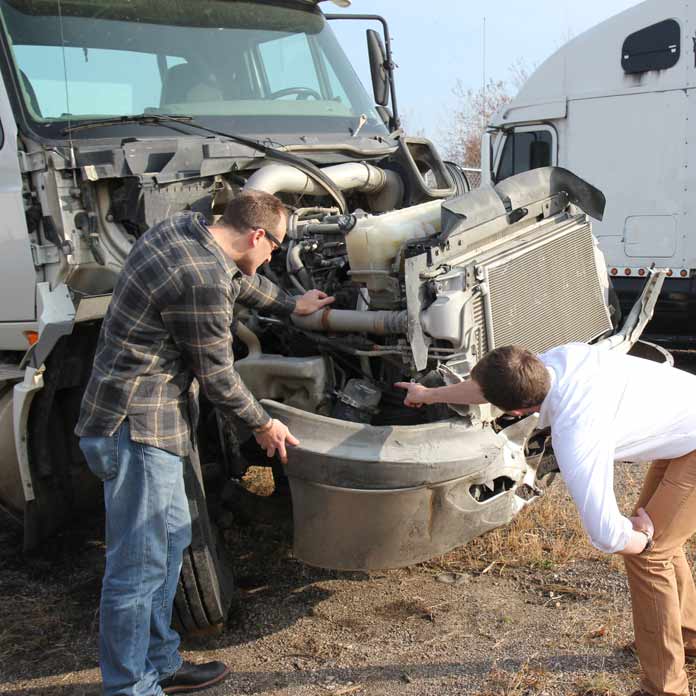
Attorneys Eric Hageman and Fred Pritzker inspecting a semi truck after an accident.

  1. It may take an independent investigation to determine how and why the accident happened. Most of the semi accident cases I handle have issues of fact. This means that I and my team of accident specialists have to reconstruct the accident to be able to prove that the semi truck driver was negligent (too tired, speeding, intoxicated, etc.) and that this negligence caused the accident.  To find answers, I need to take legal action to get documents and other evidence from the truck driver, the trucking company, and often others that may be legally responsible for the accident.
  2. Even if a truck driver or trucking company admits fault for the crash, there may be a lot they are not telling you.  Even in cases where a truck driver and/or trucking company admit fault, I dig for evidence of gross negligence that can be used for a punitive damages claim. This type of evidence is generally only obtainable by taking legal action. In addition, it can take quite a bit of digging to uncover all of the available insurance money to fairly compensate the family.
  3. Semi truck accident cases are different than regular car accident cases. There are many state and federal laws that semi truck drivers and semi trucking companies must follow. Violations of these commercial trucking laws impact the outcome of semi accident lawsuits. There are also steps that need to be taken as soon as possible after the accident to prevent the truck driver and trucking company from destroying evidence. The most important step is a spoliation letter, a request to preserve evidence, including documents, equipment, data, photographs, etc.
  4. You need to hire a lawyer with experience winning semi truck accident cases. This is important for two reasons: 1) as stated above, semi truck crash cases are different than regular traffic accident cases and 2) it generally takes a lot of money to build a winning case. My successes and those of the other accident attorneys at my law firm have provided the resources needed to litigate these cases. If you hire me to help your family, we will carry the burden of the cost of the lawsuit until it is resolved, at which time we are only paid if you win.
  5. It costs you nothing to talk to me to find out if I am the best lawyer for your family. I represent families throughout the United States in wrongful death semi accident cases just like yours. I am available for a free consultation. If you would like to meet with me before deciding to hire me, I can come to you at my law firm’s expense. I make hospital and house calls.

Eric Hageman LawyerAttorney Eric Hageman is a member of the American Association for Justice (AAJ) Interstate Trucking Litigation Group. He has won millions for accident victims and their families in personal injury and wrongful death lawsuits against negligent drivers, trucking companies, freight companies and others. To contact Eric for a free consultation, call 1-888-377-8900 or submit the firm’s free consultation form found here.

A Drunk Driver Lawsuit Can Help Prevent Accidents

by Attorney Eric Hageman Email Eric Hageman

I represent people injured by drunk drivers, including drunk semi truck drivers. Tragically, in some cases, the accident victim does not survive, in which case the claim would fall under wrongful death laws.

You May Be Able to Sue Both the Drunk Driver and a Dram Shop

Contact Eric HagemanEvery traffic accident case we handle begins with an independent investigation of the crash, which always involves finding out if the at-fault driver consumed any alcohol before the accident. There are several obvious reasons for this, but one of the most important reasons is that a bar or restaurant can be sued in some cases for the injuries (or death) caused by a drunk driver. These are called “dram shop” cases.

Having a dram shop claim against a bar, restaurant or other establishment that served alcohol to the driver means you and your family can potentially recover money from both the at-fault driver’s auto insurance company and from the dram shop. As an example, let’s say Drunk Driver rear ends your car, jolting you hard enough to cause you to suffer severe traumatic brain injury and giving your child in the back seat serious internal injuries from the seatbelt. The no-fault insurance does not cover the medical expenses or the money you have lost because you could not work at the same job.  You turn to Drunk Driver’s insurance company to get compensation, but that amount does not cover your expenses either. If there is a dram shop claim against the bar Drunk Driver was at prior to the accident, you can file a lawsuit against the bar, which should have significant insurance coverage.

Drunk Driver Lawsuits are Deterrents to Bad Behavior

In my experience, every DUI/DWI accident victim and every family that has lost a loved one in an alcohol-related accident wants to do something to prevent the drunk driver from hurting anyone else.  I firmly believe that filing a lawsuit against the drunk driver and fighting to hold accountable those who caused the harm (by recovering monetary compensation) is a strong deterrent. In addition, the lawsuit can give the victim and the family media exposure, which provides them with the opportunity to speak out against drunk driving.

Send the Message that Drunk Driving is Never Okay

According to the National Highway Traffic Safety Administration estimates that in the U.S. people drink too much and get behind the wheel over 100 million times a year, even though states have enacted tougher laws and there have been many campaigns to dissuade people from drinking and driving.  Alcohol-impaired drivers are involved in about 1 in 3 crash deaths, resulting in over 10,000 wrongful deaths per year—one every 51 minutes.

Certain groups are more likely to drink and drive than others.

  • Men were responsible for 4 in 5 episodes (81%) of drinking and driving in 2010.
  • Young men ages 21-34 made up only 11% of the U.S. adult population in 2010, yet were responsible for 32% of all instances of drinking and driving.
  • 85% of drinking and driving episodes were reported by people who also reported binge drinking. Binge drinking means 5 or more drinks for men or 4 or more drinks for women during a short period of time.

By filing a lawsuit against a drunk driver, you are another voice saying, “Drunk driving is never okay. Choose not to drink and drive.”

Attorney Eric Hageman represents accident victims throughout the United States. He is available for a free consultation to drunk driver accident victims and their families. Our offices are in Minneapolis, Minnesota. Of Counsel David Szerlag has offices in Boston, Massachusetts and Providence, Rhode Island.

Bus Safety Inspections by FMCSA Aim to Prevent Injuries to Bus Passengers

This week the Federal Motor Carrier Safety Administration (FMCSA) is conducting safety inspections of motorcoaches, tour buses, school buses and other commercial passenger buses in 13 states and the District of Columbia. These inspections look for safety violations and can result in bus company shut downs. The goal is to protect bus passengers and others from unsafe operators.

Get a FREE consultation regarding your bus accident.

The states involved are New York, New Jersey, Pennsylvania, Vermont, Maryland, Virginia, Delaware, Massachusetts, Rhode Island, New Hampshire, Maine, Connecticut, West Virginia and the District of Columbia.

The inspection process includes:

  • Checking buses for any mechanical problem, such as brakes, lights and engine defects; and
  • Inspecting bus drivers are to ensure they are operating in full compliance with hours-of-service, medical fitness, commercial driver’s license and other federal safety rules.

There are about 4,000 commercial passenger bus companies in the United States. In 2011, bus safety inspections resulted in FMCSA placing 54 unsafe companies out of service.

Fred Pritzker - Lawyer

For bus accident information, please see the following:

Take a Pledge Not to Text While Driving

by Eric Hageman, accident attorney and traffic safety advocate Email Eric Hageman


The U.S. Department of Transportation’s campaign against distracted driving includes a video series, “Faces of Distracted Driving.” The most recent video is a reminder why texting while driving has been banned in 38 states. In light of this and other tragic injuries and deaths caused by texting while driving, I am calling on drivers to take a No Texting Pledge.

Two-year-old Calli Ann Murray and her mother were walking home from her favorite park, just a block and a half from her home.  As they began to cross the road at an intersection, walking hand-in-hand, a young driver texting on her cell phone struck Calli and her mother with her car. Calli died in the accident and her mother was critically injured.


Calli’s grandfather, featured in the video, has this to say about texting while driving:

“Even though we lost Calli, we want everything that happened to change other people’s behavior. Paying attention to a text message in the car and not paying attention to what’s going on out in front of you can cause you to kill somebody. My greatest hope is that anyone who hears our story will commit to not using a cell phone behind the wheel.  It could save a life.”

The laws banning texting while driving are a critical step, but tragic deaths like Calli’s demand more.  I am calling on drivers to take a no-texting pledge. I have provided a “No Texting Pledge” for you to download.

Download the No Texting Pledge now.

Download a copy for each member of your family to sign. Parents of teenagers may also want to read my post on preventing distracted driving.

Eric Hageman is a national accident attorney and father of five children. To contact Eric, call 1-888-377-8900 (toll free) or submit our free consultation form.

For more information, please see the following:

Texting While Driving Banned in Alabama

by Eric Hageman, accident attorney and traffic safety advocate Email Eric Hageman


Cell Phone and Texting Accident

This week Alabama joined 37 other states and banned texting while driving. The law goes into effect on August 1, 2012.  The fine for violating the law is $25 for a first-time offense, $50 for a second offense and $75 for a third or subsequent offense.  Although these amounts are nothing more than a slap on the wrist, the law at least sends the message that texting while driving should not be done.

Texting has become a national pastime (about 200 billion texts in the United States per month), and driving while texting is extremely dangerous1:

  • Texting while driving creates a crash risk that is 23 times greater than when a driver is not distracted;
  • Sending or receiving a text message takes a driver’s eyes from the road for an average of 4.6 seconds, long enough for a driver going 55 miles-per-hour to drive the entire length of a football field;
  • Drivers who use hand-held devices are 4 times more likely to get into crashes serious enough to injure themselves; and
  • Driving while using a cell phone reduces the amount of brain activity associated with driving by 37%.
Get your free consultation with Eric here.

Interstate Truck Drivers Banned from Texting and
Any Cell Phone Use While Driving

 Although there are still a few states that have not banned texting while driving, commercial drivers in interstate transportation (semi truck drivers, tour bus drivers, etc.) are not allowed to text while driving (or use a cell phone at all) throughout the United States.

In November of 2011, the Federal Motor Carrier Safety Administration (FMCSA) enacted a rule banning commercial drivers from using a cell phone while operating a commercial truck or bus. Drivers who violate the restriction will face federal civil penalties of up to $2,750 for each offense and disqualification from operating a commercial motor vehicle for multiple offenses. Commercial truck and bus companies that allow their drivers to use hand-held cell phones while driving will face a maximum penalty of $11,000.

Attorney Eric Hageman represents accident victims nationwide, including those injured by distracted drivers. His practice focuses on 18-wheeler and other commercial vehicle crashes involving amputation, brain injury, spinal cord injury, internal bleeding, multiple fractures and other serious injuries. He also represents families in accident wrongful death actions. Contact Eric for a free consultation at 1-888-377-8900 (toll free) or submit our free consultation form.

 1. Data from the National Highway Traffic Safety Administration.

Reducing Commercial Truck Crashes is Goal of FMCSA 2012-2016 Strategic Plan

by Eric Hageman, accident attorney and traffic safety advocate  Email Eric Hageman


FMCSA Strategic PlanToday FMCSA announced its 2012-2016 Strategic Plan, which according to FMCSA presents a new comprehensive direction for the agency that places safety as the highest priority and employs three core principles:

  • Raising the bar to entry as a motor carrier (trucking or bus company)
  • Requiring motor carriers and commercial motor vehicle (CMV) drivers to maintain high safety standards
  • Removing high-risk motor carriers and CMV drivers from interstate transportation.

The responsibilities of the Federal Motor Carrier Safety Administration (FMCSA) fall into two main categories:

  1. Creating and enforcing rules and regulations for commercial carriers (trucking and bus companies) and drivers in an effort to prevent crashes, injuries and fatalities involving 18-wheelers, buses and other commercial vehicles; and
  2. Managing registration and licensing procedures for commercial carriers and drivers.

Through rulemaking and better enforcement, FMCSA expects to produce the following outcomes:

  • Prevent bus and commercial truck accidents that cause injuries and death;
  • Prevent bad companies from reincarnating to operate, which has become a pervasive problem;
  • Ensure only qualified semi drivers are behind the wheel of a semi truck, bus or other CMV;
  • Address safety issues of a greater segment of the industry;
  • Reduce the number of unsafe and high risk behaviors, particularly driving without adequate sleep and aggressive driving;
  • Increase the number of fleets incorporating a driver-focused safety culture centered on driver risk factors, including health, wellness, safety, and fatigue management programs;
  • Increase market penetration of on-board safety systems (e.g., adaptive cruise control, forward collision warning, lane departure warning, crash imminent braking, and stability control systems); and
  • Increase deployment of electronic data exchange and smart roadside technologies.

Attorney Eric Hageman represents accident victims and their families nationwide in personal injury and wrongful death lawsuits against trucking and bus companies. Contact Eric if you need a semi truck accident lawyer with experience and a record of success.

Contact Eric Hageman